Strategic Background
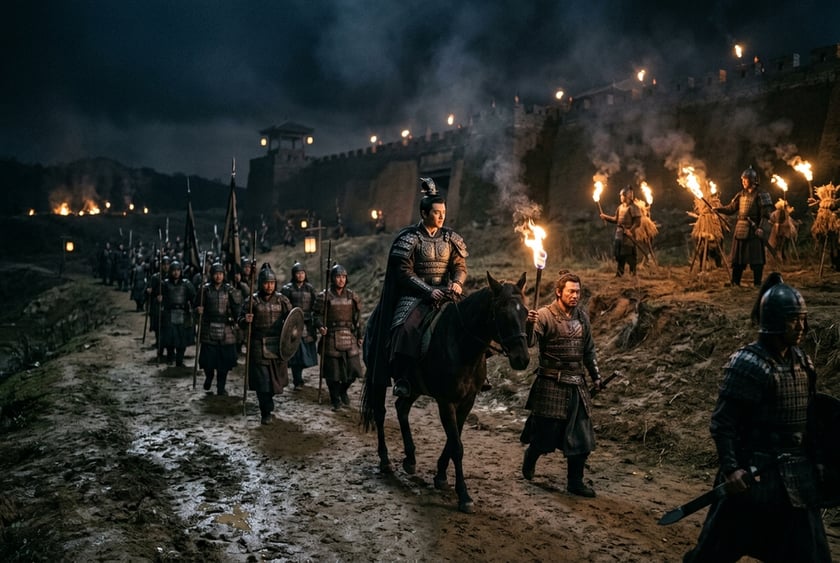
In the spring of the sixteenth year of Jian'an (211), Cao Cao appointed Zhong Yao as the forward field commander, using the pretext of attacking Zhang Lu to advance westward through Tongguan and Huayin — the actual target was to seize the moment and settle once and for all the group of Guanzhong warlords who had long maintained de facto independence from the central government: Ma Chao, Han Sui, Hou Xuan, Cheng Yin, Li Kan, Zhang Heng, Liang Xing, Ma Wan, Yang Qiu, Cheng Yi, and others — the "Ten Generals of Guanzhong." These ten were in essence the military strongmen of Liangzhou and Guanzhong who had long operated in semi-independence, their relationship with Cao Cao's central government always one of "nominal subordination, actual local rule." Cao Cao's move aimed both to sweep Guanzhong in one stroke and to open the westward corridor toward Liangzhou and Hanzhong, and also to maneuver the Guanzhong generals into the role of "rebels" through the border-army campaign — thereby gaining the legitimacy to eliminate them entirely. Ma Chao and the other nine generals did indeed react exactly as Cao Cao anticipated, raising their banners against him on the grounds of "Cao Cao using the Zhang Lu campaign as a pretext to scheme against Guanzhong," and concentrating at the Tongguan line to resist the Wei main force.
Deployments
Cao Cao personally commanded the Wei main force; Xu Huang and Zhu Ling crossed the river from Pubei to encircle Ma Chao's forces from the rear, while Jia Xu served as strategic adviser planning the estrangement scheme. Zhang Ji at this time held the post of Grand Administrator of Jingzhao and Acting Governor of Yongzhou, playing the role of "Guanzhong civil-military liaison" — he had both to organize local commandery troops for coordinated frontal operations and to carry out pacification and suborning of forces in the Fufeng, Fengyi, and Left Fengyi commanderies behind Ma Chao's army. On the Guanzhong side, Ma Chao and Han Sui jointly defended Tongguan and stationed heavy forces around Huayin to guard the supply route and watch the eastern flank. On the surface the allied force was formidable, reportedly one hundred thousand strong — but in reality each contingent operated independently with no unified command structure, a loose configuration that both Jia Xu and Zhang Ji saw clearly.
Critical Decision Points
The two most textbook-worthy decision points of this campaign were both off the main battlefield. The first was Cao Cao's "crossing at Weinan" — using a feigned frontal resistance at Tongguan as bait while the main force secretly crossed at Pubei to envelop Ma Chao's flanks and rear, instantly rendering the Guanzhong allied army's Tongguan defensive line ineffective. The second was Zhang Ji's civil-administrative operations in Guanzhong's rear — using his authority as Grand Administrator of Jingzhao to issue orders to the counties behind Ma Chao's allied army line, either inducing surrender or using commandery troops to cut their supply lines, so that the Huayin-area Ma Chao forces saw their rear increasingly threatened. Jia Xu's famous stratagem of "forging a letter to sow discord" between Han Sui and Ma Chao was also executed in the same period. These three levels — frontal river crossing, rear-area civil administration, internal estrangement — working together rapidly dissolved a rebel coalition that was already internally loose into separately crushable scattered troops. Zhang Ji's Huayin campaign was precisely the "civil-administrative rear" prong among them.
Outcome and Echoes
After the decisive battle at Weinan, the Guanzhong allied army suffered a major defeat; Ma Chao fled west to Liangzhou, Han Sui retreated in defeat to Anding, and the "Ten Generals of Guanzhong" either died or surrendered. Cao Cao left Zhang Ji to continue as governor of Guanzhong, using commandery-level consolidation, military farming, and resettlement of refugees to absorb the shattered Guanzhong region in the war's aftermath. Over the following years Zhang Ji successively completed the commandery-level reconstruction of the three adjunct regions of Fufeng, Fengyi, and Jingzhao — and in 215 accompanied Cao Cao's western campaign against Zhang Lu, in 217 supported Xiahou Yuan in crushing Han Sui, and in 219 played a central role in the aftermath of the Guanzhong defense following the fall of Hanzhong. His Guanzhong stewardship gave Caowei a solid logistical base along the western front throughout the 220s — that is, across the entire span from Zhuge Liang's first northern expedition to his fifth. One could say that Wei's ability to withstand Zhuge Liang's successive northern expeditions owed heavily to Zhang Ji's civil-administrative groundwork in Guanzhong from the sixteenth year of Jian'an onward.
Counterfactual Analysis
Suppose that in the 211 Guanzhong campaign, Cao Cao's forces had not simultaneously launched the three-track approach of "civil administration, estrangement, and surprise flanking" and had relied only on the frontal battlefield to suppress Ma Chao's allied army: even a frontal victory at Tongguan would have been only a battlefield success, and the individual commanderies of Guanzhong could still have repeatedly rebelled under Ma Chao's subordinate commanders or local strongmen — compare the situation in 219 when Guanzhong trembled after the fall of Hanzhong; without the advance groundwork laid by civil-administrative border officials of Zhang Ji's type, Caowei's actual control of Guanzhong would have been far more fragile than history shows. Suppose further that Zhang Ji in 211 had not started from the post of Grand Administrator of Jingzhao but had been assigned elsewhere: the commandery-level consolidation of all Guanzhong would have been delayed by at least five to ten years, the non-Han tribes toward Liangzhou and the Hexi commandery rebellions (see the Hexi Rebellion of 222) might have expanded in consequence, and Caowei's western security would have found itself in an entirely different configuration. Seen from this angle, the true significance of Zhangjipohuayinmachao lies not in a single battlefield victory but in the way one non-warrior-type senior official, through civil-administrative means, converted the fruits of a campaign into thirty years of border stability.