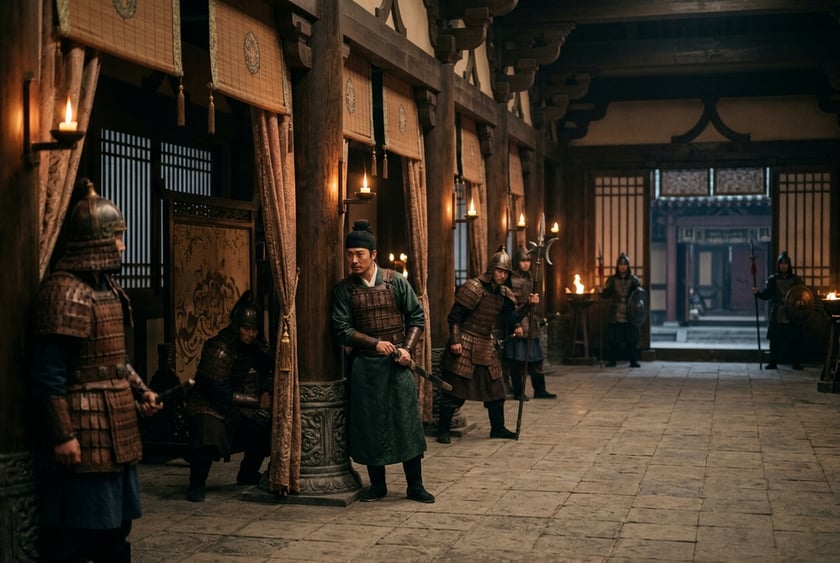
Background
As a modern political historian placing Sun Ce's 199 Lujiang operation back in its contemporary context, this campaign was not simple "expansion" — it was the pivotal step in Sun Ce's transformation from "Jiangdong regional strongman" into "a lord with a voice in northern affairs." At the time Yuan Shu had just failed in his bid for imperial status and died of illness during his flight north; his forces in the Huai River region were collapsing. Liu Xun, a former Yuan Shu subordinate who had taken over Lujiang, had not yet consolidated his position. Cao Cao and Yuan Shao were on the verge of their decisive confrontation at Guandu and had no time to look south. A brief "political vacuum" had opened along both banks of the Yangtze — whoever moved fastest in this window would claim the strategic ground of the Huai South and Jiangbei regions.
Key Figures
The natural protagonists of this operation were Sun Ce and Zhou Yu. Sun Ce had already completed the unification of Jiangdong, with well-trained troops and ample supplies; Zhou Yu, as Sun Ce's most trusted commander and strategic counselor, was one of the actual planners of the Lujiang strike (the San Guozhi biography of Zhou Yu records that he served as the vanguard in this campaign). Liu Xun was the target of the attack — newly independent from Yuan Shu's faction, lacking a stable foundation. The Governor of Yuzhang, Hua Xin, chose to submit without resistance given the power Sun Ce already commanded and his own unwillingness to make an enemy of Jiangdong. The truly formidable opponent in this operation was not Liu Xun but the far-away Cao Cao in Xu Chang — who, upon hearing of Sun Ce's growing power, swiftly arranged for a daughter of Cao Ren to marry Sun Ce's youngest brother Sun Kuang, attempting through this marriage alliance to keep Sun Ce in the position of "friendly neighbor."
Core Issues
The seizure of Lujiang involved three deeper issues. The first is geostrategy: Lujiang Commandery lay north of the Yangtze and south of the Huai River, a critical overland and waterway junction connecting Jiangdong to the Central Plains. Controlling Lujiang meant that for the first time Jiangdong possessed a springboard for attacking Hefei and Shouchun to the north, and meant that Sun Ce could intervene in the reshuffling caused by the collapse of Yuan Shu's and Liu Biao's spheres. The second is the framing of the Sun Ce–Cao Cao relationship: before 199 they had been nominal allies, with Sun Ce accepting court titles; after the seizure of Lujiang, Sun Ce's "request for the title of Grand Marshal" was refused by Cao Cao, signaling that Sun Ce sought to upgrade himself to a senior lord within the imperial system rather than remaining a local warlord — Cao Cao's refusal effectively drew a clear boundary. The third is the transformation of political identity: through the Lujiang campaign, Sun Ce officially became, in the court's perception, no longer merely a "Yangzhou local power" but "a northward-challenging actor capable of independent initiative." This change in identity brought both opportunities and dangers.
Political Consequences
The immediate consequences of the Lujiang campaign were multiple. First, Jiangdong established its first strategic foothold against the north — the Lujiang–Hefei front would thereafter serve as the main theater for successive commanders from Zhou Yu and Lv Meng to Lu Xun. Second, Cao Cao's attitude toward Sun Ce shifted from "distant ally" to "powerful adversary who must be guarded against." His sigh that "the lion cub is not someone to contend with lightly" and his move to ease tensions through a marriage alliance are the best annotation of this shift. Third, the frustration of "seeking the Grand Marshal title and being refused" began to accumulate inside Sun Ce, and "the constant wish to strike Xudou" became his obsession in the final phase of his life — and it was precisely this obsession that led Wu Commandery Administrator Xu Gong to send a secret memorial to Cao Cao warning of the Sun Ce threat. Xu Gong's death and his retainers' act of revenge followed directly from that. In a certain sense, the Lujiang campaign set the stage for the tragedy of Sun Ce's assassination.
Counterfactual Analysis
Suppose Sun Ce had been satisfied with the unification of Jiangdong's six commanderies in 199 and had not struck north at Lujiang — the friction between him and Cao Cao would have been much less pronounced, Xu Gong would have had little incentive to send a secret memorial to Cao Cao, and the ambush in the western hills of Dantu that year might never have occurred. Alternatively, suppose Sun Ce, after seizing Lujiang, had not rushed to request the Grand Marshal title but had quietly consolidated the newly gained territory and strengthened the Hefei defensive line — with his abilities and staff, he could very plausibly have established a third pole rivaling Cao Cao and Yuan Shao before or around 200, and the script of the Battle of Chibi would have been rewritten. Yet the actual historical path was this: Sun Ce seized the window created by Yuan Shu's collapse and completed an initial penetration of Jiangbei, but failed to control the political shockwave this action set off. From this perspective, Sun Ce's seizure of Lujiang was simultaneously the peak of Jiangdong's expansion and the opening of Sun Ce's personal tragedy — the two events are almost concurrent in time. This dramatic quality of "apex and decline coinciding" is the critical node that must be confronted squarely in any study of Sun Ce's life.