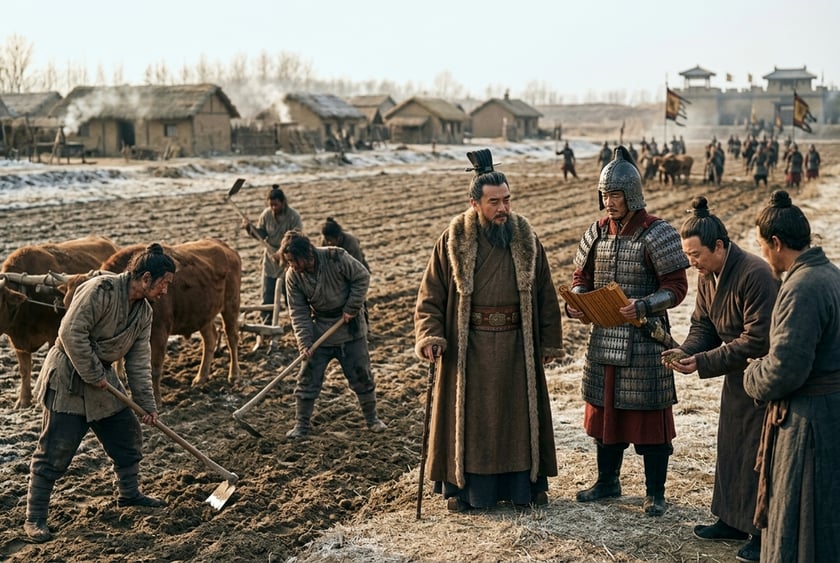
Background
In the first month of 255, Guanqiu Jian, the leading general on Wei's southern front, and Wen Qin, the Inspector of Yangzhou, jointly raised troops at Shouchun and openly opposed Sima Shi's regency — the second of the three Huainan revolts. Barely a year and a half had passed since Sun Jun executed Zhuge Ke; Sun Jun urgently needed a successful military operation against Wei to transform the legitimacy of his "imperial clan governance" — both to demonstrate to Jiangdong's literati-officials that he was more than a palace schemer, and to pull the army's tempo out of the trough left by Zhuge Ke's disastrous retreat from New City. The Shouchun campaign was decided in haste under exactly this kind of domestic political anxiety: Sun Jun personally led General of the Flying Cavalry Lv Ju and General of the Left Liu Zan northward, intending to coordinate with the Huainan rebels and relieve the Wei pressure on the south.
Principal Figures
Sun Jun at this moment held simultaneously the posts of Chancellor, Grand General, and Marquis of Fuchun, exercising full military and civil authority over Eastern Wu — yet his actual military experience was limited, having entered the power center primarily through command of the palace guards. Lv Ju, son of Lv Fan, was a veteran Jiangdong general known for a steady fighting style. General of the Left Liu Zan was over seventy years old, one of the rare generals in the Wu army who was both versed in military texts and the Three Histories — a scholar-general; in his earlier career he had re-entered Wu service after the extreme experience of severing his own hamstring and then straightening his foot to demonstrate loyalty, and had later served as the vanguard for Zhuge Ke at the Battle of Dongxing, killing the Wei vanguard commander and earning distinction. Wen Qin was nominally the "allied contact" of this operation — but after a battlefield reverse he simply defected to Eastern Wu, causing the strategic objective of Sun Jun's northern march to evaporate not long after it had departed.
Core Issues
This campaign exposed several deep problems. The first was the failure of intelligence and coordination: Sun Jun decided to march only after receiving news of Guanqiu Jian's and Wen Qin's uprising in Jiangdong — the pace of mobilization was completely out of step with the speed of Wei's internal decisive warfare. By the time the Wu army approached Shouchun, Guanqiu Jian was dead and Wen Qin defeated; the planned "pincer from within and without" had collapsed in an instant. The second was the waste of talent under imperial-clan governance: Liu Zan, ill and debilitated, refused to abandon his troops and flee in secret, and ultimately died fighting during the retreat. His dying words — "In all my years as a general, I broke enemies and captured their banners, and I never once suffered defeat" — reflect the pathos of the last of Jiangdong's great generals fading out. The third was the undercurrent of opposition within the imperial clan: Sun Yi, Sun Shao, and others had conspired to kill Sun Jun during a visit by a Shuhan envoy; the plot was exposed and dozens killed themselves, with Princess Luyu caught up in the purge — showing that even as Sun Jun marched north he was already facing political backlash from within the imperial clan itself.
Political Consequences
Militarily, Wu failed to intervene substantively in the second Huainan revolt. After the third revolt Sima's house had consolidated its control over Huainan; the Shouchun line no longer offered Wu any opening to exploit. This directly contributed to the situation in 257 when, despite Wu's full commitment to supporting Zhuge Dan's third revolt, they could no longer relieve the siege because Sima had built Huainan's interior into an iron wall. Politically, the purge connected to the Sun Yi conspiracy brought innocent death to Princess Luyu, further exposing imperial-clan tensions; Sun Jun thereafter became even more suspicious of the clan. In terms of military talent, Liu Zan's death in battle, followed by Lv Ju's purge at Sun Lin's hands after returning, meant Eastern Wu lost three senior generals within five years — creating a talent vacuum before Lu Kang came of age.
Counterfactual Analysis
Had Sun Jun after Wen Qin's defection immediately shifted to a defensive posture — "expand the army, consolidate the Huainan front" — rather than organizing the Shouchun sortie as an offensive action in haste, Liu Zan would not have died in the pursuit, and Wu would have retained strategic initiative in the Huainan interior. When Zhuge Dan raised his revolt in 257 Wu could then have intervened in the third revolt with a more complete military-political foundation, and Eastern Wu's window of strategic opportunity on the Huainan front need not have closed entirely. Conversely, had Sun Jun flatly refused to march and abandoned any attempt to intervene in Huainan, his executive legitimacy would have eroded further and he might have been overthrown by an internal clan conspiracy even sooner. Either way, Sun Jun's governing model of "sustaining domestic politics through external war" was structurally incapable of lasting more than two to three years; the Shouchun campaign was merely the earliest flash-point of that structural impasse.