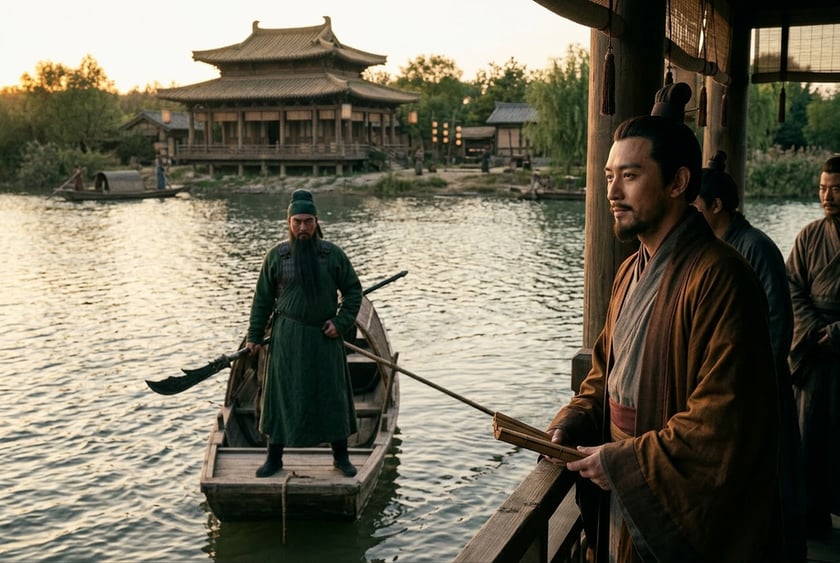
Deathbed Circumstances
From a biographical perspective, Zhou Yu's final chapter is a strikingly archetypal case of "a great strategy cut off by illness mid-execution." In the fifteenth year of Jian'an (210) he had just laid out his complete western-front strategy directly before Sun Quan: "Cao Cao has just suffered a setback and is preoccupied with troubles at his core; he cannot yet meet Your General in combined battle. I beg leave to advance together with Fenwei to take Shu, and having taken Shu to absorb Zhang Lu, then to leave Fenwei there to hold the ground firmly while forging ties with Ma Chao. I will then return and hold Xiangyang with Your General to press Cao Cao — the north can then be schemed for". This was a complete strategic blueprint for "taking Shu — allying with Ma Chao — pressing Cao Cao," and the first time the Sunwu military-political system had produced this kind of comprehensive, multi-step strategic planning on a grand scale. After Sun Quan approved it, Zhou Yu returned to Jiangling to prepare his expedition, and died of sudden illness en route at Baqiu — the place where he had once garrisoned after Chibi — at the age of thirty-six. Viewed from his deathbed circumstances, he did not fall on the battlefield but while preparing for the next campaign. This manner of dying "on the march, mid-preparation" left his life suspended at the two words "unfinished."
Final Words or Final Command
In the romance narrative, Zhou Yu's last act was to write a letter recommending Lu Su as his successor — "The various generals forwarded the sealed letter by fast courier to Sun Quan... and in it he recommended Lu Su to replace himself". The political-historical significance of this recommendation far exceeds its literary meaning: it was the first time the Sunwu regime witnessed a formal handover in which "the outgoing supreme commander designated his successor," and it also meant that the tradition within Sunwu's military-political system of "the commander's position being non-transferable" was here for the first time given an opening. Sun Quan's response was to "cry out loud in grief" and immediately accept the recommendation — an acceptance so nearly without hesitation that it reflects the special place Zhou Yu occupied in Sun Quan's mind: his deathbed counsel was tacitly accorded the highest priority. By comparison, Zhou Yu's memorial submitted at the end of his life in official history (the "letter from his illness to Wu's lord Sun Quan") also contains the same core recommendation, but places greater emphasis on remonstrating with Sun Quan personally — this form of political succession was uncommon in the warlord system of the late Han.
Posthumous Affairs
Sun Quan's handling of Zhou Yu's posthumous affairs was of the highest ceremonial grade — "Sun Quan dressed in plain mourning clothes and performed the mourning rites, moving those around him. As the cortège was to return to Wu, he went out to meet it at Wuhu, and all costs and expenses of the occasion were supplied from public funds at his order". This treatment — a ruler donning undyed mourning dress, personally going out to receive the coffin, the entire funeral paid from the state treasury — was rare in the San Guo period. Sun Quan also later specifically issued an order that "among the household guests and clients of the late general Zhou Yu and Cheng Pu, none were to be questioned as to their whereabouts" — effectively placing Zhou Yu's private retinue and clients under political protection as state assets. In the romance narrative, Zhuge Liang personally traveled from Jingzhou to Baqiu to conduct the memorial rites; even though Zhou Yu's subordinate generals "all wished to kill Kongming", Kongming still expressed solemn respect for Zhou Yu in an elaborate eulogy, and in the process brought back Pang Tong — a segment that, while literary embellishment, accurately captures the impact of Zhou Yu's death on the Sun-Liu alliance: both sides recognized the vacuum left by the departure of a commander of epoch-defining stature.
Historical Assessment
From the perspective of strategic impact, Zhou Yu's death was a staggering cost for Sunwu. First, the strategy of taking Yizhou from the west was shelved immediately — after Lu Su took over, he pivoted to a defensive line of "cooperating with Liu Bei to jointly resist Cao Cao," permanently closing Sunwu's proactive opportunity on the western front. Second, Sunwu's military-political system shifted from the "Zhou Yu model" — combining civil and military talent, capable of handling a theater independently, able to remonstrate directly with the lord — to the "Lu Su–Lv Meng model," centered on patient defense supplemented by intelligence operations. This shift briefly erupted in a moment of aggressiveness ten years later with Lvmengbaiyidujiang, but produced no comprehensive strategic thinker remotely comparable to Zhou Yu. Third, for Sun Quan personally, Zhou Yu was one of the few allies with whom he could discuss strategy directly; his death left Sun Quan increasingly reliant on the civil officials' deliberation process for decisions, structurally reducing Sunwu's decision-making efficiency from that point forward. From the broader sweep of historical assessment, Zhou Yu represents a high-water mark of the Sunwu military tradition — equally capable in naval combat and siege warfare, in alliance and in detecting an ally's danger, in direct remonstrance and in voluntarily yielding his position at the very end. His early death was one of the greatest non-combat losses in Sunwu's history, and one of the hidden reasons why the San Guo configuration in its early period moved toward stabilization.