Strategic Background
The Battle of Nanpi was the final piece of Cao Cao's unification of Hebei. Since the Battle of Guandu (200 CE), the Yuan clan bloc had appeared on the surface to have been shattered in a single decisive engagement, but in reality it was a massive military-political coalition propped up by a three-son inheritance system that was dismantling itself incrementally over five years. After Yuan Shao died in Jian'an year 7 (202), the eldest son Yuan Tan and the third son Yuan Shang (born of Shao's principal wife) went to war over the question of legitimate vs. collateral succession; Yuan Tan held Qingzhou, Yuan Shang held Jizhou, and they attacked each other repeatedly. This fratricidal conflict handed Cao Cao the strategic opportunity to pick them off one by one: in Jian'an year 9 (204) he first seized Yecheng, driving Yuan Shang north, and immediately thereafter Yuan Tan took advantage of the chaos surrounding the Yecheng siege to seize Ganling, Anping, Bohai, and Hejian—Yuan Tan's last gamble to profit from the struggle between Cao Cao and Yuan Shang [c:16425]. But he had miscalculated Cao Cao's political will: once Yecheng was stabilized, Cao Cao turned immediately toward Nanpi and designated Yuan Tan as his next target for elimination. This campaign is the textbook case of "fratricidal conflict exploited by a powerful outsider"—and the inevitable terminus of Hebei's forces being integrated by an external power.
Disposition of Forces
On the Cao side, Cao Cao personally commanded the main army northward, with Cao Chun leading the Tiger-and-Leopard cavalry to handle mobile strike operations (the Tiger-and-Leopard cavalry earned their reputation by killing Yuan Tan in this battle). By the twelfth month of Jian'an year 9, the Cao army had already reached the gates of Nanpi, but held off the assault temporarily because the rivers were frozen in the severe winter; in the first month of Jian'an year 10, once conditions had slightly improved, the final assault was launched [c:16425]. On Yuan Tan's side, having retreated from Pingyuan back to Nanpi, he was relying on the strength of the Qinghe River as his defense—but his strategic choices had been flawed from the outset: though Nanpi was the seat of Bohai commandery, geographically it lay in the eastern edge of the Jizhou plain, lacking depth and any allied support. His two potential sources of help were Liu Biao (too far away and with no inclination to march north) and Yuan Shang (pinned down at Zhongshan and barely holding his own). The Romance's addition of the detail "sending a man to Liu Biao to seek relief" accurately reflects this truly isolated and unsupported strategic predicament [c:16426]. Though the Cao army's numbers are not recorded, as Cao Cao's personal expeditionary force it would have had tens of thousands of elite troops and first-rate commanders including Xu Huang and Cao Chun.
Critical Decision Points
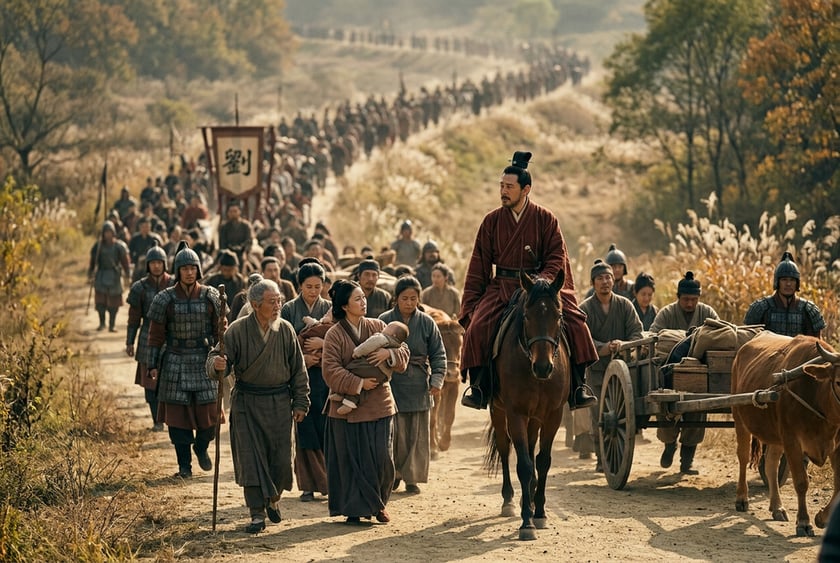
The first critical decision was Cao Cao's choice to campaign in winter. The costs of fighting in the severe Hebei winter were enormous—grain ships frozen in, men and horses suffering from cold—yet Cao Cao insisted on a swift conclusion, because he was unwilling to allow Yuan Tan to rebuild strength after the spring planting [c:16426]. This was the classic decision of "paying costs to buy time." The second decision point was Yuan Tan's withdrawal from Pingyuan to defend Nanpi. Militarily it was reasonable—Pingyuan offered no defensible terrain while Nanpi had solid walls—but politically this retreat cost Yuan Tan his last opportunity for mobile field engagement outside a city, and being confined within walls meant losing all initiative. The third decision was Yuan Tan, having seen Cao Cao reject his offer of submission, accepting Guo Tu's counsel to "drive the civilians forward as a vanguard with troops following behind" [c:16428]. Militarily this was a last desperate throw; politically it utterly destroyed whatever remained of the Yuan clan's popular support in Hebei—the Romance dwells at length on this detail, fashioning it into the moral footnote to Yuan Tan's downfall. The fourth decision was Cao Cao's differentiated treatment of former Yuan advisors such as Xin Ping and Guo Tu: Xin Ping's younger brother Xin Pi had already submitted to Cao Cao and been given a post of importance, and Cao Cao used this to pry apart Yuan Tan's camp [c:16427]—the classic "prioritize inducing surrender, apply siegecraft second" strategy of linking political and military operations.
Outcome and Resonance
In the first month the city fell; Yuan Tan and Guo Tu were both executed. Yuan Shang and Yuan Xi fled north to the Wuhuan of Liaoxi; former Yuan commanders such as Jiao Chu and Zhang Nan killed a white horse in solemn oath and defected formally to Cao Cao; Hebei was substantially unified [c:16425]. From the standpoint of military history, the Battle of Nanpi is a successful case study in northern plains winter campaigning in Chinese antiquity—Cao's forces overcame unfavorable weather, maintained logistical cohesion, and in the decisive engagement annihilated the primary enemy through mobile striking power; it is a model for later frontier operations. From the standpoint of political history, this battle completed the "physical extermination of the Yuan clan," but more importantly it triggered the process of "Hebei scholar-gentry integration into Caowei": former Yuan subordinates such as Xin Pi, Wang Xiu, Cui Yan, and Tian Chou entered Cao Cao's secretariat and formed the bureaucratic foundation for the eventual Caowei supplanting of Han. Looking further ahead, the nine-rank system of official selection devised by Chen Qun in the Jian'an 220s drew its scholar-gentry class base precisely from these Hebei and Yingchuan lineages—when the walls of Nanpi came down, the seeds of three hundred years of Chinese gate-clan politics were already planted.
Counterfactual Analysis
First counterfactual: had Yuan Tan not feuded with Yuan Shang but instead the brothers united to resist Cao Cao, what would the outcome have been? History's verdict is pessimistic—even Yuan Shao himself, before his death, had lost to Cao Cao at Guandu; even allied, the Yuan brothers could hardly have reversed their overall inferiority in forces, morale, and institutions. But "unity" would at minimum have pushed Cao Cao's timeline for unifying Hebei from 205 CE back to the 207–208 window, severely compressing his time to consolidate Jingzhou and respond to the Battle of Chibi—Chibi might thereby have been avoided (or made worse). Second counterfactual: had Yuan Tan accepted Cao Cao's offer of submission before the city fell rather than refusing, he might have preserved his life with a nominal post, as Han Fu and Zhang Yan had—but the Yuan clan as a political entity would have been extinguished regardless. Third counterfactual: had Cao Cao chosen to resume fighting in spring, Yuan Shang might have been able to counterattack from Zhongshan in relief of Yuan Tan, making Nanpi not an isolated city defense but the battlefield of the final great Hebei engagement. This line of reasoning reveals the true wisdom of Cao Cao's insistence on winter war—paying costs to secure "first resolve the elder son, then pursue the younger" as a dispersed elimination strategy. Seen from this angle, the victory at Nanpi was not only a tactical victory but a victory of strategic timing.