Background
Caochuanjiejian is a fictional episode that the Romance of the Three Kingdoms inserts before the Battle of Chibi to depict the internal tensions within the Sun-Liu alliance. Structurally, it serves two purposes: first, to portray Zhou Yu's wariness of and murderous designs on Zhuge Liang; second, to cast Zhuge Liang as an almost superhuman figure who commands equal mastery of astronomy, geography, the yin-yang arts, and strategic divination. At the level of historical record, neither the biography of Zhuge Liang nor the biography of Zhou Yu in San Guozhi, nor the Zizhi Tongjian, contains any account of this episode in their descriptions of the period before Chibi. A similar "arrow-borrowing" episode does appear, however, in the annotation to the "Basic Annals of Sun Quan" in San Guozhi, which cites the Weilue: Sun Quan sailed a large vessel to Ruxukou to observe the enemy formation; Cao Cao's forces shot at it with arrows until one side was so laden with arrows that the ship began to tilt, whereupon Sun Quan ordered it turned around so the other side would receive arrows evenly — but that was a tactical improvisation at Ruxukou, entirely unrelated to Chibi or to Zhuge Liang. Luo Guanzhong transplanted this historical material to the period before Chibi, assigned Zhuge Liang the role of mastermind, and added dramatic elements such as the military pledge, the prediction of fog, and the taunting of Cao Cao, producing one of the most celebrated episodes of wit in the entire Romance [c:17531].
Course of Events
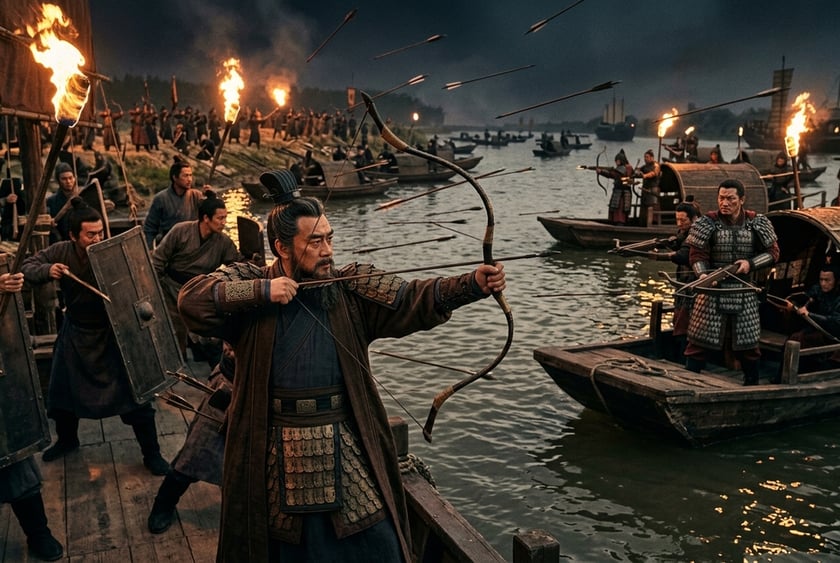
Following the narrative rhythm of the Romance, Zhou Yu first uses "arrows are the most important weapon in naval warfare" as a pretext to assign the impossible task of "supervising the production of one hundred thousand arrows" to Zhuge Liang; Zhuge Liang volunteers to complete it in three days and gives a military pledge, which leads Zhou Yu to conclude he has consigned himself to death [c:17531]. Zhou Yu then instructs the camp's craftsmen to delay supplies, creating conditions for a breach of deadline. Lu Su, out of goodwill (and in keeping with his emblematic role in the Romance as the buffer of the Sun-Liu alliance), secretly provides Zhuge Liang with twenty fast boats fitted with grass bundles and curtains, waiting to be called upon [c:17532]. At the fourth watch of the third night, Zhuge Liang takes Lu Su out on the boats in the thick fog; he connects the twenty boats in a line with long ropes and steers them toward Cao Cao's naval camp, beating drums to attract the enemy's attention [c:17533]. Cao Cao, hearing the sound from the northern bank, suspects an ambush and orders the crossbowmen and archers to fire in volley; once arrows have filled the grass bundles on one side of the boats, Zhuge Liang orders the fleet turned around so the other side receives arrows evenly; when both sides are loaded, the boats return with wind and current. As they leave, the men shout and jeer at the Cao forces — by the time the Cao army realizes they have been duped, pursuit is no longer possible [c:17534]. On return, the tally shows roughly five to six thousand arrows per boat, totaling well over one hundred thousand.
Outcome
From within the Romance's internal logic, the outcome operates on three levels. First, Zhuge Liang accomplishes the "arrow-borrowing" task at zero cost and turns Zhou Yu's attempted murder into his own moment of glory. Second, Lu Su, having witnessed all of this, is won over by Zhuge Liang and becomes the de facto stabilizer of the Sun-Liu alliance throughout the Romance — thereafter he repeatedly speaks on behalf of Zhuge Liang and Liu Bei and deflects several of Zhou Yu's traps. Third, the depiction of Cao Cao's side presents it as "having been tricked without knowing it" — not only does Cao Cao's army donate over one hundred thousand arrows, it also exposes its tactical thinking: heavy reliance on crossbows and arrows, light regard for naval warfare — which provides narrative groundwork for the subsequent sequence of Pang Tong offering the Linked-Ships ruse, Huang Gai's false surrender, and the fire attack at Chibi [c:17534]. Within the Romance, this episode is the foundational scene for Zhuge Liang's image as one who "understands the heavens above and knows the terrain below."
Historical Significance
At the historical level, Caochuanjiejian never occurred; yet as a literary event its influence far exceeds that of many real battles. This story was taken into Yuan dynasty zaju drama, chuanqi fiction, and Ming-Qing storytelling, and from there entered folk oral tradition, opera, and primary school textbooks, becoming the classic archetype of "winning through intelligence" in the Chinese-speaking world. Scholars such as Qian Mu, Lv Simian, and Yi Zhongtian have at different times reminded readers that the Zhuge Liang of the Romance has drifted far from the portrait in the historical records, and that Caochuanjiejian is a prime example. At another level, it also deepens the public's perceptual bias about the Battle of Chibi — most readers approaching from the Romance conclude that Chibi was a feast of stratagems masterminded single-handedly by Zhuge Liang, overlooking Zhou Yu's dominant role in both strategy and tactics. From the perspective of historical education, Caochuanjiejian can serve as a calibration point: when readers are able to clearly separate it from historical fact while still appreciating its literary value, they have completed the necessary transition from readers of the Romance to readers of the historical record.