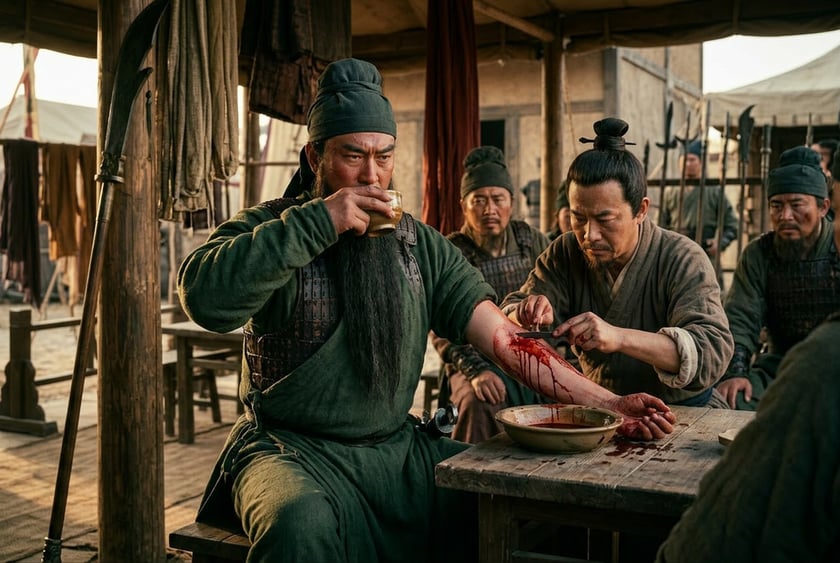
Background
At the strategic level, Lv Meng's crossing of the Yangtze in disguise in the twenty-fourth year of Jian'an (219) — the Lvmengbaiyidujiang — was the precipitating event in the transition of the Sun–Liu alliance from "partition by the Xiang River" to final rupture. Since the fifteenth year of Jian'an (210), when Liu Bei borrowed Nanjun, Sun Quan had never set aside the question of Jingzhou's ownership: he first demanded the return of Changsha, Lingling, and Guiyang; then achieved a temporary compromise by using the Xiang River as a boundary; and by the time of Guanyubeifa had been waiting for an opportunity window that would allow him to overturn the board in a single stroke. When Guan Yu's Shuiyanqijun operation "shook Huaxia" and drew the Caowei main force northward toward Fancheng, the hollowness of Jingzhou's rear was pushed to its extreme — precisely the objective conditions that enabled Gu Yong to counsel Sun Quan on the opportunity. Viewed across a longer timespan, the true origin of this affair lay not in that ninth month of that year, but in Sunwu's sustained anxiety over the Jianhan corridor across the full decade following Chibi.
Key Figures
The key decision-maker in this affair was Sun Quan, not Lv Meng. Lv Meng was the tactical executor, but the strategic proposal — "why not dispatch one army first to cut off the river mouth and sever their line of retreat" — was advanced by Gu Yong, with Sun Quan himself making the final call. This reflects an important characteristic of Sunwu's decision-making circle in this campaign: strategy was first proposed by civil official advisors and then executed with precision by military commanders, while the supreme power of decision remained firmly in the sovereign's hands. Lv Meng's true contribution lay not in the tactical feat of "crossing in disguise" but in his manufacturing — through feigning illness and resigning his command, handing off military duties to Lu Xun — of a gap in Guan Yu's intelligence assessment at the strategic level, causing Guan Yu to miscalculate that no one of consequence was in charge on the Jingzhou side, and thereby to withdraw Jiangling's garrison forces northward to the front lines. Lu Xun's appearance in this campaign as a "young scholar" persona was a carefully designed cover identity.
Core Issues
The core issue embodied in Lvmengbaiyidujiang is: in a configuration of three evenly balanced legs, where exactly does a treaty's boundary lie? The Sun–Liu alliance had since Chibi rested on the practical necessity of jointly resisting Caowei, but the ownership of Jingzhou had never been genuinely resolved — it was a structural contradiction that remained outstanding. When Guanyubeifa appeared on the verge of unilaterally shattering the equilibrium — threatening Caowei while also allowing Shuhan's power to grow far beyond Sunwu's — Sunwu's calculation was: "this is an opportunity not to be missed", meaning that "breaking the alliance" in Sunwu's interest calculus had already outweighed "maintaining the alliance." This was a classically realist decision: the boundary between ally and adversary is not fixed but shifts with relative power; when an ally's growing power threatens one's own core interests, that ally transforms into the more pressing enemy.
Political Consequences
The direct consequence was Guan Yu's military defeat and death, and all of Jingzhou passing to Sunwu; the indirect consequences were far larger than the direct ones. First, Shuhan permanently lost the geographic foundation for the "two-pronged offensive" of the Longzhong strategy; all subsequent northern campaigns by Zhuge Liang and Jiang Wei were confined to a single axis out of Hanzhong through the Qin Mountains, an inherently inefficient route. Second, Liu Bei launched the Battle of Yiling to seek revenge, and Sunwu again crushed the Shu army at Xiaoting, severely depleting the strategic vitality of both states — precisely the fundamental reason that Caowei was able to consolidate its power in the 220s and 230s. Third, although Sunwu gained Jingzhou, it was henceforth compelled to bear the full pressure of frontally resisting Caowei, losing the strategic dividend of having Shuhan divert Caowei's attention. Viewed across a ten-year timeframe, Lvmengbaiyidujiang was ultimately a poor bargain for Sunwu itself.
Counterfactual Analysis
Had Sun Quan foregone this opportunity and continued to maintain the Sun–Liu alliance, could Guan Yu have taken Xiangfan? Even if he had, could the Liubeijituan have threatened the Central Plain? The answer is most likely no — Cao Cao had already begun organizing Xu Huang's relief force, and even a short-term victory for Guan Yu might not have been sustainable. But if Sunwu had held back, Shuhan's long-term presence in Jingzhou would have kept Caowei perpetually under two-front pressure, and the San Guo balance might have persisted longer and with greater internal tension. A second counterfactual: had Lv Meng not feigned illness — had he not replaced himself with Lu Xun as commander — would Guan Yu still have pulled back his troops? Guan Yu's wariness toward Lv Meng was genuine; the disguise substantially lowered Jingzhou's defensive readiness on that side — the precision of this intelligence deception was the key that transformed this operation from "high-risk gamble" into "low-cost total victory."