Background
From the standpoint of political history, Sima Shi's deposition of Cao Fang was the second critical node in the Simashi power-seizure process since the Gaopinglingzhibian (249 CE), and its importance was in certain respects no less than Gaopingling itself. After the Gaopinglingzhibian, Sima Yi killed Cao Shuang and seized control of the central military, but the Caowei emperor Cao Fang remained on the throne, and the imperial clan along with loyalist Caowei officials retained the institutional possibility of counterbalancing Simashi authority. In Jiaping year 3 (251), Sima Yi died; his eldest son Sima Shi succeeded as Grand Marshal and head of the Board of Affairs, and began independently confronting an awkward problem: his legitimacy was far thinner than his father's. Sima Yi was a founder's meritorious minister of four reigns; deposing Cao Shuang could still invoke "the previous emperor's commission." Sima Shi, inheriting power as a son, had no such historical capital—he had to build it through new achievements. In Jiaping year 5 (253) he repulsed Zhuge Ke's northern attacks at Dongxing and Hefei, winning his first major military prestige; in Jiaping year 6 he then faced the episode in which Li Feng, Xiahou Xuan, and Zhang Ji conspired to eliminate Simashi [c:16444]—this conspiracy, though anticipated and suppressed by Sima Shi before it could act, with three clans exterminated, exposed that Cao Fang's immediate circle was still a latent source of anti-Sima forces. Deposing Cao Fang thus became the logical choice for "a thorough resolution of the problem."
Principal Figures
Sima Shi (courtesy name Ziyuan, 208–255) was the second-generation core of the Simashi power seizure. Compared with his father Sima Yi's "deep scheming and extreme self-restraint," Sima Shi projected a more resolute and decisive manner, swift and decisive in military affairs. The deposition of Cao Fang was a typical display of his personal political style: rapid, thorough, leaving no buffer. Cao Fang (courtesy name Lanqing, 232–274) was an adopted son of Emperor Cao Rui (his biological father's identity is unclear in the historical sources); he inherited the throne at age eight, with Cao Shuang and Sima Yi jointly as regents. After the Gaopinglingzhibian he was effectively a Simashi political puppet; he was twenty-three at the time of his deposition. In the deposition scene as recorded in the Romance, Cao Fang is absent—the investiture ceremony is organized directly around the new emperor Cao Mao, and Cao Fang is "demoted to Prince of Qi and sent to his fiefdom" [c:16444]. This approach—"dispose of the former emperor without a public proceeding"—was more politically shrewd than direct execution: it removed the threat while avoiding the infamy of "regicide." Cao Mao (courtesy name Yanshi, 241–260) as new emperor was a deliberate selection by Sima Shi: young (fourteen years old), talented yet without independent power, with a deceased father (the Prince of Donghai, Cao Lin), isolated and friendless. Sima Shi chose him precisely for this "malleability"—an apparently dignified, legitimate emperor who was in practice an easier puppet to control.
The Central Issues
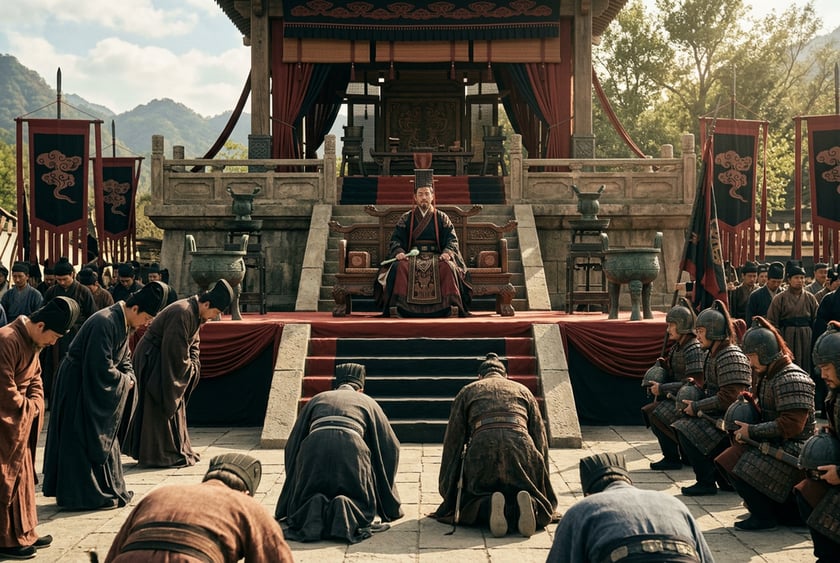
The central issue of the deposition was not "whether Cao Fang was adequate" but "how Simashi would institutionalize the fruits of the coup." This manifested in three layers. First layer: using the deposition to obtain additional dignities. Sima Shi was granted the yellow battle-axe, entry to court without hurrying, memorial-presenting without naming himself, and the privilege of wearing his sword in audience—the standard package of ritual elevation for power-wielding ministers throughout history in the lead-up to usurpation [c:16444]. From Wang Mang to Cao Cao, from Sima Shi to Huan Xuan, virtually all followed this same formula. Second layer: invoking the Empress Dowager's authority. Empress Dowager Guo, in the deposition edict, cited "the sovereign's confusion and unfitness to maintain the ancestral temples" (the Romance does not elaborate these details but the historical record is clear), transferring political responsibility for deposing the emperor onto "internal correction by the imperial family"—the standard technique for circumventing the Confucian "duty of minister to lord" obstacle. Third layer: using the new emperor to provide legitimation. In the Romance, Cao Mao displays a ritual self-awareness beyond his years—"the Empress Dowager's edict; not knowing its purpose, how could I enter in a carriage?"—proceeding on foot to the Taiji East Hall and bowing first to Sima Shi on meeting [c:16444]. These details were deliberately written into both official history and the Romance with the purpose of packaging the deposition as an "orderly, decorous, naturally harmonious transition between ruler and minister."
Political Consequences
The short-term consequence was a further hollowing-out of Caowei imperial authority. Although Cao Mao was installed as emperor, his actual power was weaker than Cao Fang's had been—younger, more isolated, and having witnessed firsthand the complete process by which his predecessor was deposed, more psychologically suppressed. The medium-term consequence was that Simashi began to face the backlash of an emperor unwilling to submit to diminishment. Cao Mao's resentment of the Sima family grew during his six-year reign, erupting famously in the declaration "Sima Zhao's intentions are known to every passer-by on the road," and culminating in Ganlu year 5 (260 CE) when he personally led several hundred palace guards in an armed attack on Sima Zhao, only to be killed at the palace gate at Jia Chong's instigation by Cheng Ji—one of the exceedingly rare instances in Chinese history of an emperor openly "taking up arms to resist a powerful minister." The long-term consequence was that Simashi's usurpation timetable was forcibly stretched: Sima Shi died the following year (255) after suppressing Guanqiu Jian's rebellion; Sima Zhao succeeded him as Grand Marshal and finally in 263 earned great merit by destroying Shuhan, but it was not until 266 that his son Sima Yan formally supplanted Caowei and founded Jin. From the deposition of Cao Fang to Sima's supplanting of Caowei, a full twelve years passed. These twelve years of back-and-forth maneuvering constituted the complete Caowei-era version of the cycle: "powerful minister receives additional dignities → emperor is killed → enemy state is destroyed → abdication is enacted."
Counterfactual Analysis
First counterfactual: had Sima Shi not deposed Cao Fang, Cao Fang might subsequently have prevailed in some coup attempt (the Li Feng and Xiahou Xuan conspiracy was a genuine anti-Sima force), and Simashi authority might actually have been overturned—though the probability was low, since military power was already firmly in Sima Shi's hands. Second counterfactual: had Sima Shi chosen a more pliant new emperor (say, a younger descendant of Cao Rui's line), Caowei imperial power might not have produced a defiant episode like Cao Mao's "armed resistance," but the legitimacy-building project of Simashi supplanting Caowei would still have proceeded—only with a smoother process. Third counterfactual: had Sima Shi not died young (he died at Xu Chang in 255 from an eye ailment), he might have completed the supplanting of Caowei earlier than his younger brother Sima Zhao—his political style was sharper and more urgent; he might not have needed to wait until Sima Yan's time for the formal abdication. From these three counterfactuals it is clear that the deposition of Cao Fang was not a single event but one link in a chain of highly precise power-engineering. Its success depended on Sima Shi's capacity to coordinate "ritual-institutional decorum," "imperial dynastic succession," and "firm military control" simultaneously—a capacity that in the history of Chinese political coups was rare and, by the measure of its own goals, a model operation.