Context of the Meeting
After Chibi, the Sun-Liu alliance transitioned from a wartime coalition into a post-war division-of-spoils phase, and the two sides never reached a stable agreement on the allocation of Jingzhou's seven commanderies. In Jian'an year 19, Liu Bei acquired Yizhou; Sun Quan judged that political conditions for demanding the return of Jingzhou were now in place. In Jian'an year 20, Lv Meng's attempt to seize the three commanderies of Changsha, Lingling, and Guiyang came to nothing, and the officials Guan Yu had dispatched there were all expelled—leaving Sun Quan's side at a peak of political humiliation [c:16412]. At this juncture, Lu Su proposed what amounted to a classic Hongmen-banquet stratagem: invite Guan Yu to a feast, then use gracious words to compel him to return the territory; if he refused, seize and kill him on the spot, using decapitation to open the military campaign [c:16412]. Han Ze's prior warning that "Guan Yunchang is a tiger-general of this era; none can lightly approach him" was brushed aside by Sun Quan with "If we remain so cautious, when will Jingzhou ever be recovered?" [c:16412]—a line of dialogue that makes plain the true political pressure behind the entire meeting: Sun Quan could no longer afford the cost of Jingzhou remaining unresolved.
Course of the Exchange
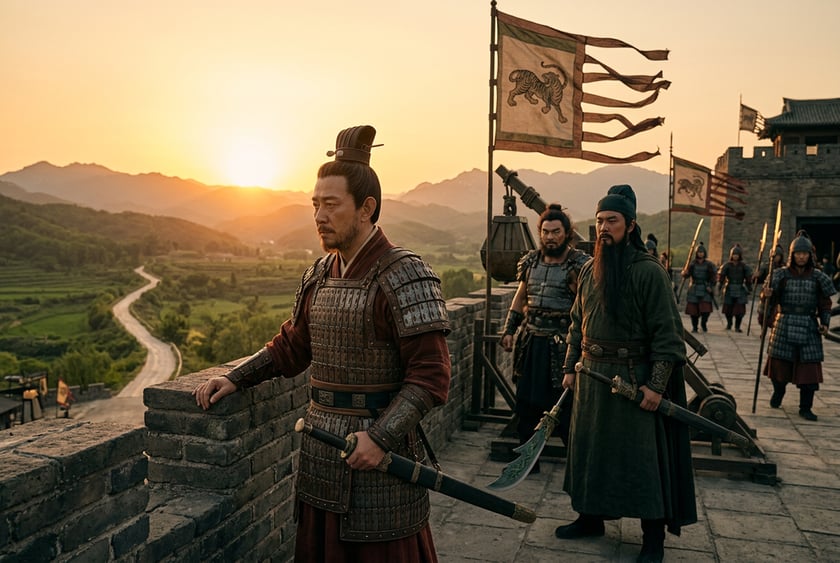
The Romance's depiction of the banquet itself is spare in detail, but the several exchanges before the event had already established Guan Yu's stance. To the arriving messenger he replied flatly: "Since Ziying invites me, I will come to the feast tomorrow" [c:16412]. To Guan Ping's misgivings he said: "Do you think I don't know? Zhuge Jin has reported back to Sun Quan that I refuse to return the three commanderies, so Lu Su has encamped at Lukou to invite me to this meeting and demand Jingzhou" [c:16413]—he had seen through the ambush plan, yet judged that he must attend without showing fear; otherwise Jiangdong would immediately translate "Guan Yu dares not face Lu Su" into "Liu Bei is showing weakness—time to advance militarily on Jingzhou." He invoked the Warring States story of Lin Xiangru at the Mianchi meeting: "Lin Xiangru had not the strength to bind a chicken, yet at Mianchi he looked upon the lord and ministers of Qin as if they were nothing" [c:16413], framing the coming meeting as a stage for "one man's bearing against the military might of a state." Tactically he made three layered preparations: bringing only a dozen close attendants to minimize the appearance of a military visit; ordering Guan Ping to conceal ten fast boats with five hundred skilled swimmers on the river, ready to signal a retreat with red banners [c:16413]; and using "I have given my word and cannot break faith" as the public justification, packaging "daring to go" as a matter of principle rather than recklessness.
Outcome of the Decision
The ultimate result of the feast was that Guan Yu, through ceremonial decorum and sheer force of presence, neutralized Lu Su's ambush plan and returned safely. Lu Su's genuine dilemma in that room was that he—as the representative of Jiangdong's "maintain the Liu alliance" faction—had no wish to tear the relationship open in any case; summoning Guan Yu to a feast was itself a compromise, imposed on him by Sun Quan and the pro-war bloc, and in the moment of execution he was inclined to let events conclude as a "failed negotiation" rather than an "assassination at the banquet table." The meeting that appeared so perilous was therefore closer to a political performance in which both sides deliberately maintained a stance of "not yet openly broken": Jiangdong displayed toughness to probe Liu Bei's camp for its response, while the Shu side used Guan Yu's "fearlessness" to deter further military adventurism by the other party. The concrete outcome that followed was that Sun and Liu reached the "Xiangshui Compact," drawing the boundary at the Xiangshui River—Changsha, Jiangxia, and Guiyang to Eastern Wu; Nanjun, Lingling, and Wuling to Liu Bei—a partial compromise.
Historical Impact
The fictional episode of Dandaofuhui holds an exceptionally high place in later Chinese cultural memory—the Yuan dynasty playwright Guan Hanqing's play of the same name, Guan Dawang Dandao Hui, further dramatized and theatricalized the episode, making the four characters "dandao fuhui" into the most classic Chinese phrase for "using personal bearing to confront political coercion." For the shaping of Guan Yu's image the episode has a cumulative significance: compared with "warming wine to behead Hua Xiong" (youthful valor), "breaking through five passes and slaying six generals" (middle-period loyalty), and Guaguliaodu (middle-period fortitude), Dandaofuhui displays a more mature political judgment—he does not go into enemy territory to kill anyone; he goes to settle a purely political contest through ritual decorum, presence, and diplomatic language. From the standpoint of historical influence, this fictional episode made Guan Yu not merely a martial commander but a spiritual symbol—revered by later bureaucrats, literati, and merchant guilds—of "maintaining one's principles inside the enemy's camp"; the dimension of "loyalty to one's covenant" in the cult of Guandi is intimately related to Dandaofuhui. From the angle of military-political history, the episode reminds us that in an age without modern diplomatic protocol, an individual's performance on the spot was itself the most important tool by which states probed and signaled to one another—Dandaofuhui is the fullest expression of that "body as diplomatic medium." Though the confrontation of Jian'an year 20 concluded with partial compromise, four years later Lv Meng crossed the river in plain white garments and Guan Yu was defeated and lost at Maicheng—the final eruption of a Jingzhou contradiction that had never been fully resolved. Seen in this light, the supreme dramatic irony of Dandaofuhui lies in the fact that it delayed, rather than erased, that fated reckoning.