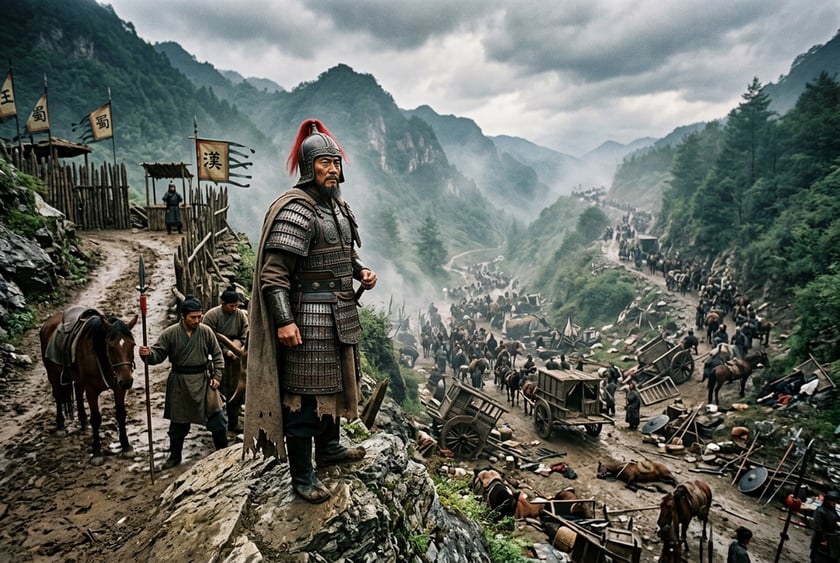
Strategic Background
The period around the first year of Xingping was the final peak of Yellow Turban activity in the Qing and Xu regions. The central government had collapsed after Dong Zhuo's chaos; the governors and administrators of the Shandong commanderies could only draw on their own resources to handle local uprisings. Kong Rong had taken office as Administrator of Beihai on the strength of his literary reputation as a great scholar, but his military experience was limited; in local governance he excelled far more at benevolent administration and cultural education than at drilling troops and establishing military agriculture colonies. When the Yellow Turban commander Guan Hai led "a host of brigands numbering tens of thousands" to the gates demanding a loan of ten thousand shi of grain, his military reserves were clearly insufficient to sustain a direct confrontation — the first engagement was a defeat, Zong Bao was cut down from his horse, and Kong Rong retreated inside the walls only to be besieged on all four sides. This was the direct expression of that structural weakness.
Order of Battle
The attacking force under Guan Hai consisted mainly of Yellow Turban refugees; strong in pressing a siege but weak in sustained operations, their primary demand was "the loan of ten thousand shi of grain" rather than the seizure of territory, so although they nominally numbered in the tens of thousands, effective fighting strength across the force was in all likelihood thin and unevenly distributed. The defending force under Kong Rong was built around commandery troops and local militia volunteers; after Zong Bao's death morale had collapsed. The only resource capable of a fight was Taishi Ci — a young gallant who had returned home from Liaodong to visit his mother — who came to the rescue singlehandedly because his mother felt deeply that Kong Rong "had repeatedly shown profound kindness to our household". This mode of entry — "coming to repay a debt of honor at a mother's instruction" — foreshadows the Romance's consistent characterization of Taishi Ci: shaping him as a military general who combines valor with filial piety and righteousness.
Critical Decision Points
The outcome of this engagement turned not on the defense of the walls but on "how to get a call for help out." The first person Kong Rong thought to appeal to for rescue was Liu Bei, far away at Pingyuan — a choice that defies geographic intuition, since Qingzhou should logically have appealed first to neighboring commanderies or to Tao Qian in Xuzhou. Yet the Romance uses this to deliberately draw Liu Bei onto the larger stage. Taishi Ci broke through the encirclement on a single horse, hitting every pursuing cavalryman with his arrows so that none failed to fall — this was the campaign's most critical "information delivery act" at the tactical level. When he reached Pingyuan and placed the letter in Liu Bei's hands, Liu Bei's response — "does Kong Beihai know there is a Liu Bei in this world?" — is deliberately amplified by the author. This is not only a character sketch of Liu Bei but also the first time he appears in the role of "one who is called upon," signaling that his political credit has entered a new tier.
Outcome and Repercussions
The actual relief operation is compressed into a single exchange: Guan Hai, contemptuous of Liu Bei's small force, charged straight in with his own troops; Guan Yu rode out and after several dozen passes of combat cut Guan Hai down from his horse; Taishi Ci and Zhang Fei then rode abreast and drove deep into the enemy formation; Kong Rong, seeing the opportunity, led his men out from the city to strike from within; the Yellow Turban army was cut in two and suffered a great defeat, with the survivors submitting. This tactical process is consistent with the general logic of ancient mixed infantry–cavalry battle: once a mob's line is pierced by elite cavalry, the lack of discipline causes rapid collapse. After the battle Liu Bei did not linger, instead turning immediately to borrow troops from Gongsun Zan to relieve Xuzhou, seamlessly linking the relief of Beihai to the larger Xuzhou diplomatic situation, ultimately paving the way for his entry into Xuzhou and Tao Qian's passing of the province. Taishi Ci later moved south to Jiangdong, and in the fifteenth chapter of the Romance had his celebrated solo duel with Sun Ce at Shentingling, ultimately becoming an important general of Jiangdong — the true starting point of that character thread is precisely here at Beihai.
Counterfactual Analysis
Had Kong Rong appealed not to the distant Liu Bei at Pingyuan but to the neighboring Tao Qian in Xuzhou, what would the outcome have been? Tao Qian could in principle deploy far more troops than Liu Bei, but at that moment Tao Qian was under siege by Cao Cao and unable to help himself; the likely result would have been Beihai waiting in vain for relief, with Kong Rong forced to accept Guan Hai's "grain loan" in exchange for a withdrawal. Not only would Kong Rong's reputation have suffered, but Liu Bei would have missed this critical opportunity to enhance his political credit. A second counterfactual: Taishi Ci failing to break through the encirclement — given the size of the besieging force, this was entirely possible. Had Taishi Ci fallen in the breakout, Kong Rong might have been forced to abandon the city; the scholar-gentry tradition of Beihai would have suffered a major blow, and the Confucian scholar network of the Qing and Xu regions behind Kong Rong (Zheng Xuan, Bing Yuan, Guan Ning, and others) would have lost a central figure. A final counterfactual: Liu Bei refusing to send troops. At that time he was merely a subordinate commander under Gongsun Zan's authority, with no obligation to march a thousand li to rescue a famous scholar he had never met; yet his posture of "one must not break a promise to a man" was precisely the starting point of his future political capital. Looking back from these three counterfactuals, the Romance in this passage in fact links three future pivotal figures — Liu Bei, Taishi Ci, and Kong Rong — through a single local battle, making it one of the most skillful pieces of connective stitching in the novel's early "heroes take the stage" sequence.