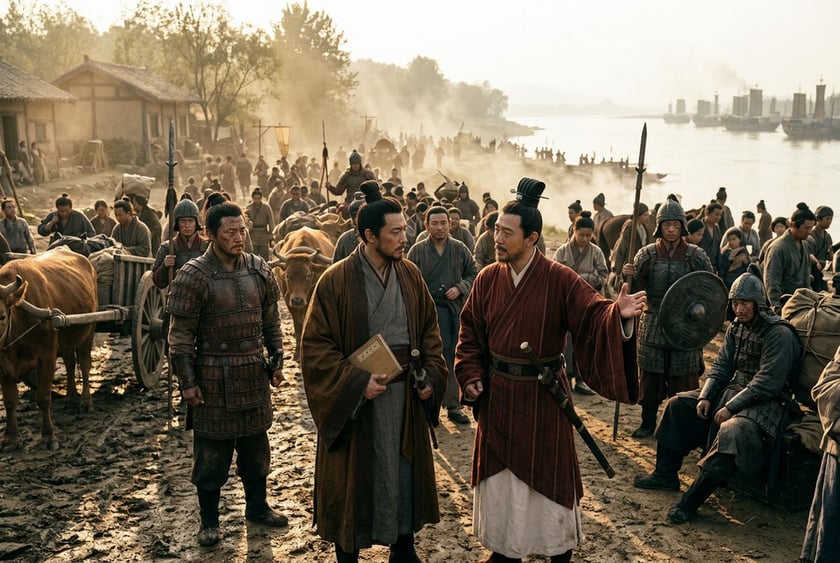
Strategic Background
Guan Yu's northern campaign against Fancheng in the twenty-fourth year of Jian'an — the flooding of the Seven Armies and the terror that shook the realm — was the greatest military gamble Shuhan's Jingzhou forces had undertaken since Chibi. Cao Cao briefly considered relocating his capital at Xudou to escape Guan Yu's advance; Sima Yi and Jiang Ji advised him instead to promise the Yangtze south bank to Sun Quan in order to lure Wu into striking from the rear, and Cao Cao agreed. This meant that Guan Yu faced not only Xu Huang's relief army marching toward Fancheng, but a second front quietly opening from the direction of Jiangdong. A deeper layer of context lay within Sun Quan's camp: Lv Meng had already memorialized the throne proposing that they seize Nanjun while Guan Yu was fully committed to the north, so strategically Guan Yu was encircled on two sides with no prospect of relief.
Dispositions of Both Sides
Guan Yu shifted his main force north to the Fancheng front line, leaving Mi Fang to hold Jiangling in Nanjun and Fu Shiren to hold Gong'an. Both commanders had long harbored resentment toward Guan Yu and had already been upbraided by him for failing to supply the army on time; their loyalty was already in doubt. Lv Meng's dispositions were a masterpiece of deception: he first feigned illness and withdrew to Jianye to lull Guan Yu's suspicions, then ordered his soldiers to dress as merchants in white robes and pole their boats quietly along the riverbank, picking off Guan Yu's lookout posts one by one. By the time the Wu army reached Nanjun, Mi Fang and Fu Shiren had surrendered one after the other, and Guan Yu's line of retreat was severed overnight. On the Cao Cao side, Xu Huang was dispatched to relieve Fancheng and ultimately combined forces with Cao Ren outside the walls to squeeze Guan Yu back south of the Hanshui from the northern front.
Critical Decision Points
The first fatal misjudgment was Guan Yu's failure to maintain his guard after Lv Meng feigned illness: he believed Lv Meng genuinely gravely ill and pulled his troops from Gong'an and Nanjun to concentrate at Xiangyang, surrendering the entire strategic depth from Jiangling to Gong'an. The second misjudgment came on his march back, when he sent envoys to Jingzhou to gather intelligence — Lv Meng deliberately entertained the envoys lavishly, allowed them to wander freely through the city, and let them deliver letters home; when the envoys returned reporting "all is well at home," the fighting spirit in Guan Yu's army collapsed, and soldiers deserted in large numbers to rejoin their families in Jingzhou. The third and decisive mistake was the refusal of relief from Shangyong: Liu Feng and Meng Da turned away Liao Hua's plea for help on the pretext that their "mountain city had only recently submitted", turning Maicheng from a stronghold into a death trap. Structurally, Guan Yu committed a string of "trust without verification" errors, each of which Lv Meng exploited in turn.
Outcome and Repercussions
Guan Yu withdrew with his remnants to hold Maicheng; his force had dwindled from tens of thousands to barely three hundred men. With no relief army from Shangyong in sight, he chose to break out by night with a dozen or so horsemen, hoping to cut through the highlands of Linshu and make for Chengdu. He fell into Ma Zhong's rope trap at Jiashi and was captured, then executed along with his son Guan Ping on Sun Quan's orders. The immediate consequence was Shuhan's permanent loss of Jingzhou; the indirect consequence was Liu Bei's full-scale eastern punitive expedition two years later, which culminated in the defeat at Yiling and left Shuhan's national strength beyond recovery. The complete rupture of the Wu-Shu alliance and the subsequent chain defections of Liu Feng and Meng Da at Shangyong all trace back to this campaign. In strategic terms, Maichengbaizou marked the final failure of Zhuge Liang's Longzhong strategy of holding both Jingzhou and Yizhou as dual axes of advance; from this point on, Shuhan could only defend Yizhou on a single front.
Counterfactual Analysis
The most tempting counterfactual is whether Guan Yu would have kept his main force along the Jiangling–Gong'an line had Lv Meng not staged his false withdrawal. San Guozhi's account of the entire operation to seize Jingzhou makes clear that the whole plan depended critically on Guan Yu's credulity; had Guan Yu left even ten thousand men in Nanjun, Baiyidujiang would not have succeeded at a single stroke. The second variable is the Shangyong relief: had Liu Feng heeded the call of duty and sent troops out, Guan Yu might have broken through with his three hundred survivors and a light cavalry screen into the Shangyong highlands and turned to protracted guerrilla warfare. But the deeper structural problem lay in Guan Yu's relationship with Jiangdong — he had publicly insulted the envoy Sun Quan sent to propose a marriage alliance, hardening Sun Quan's resolve to strike his rear; this diplomatic collapse, in place before the campaign even began, had already narrowed every tactical counterfactual to the smallest of margins. In other words, Maichengbaizou was not the loss of a single battle but the final reckoning of years of failed diplomacy, failed internal coordination, and failed battlefield judgment compounding together.