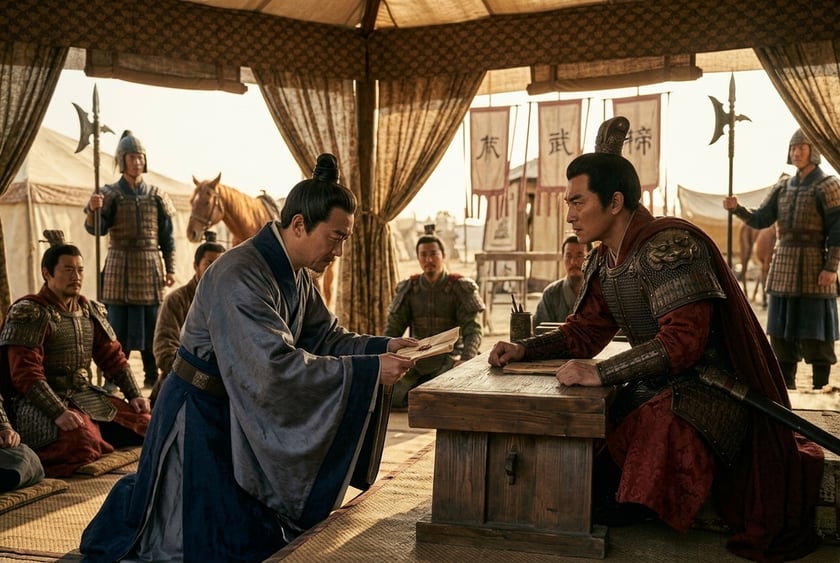
Strategic Background
Within the novel's narrative framework, Liu Bei's campaign in Yizhou had, by Jian'an 18 (213), entered the pivotal phase of transformation from guest to master: he seized Fushuiguan, killed Yang Huai and Gao Pei, and broke decisively with Liu Zhang. Before this point, Liu Zhang might still have hoped to expel his unwanted guest peacefully; from here on he had no choice but to defend the heartland of Yizhou with everything he had. Liu Zhang's subordinate Huang Quan advised him to "send troops overnight to garrison Luocheng and block the throat of the road" [c:17997] — this was the last strategic line of defense against Liu Bei taking Chengdu. Luocheng commanded the Fushuiguan corridor to the north and controlled the approach road to Chengdu to the south; it was the second most critical gateway in Yizhou after Chengdu itself. Liu Zhang accordingly dispatched Leng Bao, Zhang Ren, Deng Xian, and their combined force of fifty thousand men on a night march to establish a defensive perimeter outside Luocheng.
Deployments on Both Sides
Liu Bei's main force numbered several tens of thousands, augmented by Pang Tong, Huang Zhong, Wei Yan, Liu Feng, and Guan Ping from the Jingzhou corps, together with a strategic advisory group that included Fa Zheng (an insider from Yizhou). On Liu Zhang's side, the four generals Leng Bao, Zhang Ren, Deng Xian, and Wu Yi each commanded a fortified camp, with Wu Yi, Wu Lan, and Lei Tong as reinforcements, for a nominal total of fifty thousand [c:17997]. The preliminary fighting unfolded around the outer perimeter of Fushuiguan: Huang Zhong attacked Leng Bao's camp and Wei Yan attacked Deng Xian's camp; the two nearly came to blows over a quarrel about credit and had to be mediated by Liu Bei and Pang Tong [c:17998]. In the end Huang Zhong killed Deng Xian and Wei Yan captured Leng Bao; Liu Bei's main force attacked Deng Xian's camp from the rear [c:17999], and all three outer camps fell. Wu Yi then arrived with twenty thousand reinforcements, and Leng Bao proposed the stratagem of "flooding the Fushuiguan valley by breaking the river" to drown the Shu army [c:18001] — one of the few instances in the novel where Liu Zhang's forces attempted a proactive tactical maneuver. It failed because Leng Bao's feigned surrender and subsequent defection exposed the plan.
The Critical Turning Point
In the phase of closing on Luocheng, the decisive turning point of the entire campaign was the death of Pang Tong. Pang Tong's role in this engagement in the novel is that of a deputy military strategist eager to establish an independent record of achievement. He repeatedly urged Liu Bei to press forward and insisted on taking the southern short cut to attack Luocheng's western gate directly. Liu Bei had misgivings — he had "dreamed at night of a divine being who struck my right arm with an iron staff" — and a letter from Zhuge Liang cautioning him added to his hesitation [c:18002]. Pang Tong replied sharply: "My lord is being confused by Kong Ming. He does not wish to let me win this great achievement alone," and persisted in choosing the short route [c:18002]. This dispute over route selection is one of the very rare direct confrontations in the novel between two top-tier strategists, with the underlying dynamic being the latent competition between Zhuge Liang and Pang Tong for credit. In the end, Pang Tong was riding the white horse Liu Bei had offered him when Zhang Ren's ambush at Luofengpo caught him in a hail of arrows — horse and man both killed [c:18003][c:18005]. The fact that the place name "Luofengpo" (Phoenix-Fall Slope) mirrors Pang Tong's sobriquet "Fengchu" (Young Phoenix), and that the white horse drew the arrows meant for Liu Bei, made this passage a signature scene of the novel's "fate and choice" motif. After Pang Tong's death the Shu vanguard collapsed across the board; Liu Bei retreated to hold Fushuiguan and urgently dispatched Guan Ping to summon Zhuge Liang into Yizhou. Zhuge Liang, Zhang Fei, and Zhao Yun advanced along separate routes, and from this moment the intellectual leadership of the entire Yizhou campaign shifted from Pang Tong to Zhuge Liang — a deliberate dramatic structuring of how the novel uses its two "sleeping dragon and young phoenix."
Outcome and Resonance
After Zhuge Liang entered Yizhou and reorganized the campaign, Liu Bei's forces renewed their siege of Luocheng. The siege lasted many days; Zhang Ren repeatedly sallied out and repeatedly withdrew back inside the walls [c:18007][c:18008]. Zhang Ren was eventually caught in a stratagem of feigned retreat and surrounded by Zhang Fei and Yan Yan; he refused to surrender and was executed [c:18009]. Inside Luocheng, Leng Bao was killed by his own subordinate Zhang Yi, who opened the gates to surrender; Liu Xun fled by the western gate to Chengdu [c:18010]. The fall of Luocheng meant the collapse of the last organized line of defense within Yizhou — Chengdu was now without natural barriers, and Liu Zhang's surrender was imminent. Viewed within the novel's overall narrative arc, the Battle of Luocheng was simultaneously the climax of the Yizhou campaign and a pivotal reorganization of Liu Bei's command structure: Pang Tong's death left Zhuge Liang as the sole "military advisor," and the pattern of "Zhuge Liang's unitary dominance" that would define Shuhan's political and military life was effectively established at this battle.
Counterfactual Analysis
If Pang Tong had not insisted on the southern short cut, had instead coordinated a combined assault with Liu Bei through separate routes, and had avoided the Luofengpo ambush, he would have survived to see Liu Bei take Chengdu and become one of two paramount strategists alongside Zhuge Liang. Such a configuration could have had far-reaching effects on Shuhan's internal dynamics — the Jingzhou faction would have developed internal divisions, and it is impossible to know whether Shuhan could under those circumstances have maintained the monolithic will to sustain "one province against the whole realm" that Zhuge Liang alone was able to enforce. If Zhang Ren had chosen to surrender rather than die in loyalty after being captured, Shuhan's integration of Yizhou's native military officers would have proceeded more smoothly, but the novel would also have lost one of its archetypal portraits of a "loyal and upright general who chose death." If Liu Bei had not summoned Zhuge Liang in time and had attempted to storm Luocheng with only the forces available at Fushuiguan, the Battle of Luocheng might have dragged on past Jian'an 20 due to the command vacuum in the Shu army, giving Cao Cao or Sun Quan the opportunity to advance south or east — Yizhou might have been consolidated by whichever power arrived first, and Liu Bei's plan to enter Yizhou could have entirely failed, completely rewriting the tripartite structure of San Guo. Within the novel's overall architecture, the Battle of Luocheng is the key node at which the opening prophecy — "whichever of the sleeping dragon and the young phoenix you acquire, either one alone can bring peace to the realm" — is partially negated: the young phoenix fell here, and from this moment the possibility of "both advisors shining together" was foreclosed forever.