Background
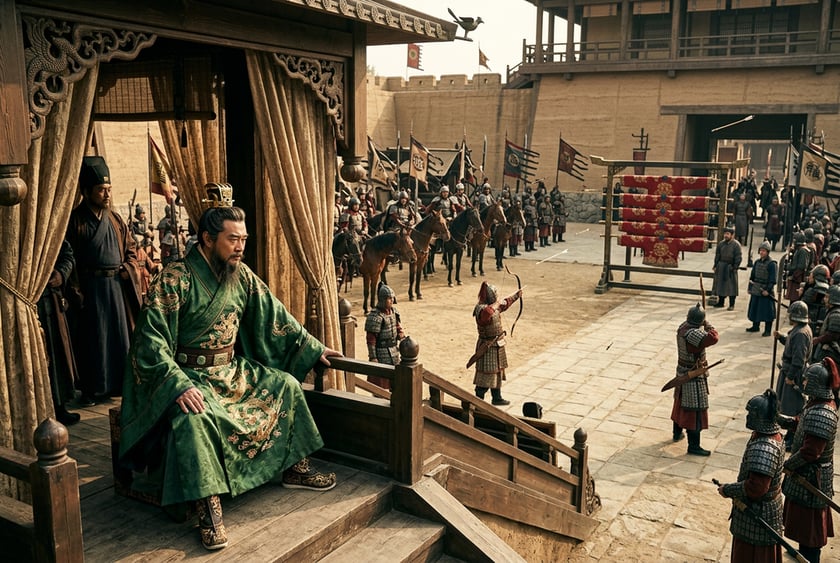
In the summer of the second year of Ganlu (257), Zhuge Dan, General Who Conquers the East and military administrator of Huainan, raised the banner of revolt at Shouchun under the dual pressure of Sima Zhao's incremental stripping of his military authority and the ongoing campaign of centralizing purges. He also killed the Inspector of Yangzhou, Le Lin. Seeking outside support, Zhuge Dan sent his son Zhuge Jing to Wu as a hostage and requested military aid. After Sun Quan's death, Sunwu had long been kept on the defensive by the Simashi-controlled Caowei along the Hefei–Shouchun line. The Sunwu court viewed Zhugedanzhiluan as an extraordinarily rare strategic opportunity — if they could support him in Huainan, Wu forces could exploit the moment to penetrate deep into the Jiangbei hinterland and break out of the long pattern of passive defense. Sun Liang was still young at the time; court affairs were controlled by Grand Tutor Teng Yin and Grand General Sun Lin, and the war faction held the upper hand. Lu Kang then held the post of Chaisang Commander and General Who Displays Martial Might, the most eagerly anticipated figure among Wu's rising generation of commanders, and was naturally incorporated into the relief force.
Key Figures
The Wu side's supreme commander was Grand General Zhu Yi, who superintended all armies advancing north; Tang Zi and Wen Qin (who had defected from Wei) served as deputy commanders, with Lu Kang providing flank support. At court, Sun Lin held sway from Jianye, issuing orders to the front line; Sun Liang, though nominally emperor, had no actual decision-making power over this campaign. On the Wei side, Sima Zhao personally superintended a force of 260,000 to besiege Shouchun; advisors Zhong Hui, Wang Ji, and others accompanied him. Inside the city, in addition to Zhuge Dan's own troops, there were soldiers from the former retinues of Xiahou Xuan and Guanqiu Jian, as well as troops and civilians swept into the city from the Yangzhou Inspector's jurisdiction. Also inside the city were the Wu relief troops led by Quan Cong's sons Quan Yi and Quan Zhu — a critical variable determining whether Shouchun could hold.
Core Issue
This campaign was in essence a strategic game of "using the city as bait." Sima Zhao judged that once Zhuge Dan had Wu reinforcements he would inevitably rely on outside help and refuse to sortie, so he positioned heavy forces in a prolonged encirclement, firmly refused to accept a decisive battle, and simply waited for the city's food to run out and the relief force's momentum to flag. The Wu army faced a dilemma — attacking the main force deep in enemy territory offered poor odds of success, while not attacking meant watching Zhuge Dan perish. Zhu Yi led multiple attempts to break the encirclement and was defeated each time; after every defeat Sun Lin berated him from the rear, and even had men executed at the front: Zhu Yi's death occurred at the front in this very campaign, a classic case of Sunwu destroying its own capable commanders. As a newcomer, Lu Kang had no independent decision-making room in this campaign, but his unit survived intact, preserving the core cadre for his later command of the Jingzhou theater.
Political Consequences
Shouchun fell in the second month of the third year of Ganlu (258); Zhuge Dan was killed by Hu Fen's troops. Inside the city, Quan Yi and Quan Zhu surrendered with their forces after being broken by Sima Zhao's psychological warfare of forged letters — their surrender not only weakened the defenders' combat strength but also destroyed Zhuge Dan's last confidence in Wu relief. For Wu, the defeat at Shouchun was the failure of Sunwu's last large-scale military intervention in the north; thereafter Wu no longer possessed the capacity to strike offensively, and the entire strategic focus shifted to pure defense. For the Simashi, this was the key battle in completing the thorough purge of Huainan and eliminating the residual military forces of the Cao clan, laying the military foundation for the process that saw Sima Zhao slay Cao Mao two years later and Jin replace Wei two years after that. Although Lu Kang personally won no distinction in this campaign, he witnessed the entire process — Zhu Yi killed at the front by Sun Lin, the Quan clan fracturing internally, and the isolated city of Shouchun finally falling for lack of relief. These experiences were transformed, fourteen years later in the Battle of Xiling, into his precise judgment that "interdicting the relief force takes priority."
Counterfactual Analysis
If, when Zhu Yi's repeated offensives proved ineffective, the Wu court had decisively replaced him with Lu Kang or Ding Feng to take front-line command and opened a flanking corridor to Shouchun through maneuver, Zhuge Dan might have held out until the autumn rainy season, forcing Sima Zhao to lift the siege. If the Quan brothers had not been broken by Sima Zhao's divisive tactics, the city's defenders could have held out even longer even with food exhausted. If Sun Lin had not killed Zhu Yi in front of the army mid-battle, Wu's morale could have maintained basic fighting spirit. Any single one of these three conditions, had it held, could have fundamentally altered the situation at Shouchun — but Sunwu, after the succession struggle of the Two Palaces in Sun Quan's final years and the factional infighting among the regents in Sun Liang's early reign, had already lost the political cohesion needed to sustain a large-scale military operation on foreign soil. The defeat at Shouchun was therefore not merely a military failure but a concentrated exposure of the decayed state of Sunwu's political system.