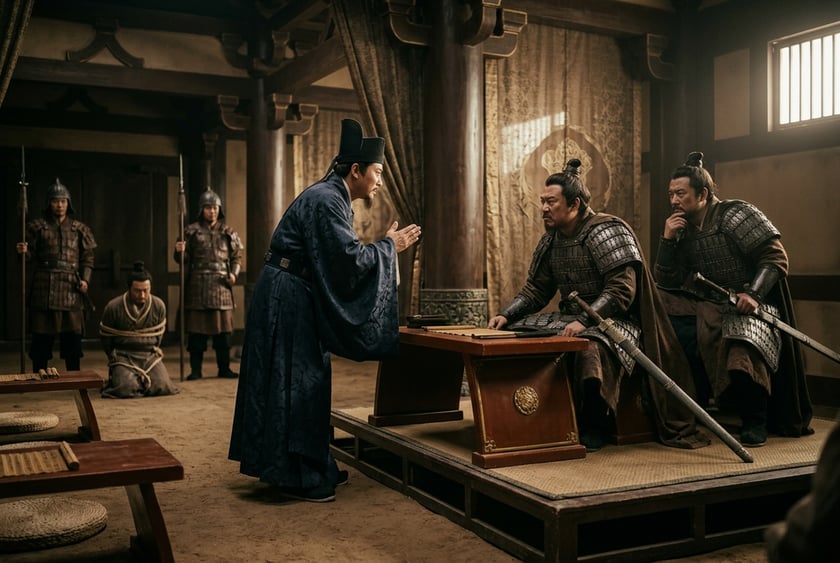
Strategic Background
As presented in the Romance, the Hanzhong campaign of the twentieth year of Jian'an was the first major large-scale offensive Cao Cao actively launched on the western front after his defeat at Chibi. In the preceding years Cao Cao had spent time methodically consolidating the western front: in the sixteenth year he crushed Ma Chao at Tongguan; in the seventeenth year he pacified the Guanzhong region; in the eighteenth year he secured Liangzhou — a series of actions that cleared out the strategic space north of the Qinling Mountains and paved the way for a southward drive into Hanzhong. Hanzhong had been the special politico-religious domain of Zhang Lu's Wudoumidao (Five Pecks of Rice Taoism) for over twenty years — terrain difficult and self-contained — and was the only western mountain stronghold that had not come under Cao Cao's control after he unified the north. From a broader strategic perspective, Hanzhong was the vital corridor between the Guanzhong plain and the Sichuan basin: capturing it could directly threaten Liu Bei, who had just entered Sichuan, forcing him to split forces on two fronts; leaving it alone would inevitably lead Liu Bei to take it first, permanently costing Cao Cao western strategic initiative. In the third month of the twentieth year of Jian'an, Cao Cao set out westward from Yecheng; by the seventh month he had already arrived before Yangpingguan — the march tempo itself demonstrates how much more seriously Cao Cao regarded the Hanzhong campaign than a routine expedition.
Dispositions
The Cao army's deployment exemplified the typical "three-tier expeditionary force" structure: Xiahou Yuan and Zhang He served as the vanguard, responsible for assaulting key points and reconnaissance; Cao Cao led the central army personally to make decisions and commit heavy forces; Cao Ren and Xiahou Dun managed the supply train as the logistics echelon. This structure had become standard practice in Cao Cao's late-period campaigns — its greatest advantage was clear layering and stable supply, its weakness being that mobility was constrained by the supply column. The core of Zhang Lu and Zhang Wei's dispositions was "camping along the mountain slopes" — Zhang Wei held that of all the Hanzhong defenses none was more formidable than Yangpingguan, and recommended deploying more than ten stockaded camps along the mountains and forests flanking the pass to meet the enemy, while Zhang Lu himself remained at Hanning to provide ample grain supplies, with the front line defended by Yang Ren and Yang Ang holding key positions. This design of "using mountain stockades to offset superiority on open terrain" was tactically sound — Cao Cao's cavalry was difficult to deploy effectively in the Qinling hill country, and the dense interconnected stockades could form a defense in depth.
Critical Decision Points
The decisive turning point of the campaign lay in two psychological misjudgments. The first was the interpretation by Zhang Wei and other Hanzhong commanders of the signal of Cao Cao's "retreat." After the initial battles ended inconclusively and a standoff had lasted for more than fifty days, the Cao army suddenly announced a withdrawal. Jia Xu was suspicious and questioned Cao Cao, who answered: "I calculate that the enemy soldiers are on alert every day and it is difficult to win quickly. I use the name of withdrawal to make the enemy relax and drop their guard, then dispatch light cavalry to strike their rear" — a classic "feigned retreat to invite slackness" tactic. Having defended for over fifty consecutive days, the Hanzhong forces were already exhausted; hearing that the Cao army was withdrawing, their psychological vigilance instantly dropped — which was precisely the window Cao Cao wanted. The second was the contingency of Xiahou Yuan's force stumbling into Yang Ang's stockade in the fog. "Xiahou Yuan's army skirted around to the rear of the mountain and, seeing thick fog hanging in the air and hearing the sounds of people and horses, feared an ambush and urged the men to press on; in the heavy fog they mistakenly arrived before Yang Ang's stockade" — this passage reads almost like fate-given tactical windfall: the fog led the defending troops to mistake the enemy for their own men returning, opened the gate to admit them, and the Cao forces poured in and set fires, causing five stockades to collapse in quick succession. From a modern military history perspective, this is a textbook case of battlefield fog and misidentification — the Hanzhong defenders' identification mechanism failed under conditions of near-zero visibility, and one random event cascaded into a full-line collapse.
Outcome and Resonance
In terms of tactical results, Yang Ang was slain by Zhang He, Yang Ren retreated to Nanzheng, and Zhang Wei abandoned Yangpingguan overnight upon hearing of the defeat — the entire defensive line collapsed in an instant. The Cao forces took Yangpingguan and all the stockades; Zhang Lu himself was soon compelled to surrender, and Hanzhong was incorporated into Caowei territory. In terms of strategic consequences, the loss of Hanzhong was enormous pressure on Liu Bei, who had just taken Chengdu — stripped of Hanzhong as a buffer zone, Caowei could look directly down into Sichuan, and Shuhan's strategic depth shrank dramatically. This directly catalyzed the Battle of Hanzhong lasting two full years from the twenty-second to the twenty-fourth year of Jian'an — Liu Bei, supported by Fa Zheng, Huang Zhong, Zhao Yun, and Wei Yan, committed the full national strength to seize Hanzhong back, ultimately killing Xiahou Yuan at Dingjunshan and forcing Cao Cao to withdraw — at enormous cost, recapturing this strategic chokepoint. In other words, the Battle of Yangpingguan in 215 was round one of the struggle over Hanzhong, won by Caowei; the Battle of Hanzhong in 219 was round two, won by Shuhan. Together, these two campaigns form the most strategically decisive consecutive contest on San Guo's western front. From the Romance's narrative rhythm, the Battle of Yangpingguan was the iconic scene marking the end of the Zhang Lu regime and the founding campaign that established Xiahou Yuan and Zhang He's status as western front commanders — all the chain events that followed, their garrisoning of Hanzhong, Xiahou Yuan's death at Dingjunshan, and Zhang He taking over command, all grow out of this battle's achievements.
Counterfactual Analysis
If the Hanzhong defenders had not mistakenly opened the gates, and the Cao forces had not broken through in the fog, how long could the Hanzhong defensive line have held? By estimates of Zhang Lu's manpower and grain reserves, holding the Yangpingguan line for two or three more months was not difficult — the Cao expeditionary force sustained in Hanzhong's hill country for an extended period would have faced enormous attrition, and the Chibi experience had already shown that Cao Cao's army was poorly suited to sustained operations in mountain and wetland terrain. If that scenario had played out, Cao Cao would very likely have been compelled to partially withdraw to Guanzhong, Zhang Lu could have seized the opportunity to rebuild his defensive line, and Liu Bei would have gained a precious window to press actively into Hanzhong. Had that occurred, Caowei might not have won round one over Hanzhong, and the entire western front of San Guo would have unfolded at a different tempo. A second counterfactual: if after taking Hanzhong Cao Cao had heeded Sima Yi and Liu Ye's advice to "press the victory and take Yizhou," what would have happened? Both the Romance and historical records note that Cao Cao replied with "Men suffer from insatiability — having gained Long, do we still covet Shu?" and let this window pass. In hindsight, this is one of the most criticized decisions of Cao Cao's later years — a single day's delay in taking Shu meant that within three days Liu Bei had already consolidated the hearts of the people, and the repeated reversals of the Battle of Hanzhong were thereby made inevitable. The fortuitous victory at the Battle of Yangpingguan thus ultimately failed to translate into a permanent strategic dividend.