Strategic Background
After the Battle of Guandu, Yuan Shao, though defeated, still held the four Hebei provinces; for Cao Cao to push from the south bank of the Yellow River into Hebei, the only reliable path was to first clip away the Yuan clan's flanks in Bingzhou and in the Hedong direction. Yuan Shang had clearly understood this point as well: in 202 he suborned the Hedong Prefect Guo Yuan, deployed Bingzhou Inspector Gao Gan, and drew on the strength of the Southern Xiongnu Chanyu Hu Chuquan, applying pressure from the western flank to relieve the Hebei heartland. At this time Zhong Yao, in his capacity as Sili Inspector holding the imperial tally and superintending the armed forces of Guanzhong, was based at Changan. His task was to nail down the north-south corridor linking Guanzhong and Hedong; if it were lost, Cao Cao's northern campaign would be forced to scramble between two battlefronts.
Deployments
On Yuan Shao's side: Guo Yuan led the Hedong commandery forces advancing from east to west along the Fenhe valley, joining forces with the Southern Xiongnu Chanyu Hu Chuquan to besiege Pingyang from the outside; Gao Gan led the Bingzhou troops from the north to provide support, aiming to open a vertical corridor through Bingzhou–Hedong–Guanzhong. On Zhong Yao's side: the troops available to him were far fewer than the enemy's, but he held two cards — one was the forces of the Liangzhou commanders Ma Teng and Han Sui; the other was the "currently waiting and watching but potentially winnable" attitude of the Guanzhong generals. Zhong Yao did not hold defensively at Changan but personally led his main force northward, closing on Pingyang to push the battlefield forward to the Fenhe valley; Zhang Ji and Fu Gan were dispatched to Liangzhou to undertake the most difficult diplomatic task: at the critical moment when Ma Teng and Han Sui were repeatedly weighing their options, binding them firmly to Cao Cao's side.
Critical Decision Points
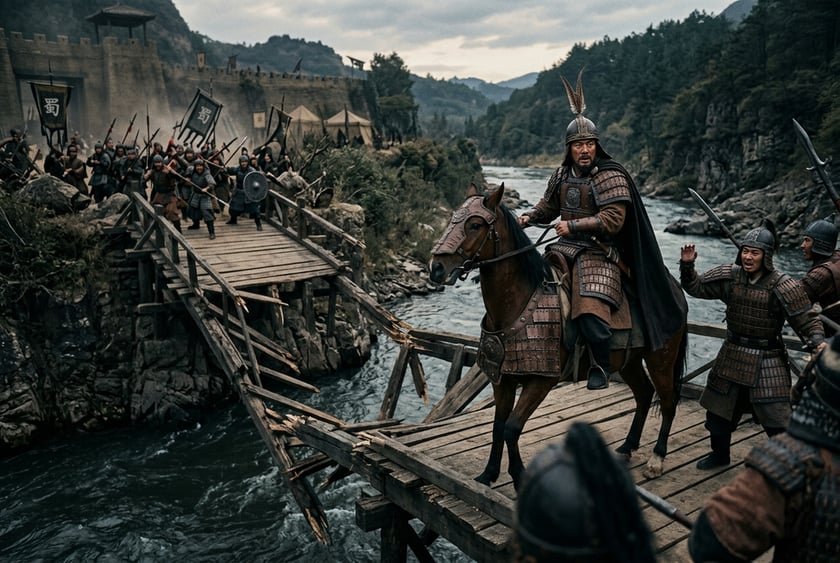
The battle had two decisive decision points. The first was "locking down Guanzhong through diplomacy." Rather than "fight first, then negotiate," Zhong Yao reversed the order, using Zhang Ji and Fu Gan to persuade Ma Teng with the logic of "Guo Yuan will certainly be defeated — aligning with Yuan brings no benefit, aligning with Cao brings merit." Ma Teng sent Ma Chao leading more than ten thousand elite troops east to support the campaign, with Pang De as the vanguard — these ten thousand became the only mobile main force in Zhong Yao's hands capable of suppressing Guo Yuan in the open field. The second was the battlefield choice to "strike at the halfway crossing." Guo Yuan, overconfident in his numbers, was in a hurry to cross the Fenhe and encircle Pingyang from outside; Zhong Yao and his generals analyzed Guo Yuan's character as "arrogant and rash, prone to underestimate opponents," and decided to launch the assault when Guo Yuan's forward force was halfway across and his rear force had not yet crossed. This judgment minimized the tactical risk — if they struck too early the enemy would not yet have moved and could withdraw; if too late the entire enemy force would have crossed and a frontal defeat would be almost impossible to reverse — the outcome depended solely on whether their reading of Guo Yuan's character was correct.
Outcome and Resonance
The result of the Fenhe halfway-crossing battle was almost textbook: Guo Yuan's forward force was cut off, his rear force was trapped, and the whole column collapsed under the division of the river current. Guo Yuan himself was slain on the spot by Pang De. Pang De afterward discovered that the man he had killed was Zhong Yao's nephew; Zhong Yao wept upon seeing the head, but still declared publicly: "Guo Yuan was my nephew, yet he was an enemy of the state." This public stance was the political coda of the victory — it announced to all the watching forces in Guanzhong that "kinship cannot substitute for political alignment." The Southern Xiongnu Chanyu Hu Chuquan, seeing Guo Yuan dead in defeat, immediately submitted to Zhong Yao; Gao Gan retreated north with his broken forces into Bingzhou. Two years later, when Cao Cao besieged Yecheng from the north, Guanzhong, Hedong, and the Southern Xiongnu were no longer any cause for anxiety. Looking further ahead, Cao Cao personally acknowledged Zhong Yao's strategic value in "pacifying Guanzhong to stabilize the realm" (invoking "the precedent of Xiao He holding Guanzhong"), and his political weight in the period surrounding the founding of Caowei was built on the foundation of this battle.
Counterfactual Analysis
The most critical counterfactual is Ma Teng's choice. Had Ma Teng remained neutral and not sent troops, Zhong Yao would have had virtually no field force available near Pingyang; he would have been forced either to retreat and defend Changan — ceding the entire Hedong corridor — or to fight and be defeated. In either case, the north-south corridor linking Guanzhong and Hedong would have been opened to the Yuan clan. Cao Cao's attack-Ye campaign the following year would have been forced to delay, and the timetable for pacifying Hebei would have been dragged back by at least a year. A second line of speculation: had Guo Yuan followed his strategists' advice to "not underestimate the enemy" and crossed the Fenhe steadily with no rash advance, the window for Zhong Yao's "strike at the halfway crossing" would never have appeared — the battle at Pingyang would have devolved into a conventional engagement, and the outcome would have been far less certain. A third counterfactual involves Ma Chao himself. This western Liangzhou commander who would later fight Cao Cao bloodily at Tongguan was in 202 Zhong Yao's allied principal commander; had Ma Teng already been dead then and Ma Chao not yet grown into his own, it is even doubtful whether Guanzhong could have mobilized this mobile force at all. Working back from the outcome, one discovers an ironic fact: one of the greatest contributors to Cao Cao's pacification of the north was the Ma Chao clan — the very men who would turn against him ten years later. History's jokes are often precisely this precise.