Strategic Background
The Battle of Luofengpo falls in the middle of Liu Bei's campaign to take Yizhou, forming the transition from the standoff at the Fucheng pass to the decisive engagement at Luocheng. In the sixteenth year of Jian'an (211), Liu Zhang, threatened by Zhang Lu in Hanzhong, invited Liu Bei to enter Sichuan; Liu Bei marched his forces north to Jiameng, nominally to help Yizhou resist Zhang Lu, but in reality eyeing Yizhou itself. By the end of the seventeenth year of Jian'an the two sides had turned against each other, and Liu Bei drove south to seize Fucheng, clashing with defensive lines held by Liu Zhang's son Liu Xun and Yizhou commanders Wu Yi, Zhang Ren, Liu Gui, Deng Xian, Leng Bao, and others. Once Fucheng fell, the logical next step for Liu Bei was to take Luocheng — Luocheng was the northern gateway to Chengdu, controlling the throat through which the Fu River descends to the Chengdu plain; once it fell, the gate to Chengdu would swing wide open. Pang Tong, serving as Liu Bei's Military Advisor and General of the Central Army in this campaign, was both the chief-of-staff for the entire Yizhou operation and the indispensable pillar enabling the campaign to proceed independently of the Jingzhou main force under Guan Yu and Zhuge Liang. The occurrence of the Battle of Luofengpo was, in essence, because Pang Tong hoped to secure a swift decisive victory as the defining achievement of "the non-Jingzhou faction" in the Yizhou campaign.
Disposition of Forces
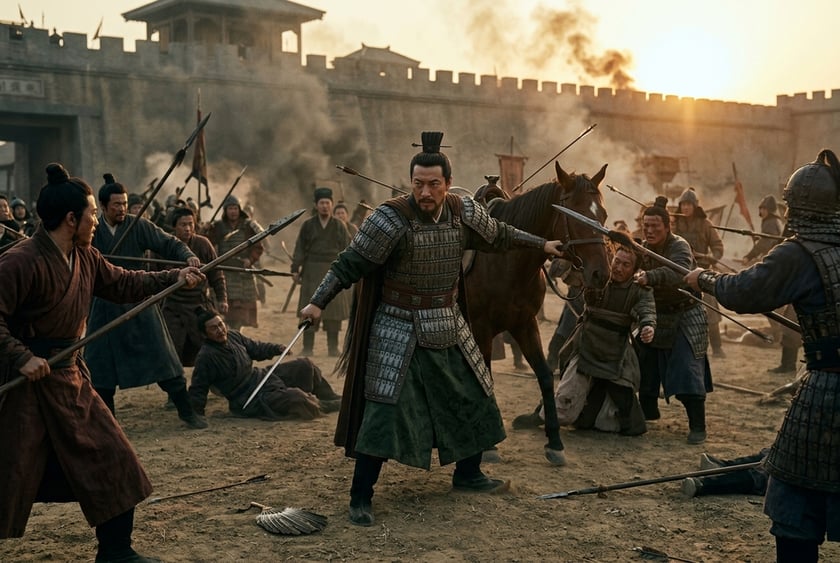
Liu Bei's strategy for advancing on Luocheng called for a two-pronged encirclement. The northern prong would follow the main road from the Fucheng pass to the eastern gate of Luocheng, led by Huang Zhong. The southern prong would take a mountain path to attack the western gate of Luocheng, personally supervised by Pang Tong with Wei Yan as vanguard. Liu Bei himself had originally intended to take the mountain path but was replaced at Pang Tong's insistence. This arrangement was militarily reasonable — the main road was flat and suited to the movement of the main force with the commander holding the center; the mountain path was steep and suited to a surprise attack, with the military advisor personally overseeing operations to make real-time decisions. But the deployment also had an obvious vulnerability: Pang Tong's column had only Wei Yan as vanguard, lacked an independent reserve, and would have no room to react if it ran into an ambush. On the Yizhou side, Zhang Ren directed the defensive dispositions: he assessed that the southern prong along the mountain path was the more likely weak point to be overlooked, and led three thousand crack troops to preemptively enter the mountains and set an ambush, planning a "decapitation strike" aimed at Liu Bei himself — he even mistakenly identified the rider on a white horse as Liu Bei, intending to decide the battle's outcome with this single engagement.
Key Decision Points
Three decision points in this battle are worth revisiting. The first is the swap of routes between Liu Bei and Pang Tong. Liu Bei had a foreboding dream the night before and requested to take the mountain path himself; Pang Tong refused and insisted on taking it himself. Behind this lay both military calculation (Pang Tong believed the military advisor should assume the more dangerous route) and a political-psychological motive (Pang Tong was eager to achieve a great feat and escape the long shadow of Zhuge Liang's glory). The second is Zhang Ren's target identification. Zhang Ren's true target was Liu Bei, not Pang Tong, but because Pang Tong was riding a white horse — temporarily given to him by Liu Bei — he was misidentified, transforming what had been planned as a decapitation strike against the supreme commander into an ambush of the military advisor. This miscalculation was precisely what spared Liu Bei — if the white horse had still been under Liu Bei, the Shuhan campaign to take Sichuan might have ended right there outside Luocheng. The third is Zhuge Liang's advance warning from Jingzhou and Liu Bei's hesitation. Zhuge Liang had already sent a letter warning that "the baleful star is in the west and the commanding general is likely to meet grave misfortune," but the political pressure from Pang Tong to press the advance overrode the warning. This decision-making failure reflects the subtle tension already present within Liu Bei's camp between the Jingzhou faction and "the newly prominent Pang Tong faction."
Outcome and Reverberations
The immediate outcome was direct and devastating: Pang Tong was struck by stray arrows and killed; his column was destroyed; the southern line of advance was broken. Liu Bei was forced to pull back to the Fucheng pass and urgently summoned Zhuge Liang, Zhang Fei, and Zhao Yun to enter Sichuan as reinforcements. The short-term impact was that the Sichuan campaign shifted from the originally anticipated swift decisive victory into a protracted engagement lasting over a year; Luocheng held out for nearly another full year before it fell, and Liu Bei's losses expanded greatly. The medium- and long-term impacts were even more profound. First, because Zhuge Liang was pulled westward, Guan Yu became the sole supreme commander on the Jingzhou front — an arrangement that was temporary but became permanent; seven years later, when Guan Yu's northern expedition failed and Jingzhou fell, the root cause lay in this personnel adjustment. Second, Shuhan lost a senior strategist who could have formed a "dual military advisor" structure alongside Zhuge Liang; thereafter Zhuge Liang monopolized both military and political authority, and Shuhan never again had a second voice capable of independently proposing alternative strategic directions. Third, after Pang Tong's death Shuhan never produced another strategic-level military advisor comparable to him who came from the Jingzhou native gentry; the long-term result was a teacher-student single lineage of "Zhuge Liang to Jiang Wei," leaving the talent structure deeply fragile by the late Shuhan period.
Counterfactual Analysis
If Pang Tong had not died and Luocheng had been taken within a few months, Shuhan's strategic situation would have differed significantly. First, Zhuge Liang would have had no need to enter Sichuan; he could have continued to hold Jingzhou and coordinate the big picture, Guan Yu's role would have remained that of a regional commander rather than supreme commander of an autonomous theater, and the probability of Jingzhou falling would have dropped substantially. Second, Pang Tong was only thirty-six years old; had the normal course of his career continued, he could easily have lived past the Battle of Yiling and beyond, forming after Shuhan's founding a division of labor of "Zhuge Liang handling internal affairs and diplomacy, Pang Tong handling campaigns and strategy" — precisely the "dual military advisor" arrangement that Liu Bei had truly wished for during his lifetime. Third, Shuhan's talent network would have sunk deeper roots along the Jingzhou, Xiangyang, and Nanyang corridor, avoiding the "inward-turning" problem that later arose from excessive dependence on Yizhou native gentry such as Qiao Zhou and Zhang Yi. In other words, the single arrow at Luofengpo determined not only Pang Tong's personal fate but quite possibly altered the strategic and personnel structure of Shuhan for thirty years after its founding — this is the costliest of all the accidents in the campaign to take Sichuan.