Background
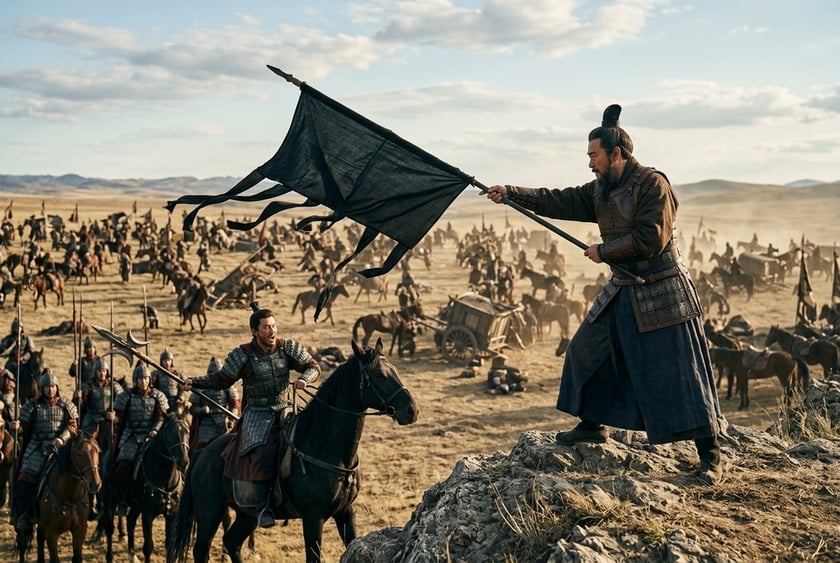
Chengyushousanchengjuchengong — Cheng Yu holding three cities against Chen Gong — was the most dangerous and most consistently underestimated political-military crisis of Cao Cao's early career. In the first year of Xingping (194), Cao Cao led his main force on a punitive expedition against Tao Qian in Xuzhou, leaving his home base of Yanzhou far behind; Zhang Miao and Zhang Chao conspired with Chen Gong to welcome Lv Bu into Yanzhou, and commandery after commandery responded in submission. This was not an ordinary "local rebellion" in the conventional sense — it was a systemic internal defection within Cao Cao's base area. Zhang Miao had been Cao Cao's close friend for many years; Chen Gong was a senior member of Cao Cao's early command staff; both understood the architecture of Cao Cao's political construction intimately. Once they turned against him, the Yanzhou that Cao Cao had painstakingly built collapsed almost instantly. Of the entire region, only three points held: Juancheng (the provincial capital), Fan County, and Dongā. These three points formed the only support on Cao Cao's road back — lose them and Cao Cao returning from Xuzhou would have no home to return to, which amounted to political execution. From the standpoint of strategic geography, the three cities were distributed along the south bank of the Yellow River on the line of Cangtingjin, Fan County, and Dongā — the throat of northeastern Yanzhou. Chen Gong led a heavy force to take Dongā and separately sent Fan Yi to take Fan County precisely because he had identified that if this throat were broken through, Cao Cao would be utterly cut off from his base.
Key Figures
Four key actors are involved. Cheng Yu was the actual resolver of this political crisis; he held no martial role in Cao Cao's command, yet through political judgment and persuasive power he shouldered what could not be accomplished on the battlefield. Xun Yu, as the senior civil official holding Juancheng, recognized that his own judgment and personal connections were insufficient to stabilize Fan and Dongā — "You are what the people look up to; if you go and persuade them, it may well succeed" — and rather than going himself, he delegated the task to Cheng Yu: a precisely calibrated act of "deploying the right person". Jin Yun, as the magistrate of Fan County, was the coerced "middleman" — his mother, younger brother, wife, and children were in Lv Bu's hands, and in theory he should have gone over to Lv Bu's side. But Cheng Yu used the political judgment of "those who find the right master flourish, those who lose it perish" combined with a character analysis of "Lv Bu is coarse with few intimates, rigid and lacking in courtesy" to enable Jin Yun to make a choice in an impossible dilemma. Chen Gong represents the opposing side's finest mind: not only did he participate in the planning, he personally led troops to seize Dongā and cut off Cao Cao's route back — but he underestimated the political resilience within the three cities and underestimated Cheng Yu's standing in the popular regard.
Core Issue
The central issue is "how, in the midst of sudden political upheaval, to persuade someone who by every logic should betray you to stand with you again." Jin Yun's predicament was a textbook dilemma in political theory: in principle he should go over to Lv Bu to save his family, because that was the ethics of kinship. But Cheng Yu's argument broke through that ethic on two levels: first, he asserted that "Lord Cao's intelligence and strategic ability surpass any generation — he is all but a gift from Heaven" — planting the expectation of Cao Cao as the long-term winner in Jin Yun's calculations; second, he identified Lv Bu as "coarse with few intimates, rigid and lacking in courtesy, merely a hero of the brawn" — stripping away any possibility of Lv Bu serving as a long-term lord. These two layers of argument together conveyed a single core message: betraying Cao Cao might save Jin Yun's family for the moment, but in the long run he himself would be abandoned by Lv Bu; holding for Cao Cao might cost him his family, but in the long run he would become a meritorious minister in the mold of Tian Dan. Cheng Yu appealed not to the ethics of loyalty but to a realistic calculation of "who is the long-term winner" — the most pragmatic and most cold-blooded face of early Jian'an counselor culture. Jin Yun's "weeping" reflects that he was entirely persuaded by this argument.
Political Consequences
The most immediate consequence was that the three cities held, and after Cao Cao returned from Xuzhou he had a complete base to come back to — when Cao Cao grasped Cheng Yu's hand and said "without your strength, I would have had nowhere to return," this was no courtesy; it was a precise description of the facts. The second consequence: Cheng Yu leapt from "local gentry scholar" to one of the core members of Cao Cao's command staff. Cao Cao memorialized his appointment as Grand Administrator of Dongping, garrisoned at Fan, giving him an independent military-administrative foundation; later Cheng Yu was ranked alongside Xun Yu, Guo Jia, and Jia Xu as one of the "four counselors," and the foundation for that rank was precisely this crisis. The third consequence: it demonstrated a distinctive mode of personnel deployment within Cao Cao's command — in places beyond the reach of military force, use political persuasion as a substitute for military action. This mode was later employed repeatedly in Cao Cao's handling of Zhang Xiu, Liu Bei, Ma Teng, and others, and is the most prominent point of difference between Cao Cao and his contemporaries (Yuan Shao, Liu Biao). The fourth consequence: it dealt a blow to Lv Bu and Chen Gong's side. Chen Gong's carefully planned seizure of Yanzhou stalled at the three cities, buying Cao Cao time to withdraw from Xuzhou. After Cao Cao returned with his army, he immediately launched a counterattack along the Puyang front and ultimately drove Lv Bu out of Yanzhou; in the second year of Jian'an (197), Lv Bu fled east to Xuzhou.
Counterfactual Analysis
What if Jin Yun had not been persuaded by Cheng Yu and had gone over to Lv Bu? The most likely chain of events: Fan County falls, Chen Gong crosses Cangtingjin, and Chen Gong and Lv Bu's main force together assault Dongā; when Cao Cao returned from Xuzhou, the situation he would face would not be "three cities still in hand" but "all of Yanzhou completely changed hands." In that case Cao Cao would very likely have been forced to seek political subordination from Yuan Shao, or to flee toward Runan or Huainan — the political lever of "holding the Son of Heaven to command the lords" that he later wielded would have had no basis to stand on. The second counterfactual: if Xun Yu had not delegated the task to Cheng Yu but had gone himself, Xun Yu's standing among the common people of Fan and Dongā was not as strong as Cheng Yu's (Cheng Yu was a native of Dongā), and the persuasive effect would have been considerably weaker. This precision of delegation reflects the extremely high efficiency of "knowing people means knowing resources" within early Jian'an Cao Cao command culture. The third and more macro counterfactual: if Chen Gong's move of subverting Cao Cao's base area from within had become an imitable template in the Jian'an era, the years of Jian'an would have seen large numbers of "command staff turning against their lord" political events, and the entire political history of San Guo would have entered a high-entropy state driven by betrayal. But the success demonstrated by Cheng Yu in holding three cities showed that "loyalty can also win," and in fact suppressed the spread of that pattern. Seen against these alternate paths, the true weight of Cheng Yu holding the three cities lies not in the three cities themselves, but in the fact that through the purest form of political persuasion it saved Cao Cao's entire base area, and shaped the distinctive tone of early Jian'an command culture — one in which "persuasion and loyalty coexist."