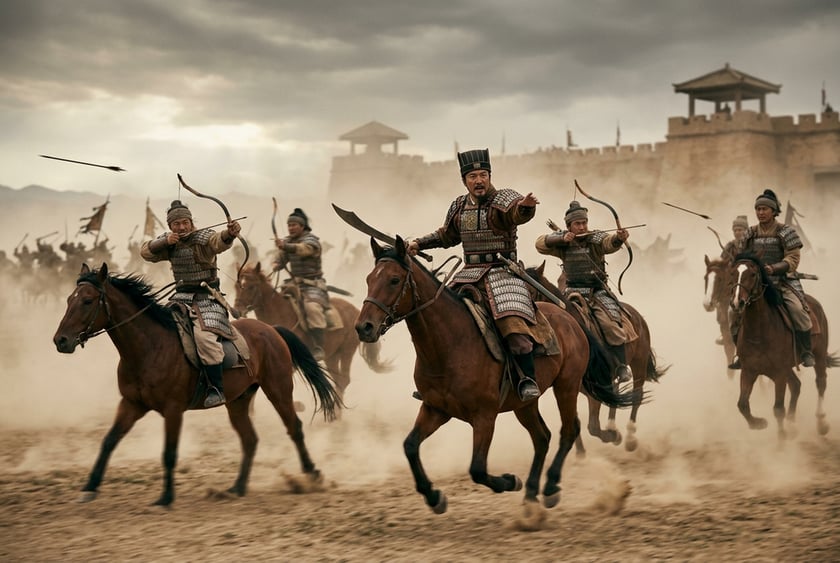
Strategic Background
In the autumn and winter of the twenty-fourth year of Jian'an (219), the three-way balance of forces was in an extremely unstable equilibrium. Liu Bei had at the start of that year pacified Hanzhong and declared himself King of Han; Guan Yu promptly launched a northern offensive from Jingzhou independently, drowned the Seven Armies with a flood (Shuiyanqijun), captured Yu Jin alive, and killed Pang De, his might shaking the whole realm. Caowei was on one side desperately holding Xiang-Fan while waiting for Xu Huang's relief force to arrive, and on the other enduring the political pressure of brigand uprisings in Liang, Jia, and Luhun near Xudou responding to Guan Yu's call — Cao Cao even at one point deliberated moving the capital to evade the threat. For the eastern state, this situation was equally a danger signal: if Guan Yu took Xiang-Fan and then controlled the Jing-Xiang waterways, once Caowei retreated the entire middle Yangtze basin would be monopolized by an adversary who had been hostile to Sunwu from the start and had refused to return Nanjun for years despite having "borrowed" it; the defensive depth along the Yangtze that Sunwu had painstakingly built since Chibi would be reduced to nothing. The strategy of Sima Yi and Jiang Ji recommending to Cao Cao that he ally with Sunwu to take Jingzhou was precisely aimed at Sun Quan's core anxiety — "better that Caowei does not collapse than that Guan Yu alone becomes dominant" [c:17397]. That Sun Quan chose this moment to strike was no sudden impulse but rather the long-arc strategy of "first ally with Liu to resist Cao, then restrain Liu and stand on one's own" — developed since Chibi — reaching its moment of payoff.
Deployments
On the Sunwu side, Lv Meng was the overall planner, Lu Xun replaced him in an apparent support role, and Sun Quan presided over the entire operation from Jianye while lending political authority to every internal and external move. Lv Meng's genius lay in the political theater of "withdraw a general, swap in a replacement": he publicly announced that illness compelled him to return to Jianye, replacing himself with the junior and outwardly mild-mannered Lu Xun to take command of the Lukou defensive line, and had Lu Xun personally write letters to Guan Yu brimming with deference and flattery, inducing Guan Yu to feel still more secure and draw down the Jiangling and Gongan garrisons to reinforce the northern front [c:17397]. The actual military movement was assembled by Lv Meng in secret at Xunyang: elite troops concealed inside vessels, with oarsmen and sailors disguised as white-clad merchants moving upriver past the coastal beacon towers Guan Yu had established along the river without being detected. This is the origin of the name "Baiyidujiang" — crossing the river in white civilian garb. On Guan Yu's side, the entire strategic focus was staked on the Xiang-Fan line: the southern defense of Nanjun was left to Mi Fang garrisoning Jiangling and Fu Shiren guarding Gongan, but both men had already developed serious grievances against Guan Yu over the issue of military supply; Guan Yu's threat before departing — "when I return, I will deal with you" — had not diminished their fear but instead destroyed whatever will they had to stand and die alongside him. Caowei's Xu Huang was at this point gradually encircling Guan Yu's forward position to the east of Xiang-Fan, steadily escalating the pressure on Guan Yu's northern front — and geographically the three forces formed a complete "encirclement space," while Guan Yu himself had not yet perceived it.
Critical Decision Points
The true fork in the road of the campaign was not the moment Lv Meng landed but rather the earlier accumulation of three decisions. The first was Sun Quan's agreement to open secret communication with Cao Cao — the substantive breaking of the Sun-Liu alliance that had held since Chibi, meaning Sunwu accepted the price of being long-term enemies of the Liu Bei camp in the future. The second was Lv Meng's "feigned illness and replacement" — a precise intelligence operation that drove Guan Yu's troop deployment to its extreme limits. The third was Fu Shiren and Mi Fang's surrender on the spot — what determined that Baiyidujiang would escalate from "a surprise assault on a city" to "a takeover of the entire Jingzhou administrative apparatus." After entering Nanjun, Lv Meng immediately imposed a discipline policy of "restraining the three armies, not violating Guan Yu's household members," completely dissolving the morale of Guan Yu's northern campaign army — an occupational model entirely different from Cao Cao's practice in Xuzhou or Liu Bei's in Yizhou: Cao Cao was skilled at using intimidation to establish authority, Liu Bei at using magnanimity to win the populace over, whereas Lv Meng for the first time in three-kingdoms warfare demonstrated a "conquering hardness with softness" psychological operation of occupation [c:17398]. Lu Xun simultaneously cut off Guan Yu's western retreat route back to Yizhou. Had any one of the three decision links failed — had Sun Quan changed his mind, had Lv Meng been exposed, had Mi Fang and Fu Shiren held the line — Baiyidujiang would have failed. Sunwu's "simultaneous success of every element" in this operation was in essence the first perfect overlap of strategic opportunity window and campaign readiness.
Results and Resonance
The campaign's results far exceeded the capture of a single commandery. In the short term, Sunwu gained the three commanderies of Nanjun, Wuling, and Lingling in their entirety; Guan Yu withdrew to Maicheng and was captured and killed; and twenty years' worth of water forces, political networks, and commercial routes that Liu Bei had built up in Jingzhou were completely lost [c:17398]. In the medium term, the Sun-Liu alliance formally ruptured, triggering in the twenty-sixth year of Jian'an / first year of Zhangwu (221) Liu Bei's eastern campaign against Yiling — his first and only personally led campaign after proclaiming himself emperor — which ended in Lu Xun's fire attack at Xiaoting, driving Shuhan's national strength back to south of Hanzhong, stripping it of any further strategic initiative for northern campaigns. In the long term, Baiyidujiang established the final outline of the San Guo configuration: Caowei holding the north and the regions north of Hanzhong, Sunwu controlling the middle and lower Yangtze and Lingnan, and Shuhan confined to Yizhou. The scenario sketched in the Longzhong Plan — "wait for change in the realm, dispatch an outstanding general to emerge from the Wan-Luo direction" in a two-pronged northern campaign — lost its eastern flank from this night onward. The consolidation of the three-kingdoms partition from possibility into structural fact began on this very night. Later military theorists placed Baiyidujiang alongside Chibi as the two classic Sunwu campaign masterpieces: Chibi relied on hard naval power, while Baiyidujiang relied on intelligence and soft diplomatic power; together they established Jiangdong's long-term strategic identity of "using warfare to preserve peace, and using strategy to found a state."
Counterfactual Analysis
The most worth-exploring counterfactual is: what if Mi Fang and Fu Shiren had refused to surrender and held their positions? Jiangling and Gongan were both formidable water cities built on the Hanjiang delta waterway network; given the siege technology of the time, even after landing Lv Meng would have needed at least two to three months to take them; that time would have been sufficient for Guan Yu to receive word and withdraw his forces south to confront the situation, creating a new standoff with Caowei's Xu Huang at Xiang-Fan. If Cao Cao had maintained the alliance with Sunwu, Caowei forces might very well have advanced east to join Sunwu in a pincer against Guan Yu, and Guan Yu might still have been defeated — but Jingzhou would not have changed hands entirely; Liu Bei at minimum could have retained the Zigui-Yiling line in the west as a support base for a counteroffensive. A second counterfactual: if Lv Meng had not used the civilian-disguise stratagem and had instead sent forces openly — Guan Yu's coastal beacon network would have given warning hours before the landing, and though Guan Yu could not have withdrawn from Xiang-Fan, the remaining defenders at Jiangling and Gongan could have held off the initial assault, leaving Sunwu in the passive position of "unable to take the city yet unable to pull back." A third counterfactual: if Sun Quan had rejected the proposals of Sima Yi and Jiang Ji for "allying with Cao" and continued to watch from the sidelines — then Cao Cao might not have survived the year before Guan Yu stormed Xiang-Fan, Xudou would have been shaken, the anti-Cao elements inside Caowei (the Wei Feng conspiracy and others) would have seized the moment to strike, and the San Guo configuration might have evolved along an entirely different historical line of "Caowei collapse, Liu Han moving north, Sunwu marginalized." Viewed through all three counterfactuals, the success of Baiyidujiang was not solely the product of Sunwu's superior tactics — it was the result of all three neighboring powers simultaneously choosing, in the same window of opportunity, to act in mutual complicity with one another. That is precisely why its place in the history of the San Guo wars is uniquely distinctive.