Strategic Background
The Battle of Hefei in the twentieth year of Jian'an (215) was Sunwu's second major-force northward push since Chibi. At the time Liu Bei had already occupied Yizhou, the Sun-Liu alliance was in the midst of dividing the account for Jingzhou, and Sun Quan needed a northern front victory to cash in on the narrative of "reachability of the Central Plains from the Jiangdong position." But Hefei's defense was held by Zhang Liao, Li Dian, and Le Jin, and Sun Quan's main force had already been checked in the Battle of Xiaoyaojin when Zhang Liao counter-attacked with eight hundred suicide troops, making the overall results of the entire Battle of Hefei far from satisfactory for Sunwu. In this tail end of "already taking a beating on the main battlefield," Sun Quan urgently needed a micro-scale victory to restore military morale — this was precisely the political context in which Ganningbaiqijieying was adopted.
Disposition of Forces
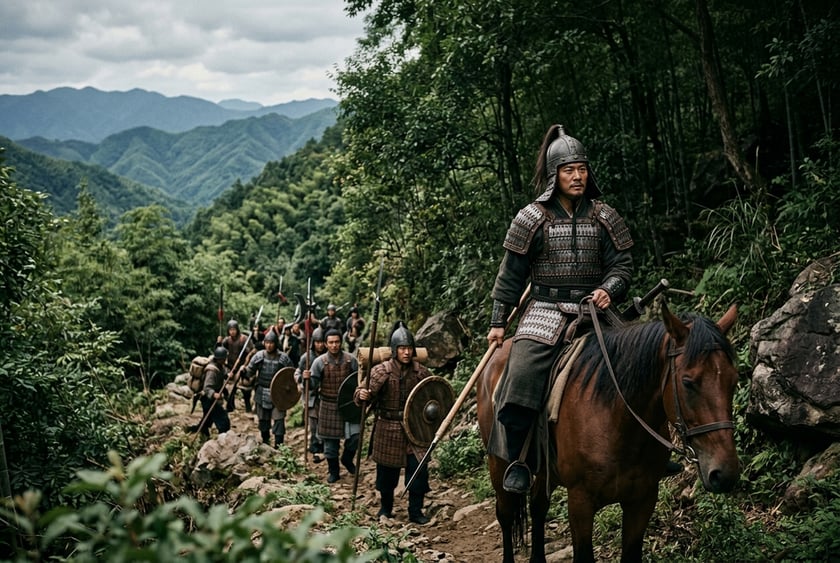
Ganningbaiqijieying in the novel's narrative was only a strike force of one hundred cavalry, but its tactical value was not low. Gan Ning first shared food and drink with his hundred subordinates, intending through the communal feast ritual to establish a covenant of fighting to the death; they set out at the second watch, each man's helmet adorned with white egret feathers to identify one another in night combat. This detail of "unable to distinguish the enemy clearly, but needing to identify one's own men clearly" addresses a real pain point of night raid operations; the novel's narrative detail at this point has considerable tactical authenticity. On the Cao side, Cao Cao's central camp was formed by carts linked end to end into a circular fortification with cavalry positioned at intervals along the perimeter to prevent surprise attacks — this was the standard night-defense configuration of the Cao main army's central camp, which held an overwhelming advantage against conventional regular-force assaults.
Critical Decision Points
The critical decision of this engagement lay not in the surprise attack process itself but in the timing of choosing when to withdraw. Gan Ning's hundred cavalry, though they broke into the Cao camp, found the linked-cart central defense making it impossible to reach Cao Cao directly; pressing deeper meant being encircled and annihilated, while withdrawing immediately would leave only the limited battle trophy of "no heads taken." Gan Ning's choice was the middle course: repeatedly hacking at the outer perimeter of the central camp, creating internal chaos and misapprehension within the Cao forces — "making noise and shouting, raising fire like stars, with great shouts that shook the earth" — making the Cao forces unable to tell how many enemies there were and throwing them into self-inflicted disorder. This tactical thinking of "frightening a hundred for every ten harmed" was the standard approach of Sunwu's sharp-spear commanders: using small-scale high-frequency disruptions to achieve the effect of "psychological warfare outweighing attrition warfare." In the end Gan Ning cut his way out through the south gate; Sun Quan ordered Zhou Tai to lead troops to receive them, and the full unit returned to Ruxu with no losses.
Outcome and Reverberations
The practical combat gains of the hundred-cavalry raid were not the number of enemy commanders killed or the number of encampments broken, but three forms of intangible assets: (1) Sunwu's military morale — after setbacks on the main battlefield, obtaining a clear "fighting small against large" narrative that could be publicly announced to the entire army; (2) psychological deterrence against the Cao forces — the Cao troops "feared there were ambushes and dared not pursue", meaning that for a period thereafter the Cao forces maintained high alertness toward Wu night movements, indirectly slowing the overall offensive tempo of Cao operations; (3) Gan Ning's reputation as a commander — Sun Quan afterward praised him: "Mengde has Zhang Liao; I have Gan Xingba," placing this raid alongside the Battle of Xiaoyaojin, creating the image balance of "two strong armies facing each other, each with their sharp-spear general." This reputation asset was repeatedly cited in the later Three Kingdoms period and constitutes the core component of Gan Ning's status as a celebrated general.
Counterfactual Analysis
Had Gan Ning chosen to charge hard at the linked-cart formation to attempt a killing blow on Cao Cao, the hundred cavalry would certainly have been wiped out; even if by some chance the assassination attempt failed, it would have cost Wu a body of elite troops and a key renowned general — a net loss. Conversely, had Sun Quan not arranged for Zhou Tai's reception force, the hundred cavalry would very likely have been ambushed and annihilated on their way back; this shows that the raid tactic was essentially a two-step operation of "surprise attack plus reception," with neither step alone sufficient to determine victory or defeat. It should be noted that the precise geographical location of this raid (Hefei or Ruxukou) and its timing (215, 217, or 213) are not entirely consistent across different texts; the novel repurposed the same tactical narrative in Chapter 68 for Ruxukou (event 326), creating the awkward overlap of "one passage, two events." This drift of historical narrative attribution reflects that the hundred-cavalry raid was more like a "signature episode" repeatedly cited in references, with its precise historical facts requiring judgment after integrating the various historical sources. But regardless of attribution, this tactical form — using a ritually organized small-scale force of death-pledged warriors to disrupt an enemy main force at night — was genuinely one of the common methods employed by Sunwu during the prolonged standoff at Hefei and Ruxukou.