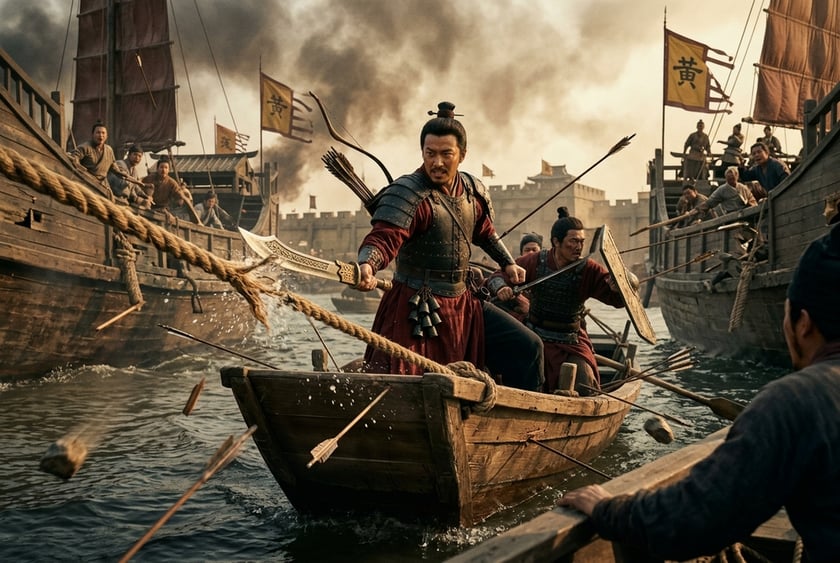
Strategic Background
The siege of Mayi in the second year of Taihe (228) came at a delicate moment when Caowei's northern frontier strategy was caught between overall retrenchment and the need to maintain deterrence beyond the passes. Since the end of the Eastern Han, the effective line of control along the northern borders of Bingzhou had shifted southward multiple times: during the reigns of Emperors Huan and Ling, the administrative seats of Yanmen, Dingxiang, Yunzhong, and Wuyuan had one by one moved inland, leaving the old Han commanderies that had once controlled the steppes south of the Yin Mountains as empty titles. During the Jian'an era Cao Cao had crushed the Wuhuan and resettled the Southern Xiongnu, but against the true steppe powers — the Xianbei tribes east of the Tuoba and west of the Yuwen — he could only resort to the indirect strategy of playing barbarians against barbarians, propping up the weak to check the strong. Ke Bineng was at that point in the critical phase of consolidating the Xianbei tribes: he was fluent in Chinese, imitated Han military conventions in his use of flags, drums, and command structure, and simultaneously acquired economic resources and prestige through raiding and market trade, rapidly rising from a mid-ranking tribal chieftain to the de facto overlord of all the eastern Xianbei. Caowei's Protector of the Wuhuan, Tian Yu, had been garrisoned for years along the Changping–Yanmen line and remained highly vigilant toward Ke Bineng's proto-unification trajectory, repeatedly bolstering the minor tribes of Suli and Mijia to check him; for his part, Ke Bineng sought a campaign-scale victory to intimidate his rivals and incidentally eliminate Tian Yu, the most troublesome frontier official he faced. Mayi — modern Shuozhou in Shanxi — sits north of Yanmen Pass along the upper Sangganhe, the throat of Bingzhou's northern defenses; once lost, there would be no barrier left to a southward drive on Taiyuan or an eastward probe into Youzhou.
Disposition of Forces
The forces actually available to Wei were extremely limited. Tian Yu led the headquarters troops of the Protector of the Wuhuan garrisoned at Mayi, composed mainly of local Bingzhou garrison soldiers and subordinate Wuhuan units, with no depth; their function was more like a frontier "outpost and dispatch center" that kept dispersed patrols in normal times and could concentrate for defense only in emergencies. The Protector of the Xiongnu, Qian Zhao, was stationed in central Bingzhou with an equally modest force, but his years of managing affairs around Xihe and Taiyuan had already integrated the Southern Xiongnu chieftains and the tributary Wuhuan into Caowei's command structure, allowing rapid mobilization of allied contingents. The Xianbei on their side presented the classic steppe army of "large numbers, loose command": Ke Bineng's core cavalry numbered several thousand, with tens of thousands more from allied tribal contingents; their greatest advantage was mobility and numbers, their greatest weakness the ability to supply themselves and sustain a prolonged siege. Ke Bineng chose to besiege Mayi rather than strike directly at Yanmen in order to use the small city as bait to draw Wei's mobile forces out through the passes and destroy them in the open — a classic "besiege one point, ambush the relief." Tian Yu saw through this intention and did not come out for a decisive engagement; instead he held within Mayi's fortifications and left the final judgment to Qian Zhao in the rear.
Critical Decision Points
The key question for Qian Zhao's relief mission was not whether to go — mutual relief between frontier commanders was nearly an institutional obligation — but at what pace, by what route, and where to strike. A direct thrust to Mayi and a head-on clash with the Xianbei would inevitably see Wei's small mixed infantry-cavalry relief force surrounded and destroyed by superior Xianbei cavalry; a methodical flanking attack on Xianbei rear-area tribes to relieve by counter-pressure would delay relief until Tian Yu exhausted his provisions. Qian Zhao's choice was "flanking maneuver plus feigned strength": he led his own troops up the Sangganhe valley, rallying pro-Wei tribes outside the passes along the way and generating through dust clouds and camp smoke the impression that the relief force was far larger than it actually was; at the same time he sent small cavalry detachments to harass the livestock and baggage wagons of the Xianbei outer grazing groups, forcing Ke Bineng to divert forces to protect his rear repeatedly. Ke Bineng's confederate army was not a monolith — the tribal warriors participating in the siege genuinely cared about plunder profits rather than strategic objectives — and once their nomadic herds and families came under threat, centrifugal force appeared immediately. Qian Zhao seized precisely this inflection point on the "cost curve of steppe alliances," forcing Ke Bineng into a position of being compelled to lift the siege and withdraw while he had not yet taken Mayi and the main Wei relief force had not yet actually engaged in battle. This was a frontier tactical case study in substituting psychology and maneuver for frontal decision battle.
Outcome and Reverberations
Lifting the siege of Mayi mattered to Caowei far beyond the scale of the battle itself. In the near term, Tian Yu preserved a critical stronghold on the northern frontier, and Qian Zhao dissolved a major crisis at low cost; the two men subsequently continued their partnership as the primary managers of northern frontier affairs through the reign of Emperor Ming of Wei, forming a dual-track structure of "Tian Yu as mobile commander within the passes, Qian Zhao as liaison and factional manipulator beyond them." In the medium term, although Ke Bineng's main force suffered no attrition, the fact that "a major assault on Wei forces had come to nothing" cost him prestige in the ongoing process of consolidating the Xianbei tribes, and sowed the seeds for Wang Xiong, governor of Youzhou, later sending Han Long to assassinate Ke Bineng in 235 — had this siege not exposed the fragile nodes of the Xianbei confederation, the Wei court might not have dared to use the all-or-nothing gamble of assassination to end a steppe leader still at his peak. In the long term, the siege of Mayi established the keynote of Caowei's northern frontier policy of "defense as strategy, no light talk of crossing beyond the passes," standing in stark contrast to Caowei's emergency mobilization in Guanzhong and Longxi at the same time in response to Zhuge Liang's Diyicibeifa: the southern front absorbed the full national effort in an attritional struggle, while the northern front needed only two or three frontier generals and local allied contingents to maintain stability. This asymmetric allocation of strategic resources was the invisible pillar that allowed Caowei to sustain its advantage in a three-front war over the long term.
Counterfactual Analysis
Had Qian Zhao failed to arrive in time and Mayi fallen to Ke Bineng, his most probable next step would not have been a southward raid on Taiyuan — that would have put him in direct contact with Caowei's central army, a net loss — but rather leveraging "the fall of Mayi" as a battle trophy to attract the Tuoba, Yuwen, and other tribes into submission, accelerating the Xianbei consolidation process by three to five years. By that point Caowei on the western front was already straining alone against Zhuge Liang and could spare no troops to look northward, making the most likely response a grant of official titles and honorifics to Ke Bineng, tacitly acknowledging his de facto status as "Great Chanyu of the Xianbei" and converting the northern frontier problem from a military problem into a tributary-management problem. Conversely, had Tian Yu rashly come out to engage Ke Bineng frontally and Qian Zhao's relief force pressed forward on the conventional direct route, Wei would most likely have lost two frontier commanders in one engagement outside Mayi — a situation similar to the repeated near-disasters on the northern frontier during the Huangchu era before Tian Yu had arrived to take up his post — but at a higher cost, since by this time Caowei no longer had a second cohort of senior commanders who knew the Xianbei that could serve as replacements. Viewed through these two counterfactuals, Qian Zhao's approach of "counter mobility with mobility, counter psychology with psychology" was the only solution available under those conditions that could both lift the siege and avoid consuming frontier capital.