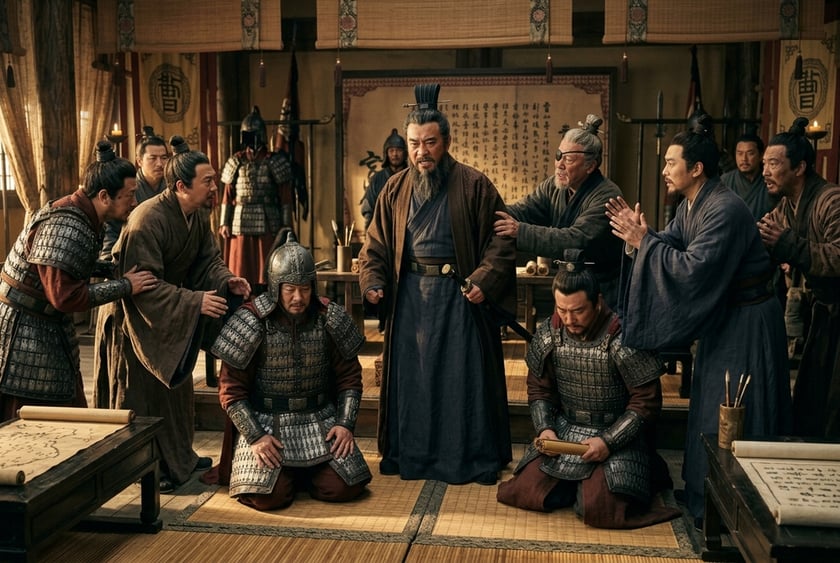
Background
In the chaos of the late Han, the lords of the Central Plain were consumed by the struggle for supremacy, and the Xianbei, Wuhuan, and Southern Xiongnu beyond the Great Wall seized the moment to migrate inward and grow in strength. Though Cao Cao dealt the Wuhuan a crushing blow at Liucheng in the twelfth year of Jian'an (207), the Xianbei tribes had not suffered heavily; over the following six decades they rose steadily. After Caowei came to power, the core threat on the northern frontier was no longer any single tribe but the great Xianbei confederacy centered on Ke Bineng — whose influence reached eastward to the Liaoxi region and westward to Bingzhou, pressing in an arc around You, Bing, Dai, and Yan. Caowei inherited the Han practice of "using barbarians to check barbarians" and systematized it, developing a frontier bureaucratic structure in which the Protector of the Wuhuan, the Colonel Who Protects the Xiongnu, and the inspectors of Bingzhou and Youzhou coordinated with one another. Qian Zhao and Tian Yu were the representative figures of this structure during the reigns of Emperor Wen and Emperor Ming.
Key Figures
Qian Zhao came from a humble background, had been a man of principle from youth, and had been on good terms with Liu Bei during the time he served under him; he later joined Cao Cao's camp. Under Emperor Wen of Wei he served as Protector of the Wuhuan, stationed for long periods at Youbeiping. He was not merely a fighting general but an official with a vision of "frontier governance": establishing military farming colonies, purchasing grain at stabilized prices, and absorbing surrendering tribes — extending pure military suppression into an integrated framework of "military, economic, and demographic" governance. Tian Yu, like Qian Zhao, was a representative capable official on the northern frontier in this period; he was more austere and strict in discipline, and during Cao Pi's reign was appointed Protector of the Wuhuan and Inspector of Bingzhou, confronting Ke Bineng directly over many years. The two men's collaboration was not without tension — the boundaries of their jurisdictions were clear and their offices did not subordinate the one to the other — yet both understood they faced the same adversary, and that fighting dispersed engagements would only allow them to be picked off in turn. Qian Zhao's decisiveness in "crossing jurisdictional lines to relieve Mayi" exemplified the professional soldier's weighing of "procedural compliance" against "actual victory." Ke Bineng was the most talented Xianbei leader of this phase: he excelled at using Sinicized methods to unite his people — keeping accounts in Chinese characters, bringing in Han craftsmen, modeling his troop formations on Han armies — and was one of the figures in northern Asia after the Xiongnu's decline most capable of forming a major polity.
Core Issues
The central issue of Caowei's Caoweibeijiangjinglve was "how to maintain long-term frontier stability with limited resources." Its strategies were fourfold. First: prop up the weaker and check the stronger — preventing Ke Bineng, Budugeng, Suli, and Mijia from ever allowing any single tribal chief to grow powerful enough to unite all the Xianbei. Second: use the political asylum of harboring defecting tribes to sustain pro-Wei factions within hostile groupings over the long term. Third: develop military garrisons rather than civilian counties — the military colonies at Yanmen, Mayi, and Daijun resolved the supply difficulties of long-range campaigns. Fourth: for the most threatening adversaries, employ "decapitation" — commissioning an assassin, Han Long, to lure and kill Ke Bineng, avoiding the cost of full-scale warfare. This combination was a relatively low-cost, high-efficiency frontier solution for the San Guo period, embodying the pragmatist principle that "the art of governance values subduing the adversary without battle."
Political Consequences
First: the Xianbei tribes fell back into disunity after Ke Bineng's death and could not form a unified grand confederacy for the next fifty years, allowing Caowei and the Western Jin to concentrate their attention on dealing with Shu and Wu in the south. Second: the Qian Zhao and Tian Yu model was inherited by the early Jin period, but the Western Jin rulers reduced their fiscal investment in the frontier, and large numbers of inward-migrating barbarian peoples were settled in the heartland regions of Bing and Yong, ultimately erupting in retaliation during the Yongjia Catastrophe. Viewed in retrospect, Caowei's policy had the advantage of maintaining clear, three-layer defenses of "Great Wall — military garrisons — heartland," whereas Western Jin was precisely the regime that blurred this boundary. Third: Qian Zhao and Tian Yu, having served for many years on the northern frontier — "not in the prominent positions of the central government" — were unable to enter the core of the regency council after Emperor Ming died; this was a latent structural weakness in Caowei's central personnel system. Those who were steadfast abroad were not necessarily capable of checking internal power-holders — a factor indirectly linked to the subsequent rise of the Simashi.
Counterfactual Analysis
Had Caowei failed to effectively contain Ke Bineng during the 220s to 240s, allowing him to complete the unification of the Xianbei tribes, the Wei northern frontier would have been confronted by a formidable adversary on the scale of the later Rouran or Turks; the strategic equilibrium among Wei, Shu, and Wu might have been broken accordingly. With Caowei compelled — while Sima Yi was directing its strategy against Shu — to simultaneously divert large numbers of troops northward, the pressure from Zhuge Liang and Jiang Wei's northern campaigns might have eased, making it not entirely out of the question for Shuhan to have gained a few extra years or even endured considerably longer. Conversely, had Caowei continued after 233 to sustain the budget and personnel support of the Qian Zhao and Tian Yu model and avoided settling barbarian peoples in the heartland, the barbarian-Han tensions in the early Western Jin period might have been delayed, and the Yongjia Catastrophe of actual history might not have arrived with such ferocity. Caowei's Caoweibeijiangjinglve can be seen as a model of frontier governance by an ancient Chinese agrarian regime that was "low-cost, long-cycle, and reliant on institutions rather than heroes" — its experiences and lessons were still being invoked continuously down through the Tang and Song dynasties.