Strategic Background
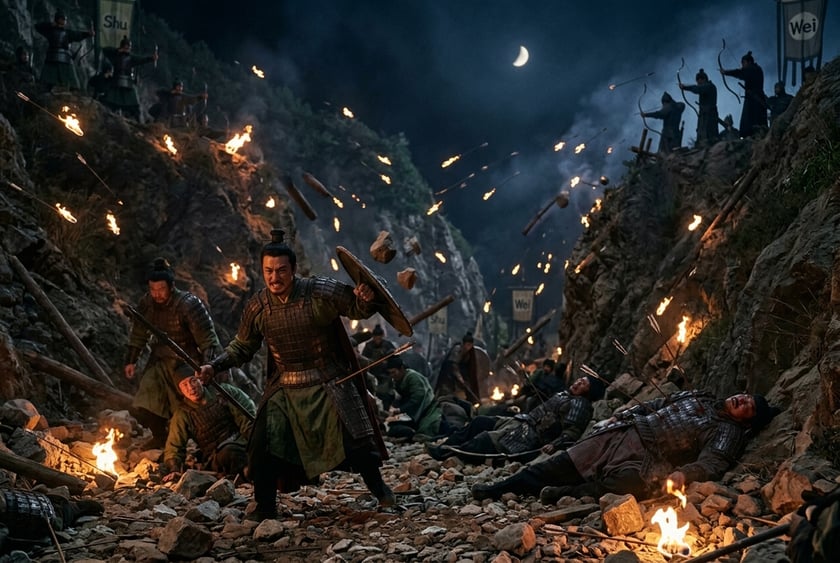
The flooding of the Seven Armies in the twenty-fourth year of Jian'an was not an isolated tactical miracle but a structural climax in the eleven years of sustained pressure that the Sun-Liu alliance had been applying against the southern rim of Cao Cao's Central Plains since Chibi. Liu Bei had just repelled Cao Cao in the Battle of Hanzhong and advanced to the title of King of Hanzhong; across the whole Jingxiang axis the strategic center of gravity had slid from "defensive holding" toward "coordinated northern advance," and Guan Yu, holding the rank of General of the Front and the authority to act in his own discretion, exercised full discretionary command of the Jingzhou theater [c:17155]. From Caowei's perspective, Fancheng was the throat through which the Central Plains opened into the Han River basin; if it fell, Xudou would be directly exposed to attack from the Hanshui direction. The reason Cao Cao, having failed in his personal campaign in Hanzhong, still dispatched Yu Jin's central army southward was precisely that he regarded Fancheng as the last screen he could not afford to surrender. But looking at the force disposition, Caowei's main strength was simultaneously tied down in Hanzhong, Huainan, and Yongliang, leaving only a mobile force of "Seven Armies" scale capable of heading south to relieve Fancheng — and this predicament of "fighting fires on four fronts" was the deep background against which the flooding of this battle became a catastrophe [c:17152].
Deployment
Guan Yu's northern-campaign army was composed primarily of Jingzhou elite troops, with a river navy as its core advantage: the Jiangling-Gongan line had long been developed under his command, allowing him to deploy naval forces anywhere in the Hanshui basin at will [c:17155]. Cao Ren defended Fancheng and Lv Chang defended Xiangyang, the two forming a mutual anchor; Yu Jin and Pang De led the "Seven Armies" (approximately thirty to thirty-five thousand men by Wei order of battle) southward in reinforcement, planned to set up camp ten li north of Fancheng on higher ground to form an interlocking inner-outer defense [c:17160]. Notably, the Caowei deployment clearly underestimated the hydrological risk of the Han River's autumn flood — Yu Jin's encampment happened to be in the low-lying river valley near Zenglou River, where the difference in elevation between the flat ground and the river surface was minimal [c:17161]. This deployment error stemmed partly from northern commanders' unfamiliarity with the water conditions of the Han River basin and partly from the tactical pressure Cao Ren felt to have the relief force advance and form a suppressive screen with Fancheng. Pang De himself, because his elder brother Pang Rou was in Shuhan, was suspected by colleagues; finding himself in an awkward position, he adopted the most aggressive stance of all, with the attitude of "if I do not kill Yu, Yu will kill me" [c:17154].
Key Decision Points
The decisive variable in the flooding was weather, but several decision nodes amplified that variable. The first was Yu Jin's refusal to move camp. When rain had been falling for days, the supervising general Cheng He had already noticed the low terrain and the danger from the Han River, and explicitly urged a withdrawal of troops; Yu Jin refused and rebuked him for disturbing the army's resolve [c:17162]. This decision reflects the tendency of Caowei central-army commanders to "execute the original deployment" rather than adjust to battlefield variables — a classic case of institutional rigidity. The second was Pang De's independent judgment being overridden: Pang De agreed with Cheng He's assessment and was prepared to move camp on his own the following day, but did not have time to act before the flooding arrived [c:17162]. The third was Guan Yu's naval preparation. Whether this flood was natural or had human assistance, the detail that Guan Yu had "prepared boats and rafts and gathered water equipment" in advance demonstrates that his Jingzhou-system forces possessed a structural advantage in water warfare that allowed them to immediately convert a flood disaster into an offensive operation the moment it occurred [c:17161]. The fourth was Cao Cao's choice of response: with Fancheng already in danger, he abandoned the plan of "directly shifting the main force south" and instead adopted Sima Yi and Jiang Ji's roundabout strategy of using Wu to strike Guan Yu's rear, transferring the resolution of the battle from the Hanshui front to the lower Yangtze [c:17155]. This decision looks like a passive improvisation on the surface, but in substance it converted the Fancheng crisis into an opportunity to fracture the Sun-Liu alliance — a winning move at the highest strategic level.
Outcome and Legacy
The flooding of the Seven Armies directly caused the surrender of more than thirty thousand troops under Yu Jin, the capture and execution of Pang De, and near collapse of Fancheng [c:17152] [c:17154]. The short-term effect was "Guan Yu's power shook all under heaven" — the bandits of Liang, Jia, and Luhun south of Xudou received Guan Yu's seals and titles from a distance [c:17155]; Cao Cao even seriously considered relocating the capital to avoid the onslaught. But in the medium and longer term, this great victory actually became the trigger for the collapse of the Shuhan Jingzhou group. For one, Sun Quan, long resentful over the refusal of a marriage alliance and additionally affronted by Guan Yu's contemptuous treatment of Wu's envoys, had already been incubating a motive to reverse the situation; the flooding of the Seven Armies convinced Sun Quan that "if Guan Yu gets his way, he will certainly not forgive us" — driving him to secretly negotiate with the Administrator of Nanjun, Mi Fang, and the garrison commander of Gongan, Shi Ren [c:17155]. For another, Xu Huang under Cao Cao's coordination led multiple waves of relief forces to advance; after reaching Yancheng he constructed a great trench as a feint while secretly assaulting Sizhe, finally routing Guan Yu's advance troops east of Yanglingbo — the only counterattack node at which Caowei regained its footing after the flood [c:17153]. Third, after Lv Meng's Baiyidujiang captured Jiangling, Guan Yu's army had its "wives and children all taken prisoner, soldiers scattered and dispersed"; every strategic dividend accumulated through the flooding was reversed within two months. Working back from the outcome, Shuiyanqijun was the pinnacle of Guan Yu's martial career and the inflection point of Shuhan's Jingxiang strategy [c:17155].
Counterfactual Analysis
Had Yu Jin heeded Cheng He's counsel during days of continuous heavy rain and moved camp in time to higher ground, the flood might not have caused total army annihilation — given the Seven Armies' formation strength and the mobility of northern cavalry and infantry, even abandoning camp and retreating north would not have handed Guan Yu's navy the windfall of "thirty thousand surrendered troops," and Cao Ren's Fancheng defense line could have held. Had Guan Yu, after his great victory from the flooding, actively withdrawn to protect Jiangling, leaving Lv Meng a fully intact defensive perimeter, Sun Quan might not have dared to truly tear apart the alliance; at the very least, the Baiyidujiang model of surprise assault would not necessarily have succeeded against a Jiangling at full garrison strength. Going one layer deeper: had Cao Cao rejected Sima Yi and Jiang Ji's strategy of using Wu to strike the rear and instead directly shifted the main force recalled from Hanzhong eastward to relieve Fancheng, then while the flooding had caused heavy losses, the Sun-Liu alliance would not have fractured and the San Guo balance might have maintained the equilibrium of "Wei weakened, Wu and Shu mutually supporting" for a considerably longer time. History in the autumn of year 219 chose a different road — one autumn flood on the Han River reshaped the entire strategic geography of the Three Kingdoms.
Counterfactual Analysis
Another more imaginative fork: had Pang De's independent judgment not been overridden by Yu Jin, and had he successfully moved camp on the eve of the flood and in fact used the vanguard's position to rescue the remnants of Yu Jin's force when the flooding struck — Caowei's central army would not have collapsed as a formed unit, Guan Yu could not have generated the public-pressure effect of "power shaking all under heaven," and Sun Quan might not have been able to make up his mind to "sever the alliance and seize Jing." Pang De's death therefore carries a double meaning — it is simultaneously the personal pinnacle of a martyr's valor and a miniature portrait of the rigidity pervading Caowei's southern relief mechanism. Only by grasping this can one truly understand why the San Guozhi author chose to pair Yu Jin and Pang De side by side, writing the same flood as two fates and two institutional nervous systems laid out as clinical specimens for comparison [c:17154].