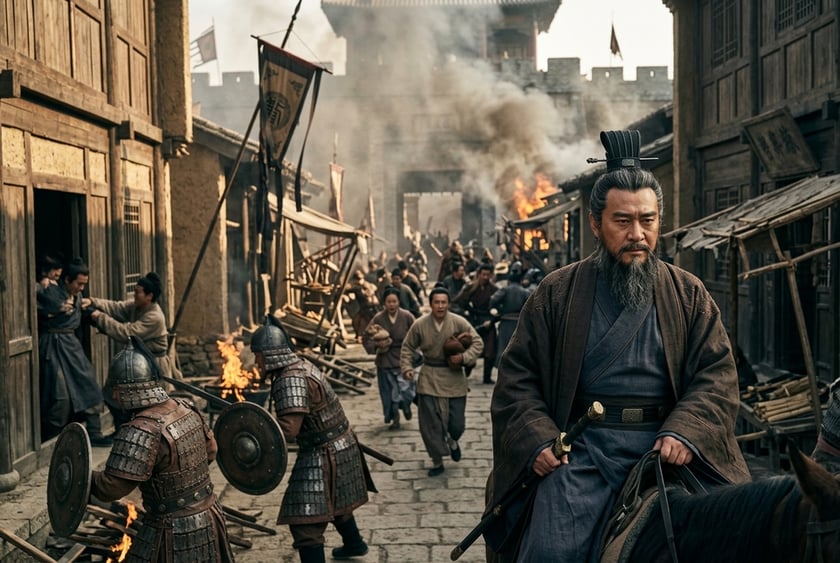
Strategic Background
The year 231 saw Zhuge Liang's fourth northern campaign (Disicibeifa). In this campaign the Shuhan army deployed a newly devised "wooden ox" transport system along the Qishan route, and near Lucheng it routed the main Wei force personally commanded by Sima Yi — making this the tactically most successful of all Zhuge Liang's northern offensives. Yet the fundamental constraint on Shuhan never changed: logistics. Li Yan, the Central Protector-General responsible for supervising the supply line, falsely reported that the rains blanketing Longxi had made grain deliveries impossible and could not continue, phrasing the message with the authority of an imperial order demanding that the army withdraw. Upon receiving this report at the front, Zhuge Liang was compelled to abandon a tactical situation he had already prised open, and the entire army turned south. The Battle of Mumendao took place in the final stretch of this forced retreat.
Deployments
On the Wei side, Sima Yi led the main force from Shangyi to Lucheng, then after the defeat at Lucheng fell back to a posture of fortified defense. Zhang He, as Right General and the most experienced theater commander on the anti-Shuhan front, took several thousand infantry and cavalry and was assigned to pursue the southward-withdrawing Shuhan army. On the Shuhan side, Zhuge Liang personally led the main body south from Lucheng, moving along the Xi-Hanshui into the mountains at the southwestern corner of Tianshui commandery; Wei Yan commanded the van, Jiang Wei covered the rear, and multiple lines of ambush were laid on both sides of Mumendao. Mumendao is a narrow north-south gorge with steep slopes and dense forest on either flank — terrain familiar to the Shuhan troops and unfamiliar to Wei, shaped overall like a one-way funnel.
Key Decision Points
The critical decision in this ambush was actually made on the Wei side. Zhang He explicitly opposed pursuit, arguing that military law holds: "when besieging a city, always leave a way out; do not pursue a withdrawing army." After more than a decade fighting Shuhan on the western front, he knew well that Zhuge Liang excelled at setting ambushes and that withdrawal routes were especially dangerous. Sima Yi nevertheless insisted he advance. Two layers of logic lay behind this: first, after the defeat at Lucheng, Sima Yi urgently needed a "visible result" to rebuild his authority; second, Zhang He, as a former subordinate of Cao Zhen and the senior commander on the Shuhan front, had influence that posed a latent challenge to Sima Yi. Pushing Zhang He to the front of the pursuit was an outcome Sima Yi could accept regardless of whether it ended in victory or defeat. The Shuhan decision was far simpler — Zhuge Liang judged that Wei would certainly pursue, so he positioned concentrated crossbow forces in the highlands of Mumendao, exchanging the fewest troops for the greatest attrition.
Outcome and Echoes
After Zhang He's force entered the narrows of Mumendao, the Shuhan ambush troops fired down from the heights; Zhang He was struck in the right knee by an arrow and died of his wound. The Wei van disintegrated and the rear echelon pulled back; the Shuhan army continued its planned withdrawal to Hanzhong. From a tactical standpoint this was a textbook ambush — terrain substituted for numbers, arrow volleys substituted for a charge, and the death of a commander was traded for dominance of the front line. From a strategic standpoint the battle's impact far exceeded the battlefield itself: Wei lost the most experienced theater commander on the Shuhan front; Sima Yi's practical authority on the western front rose another notch, though for more than five years afterward he persisted in "hold firm and do not engage," in effect acknowledging that Wei's field forces could not match Zhuge Liang in open battle. Shuhan used the "highlight" of this ambush to ease the popular pressure from the setback of the failed northern campaign, and Li Yan's false report was exposed the following year, leading to his demotion to commoner status.
Counterfactual Analysis
The most interesting counterfactual is Zhang He holding to "do not pursue a withdrawing army." Sima Yi's full record of on-the-spot orders is not preserved, but his decision to have Zhang He attack alone while the main force remained behind its walls carries the hallmarks of "using another's hand." Had Zhang He refused to march, he himself might well have been impeached for insubordination — but Wei would not have lost a veteran theater commander, and Wei's command capacity on the Shuhan front would have remained intact longer, while Sima Yi would have been unable to use the western front reorganization to concentrate power so quickly. Conversely, had Zhuge Liang failed to see through Li Yan's false report in time and held on near Lucheng for a while longer, the fourth campaign might have achieved further territorial gains — but the Mumendao ambush would never have occurred, and Zhang He would not have fallen at that moment. What makes a single ambush historically significant is often not the casualties it directly inflicts, but that it permanently fixes the balance of power within the opposing camp and locks in both sides' tactical posture for years to come.