Background
This sortie of the fifth month of the fifth year of Ganlu (260) was the last active strike mounted by a Caowei emperor against a powerful minister. Cao Mao had ascended the throne in 254 at the age of fourteen — selected by Sima Shi as replacement after deposing Cao Fang. Sima Shi had assumed the boy-emperor would be young and easy to control, but over six years Cao Mao increasingly displayed extraordinary political judgment; official histories record that he was "in talent the equal of Chensiwang [Cao Zhi], in martial spirit in the mold of Taizu [Cao Cao]." With Sima Shi's death in 255, Sima Zhao succeeded as Grand General and tightened the suppression of imperial authority still further. In private settings, Cao Mao complained repeatedly that "the heart of Sima Zhao is known to every passerby" — a remark that in itself foreshadowed the eruption of the fifth month of 260: the final confrontation between a young emperor who knew defeat was certain yet struck out anyway, and a powerful minister's faction that had long since arranged the framework for succession.
The Course of Events
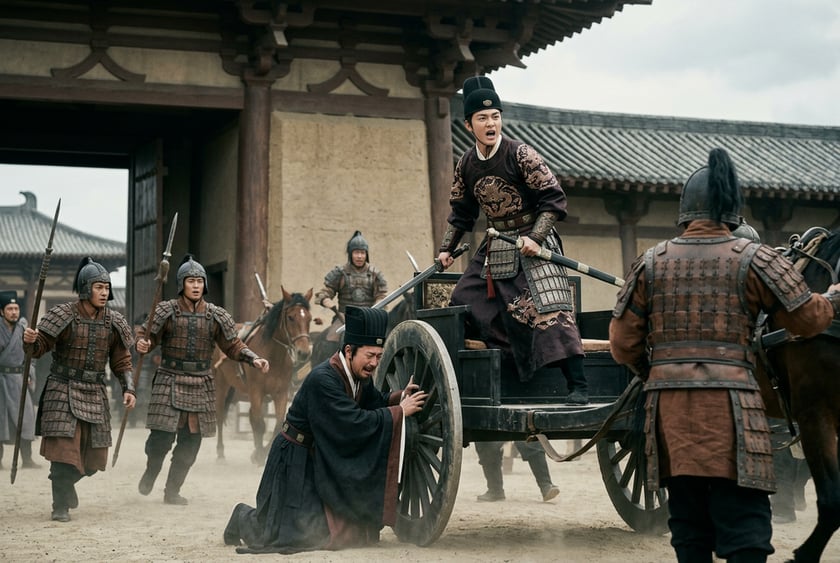
In the fifth month of the fifth year of Ganlu, once Cao Mao had made up his mind, he ordered his escort Jiao Bo to urgently assemble the palace garrison troops and steward-boys totaling more than three hundred men, then himself took up his sword, mounted his carriage, and shouted at those around him as he headed straight for the Southern Gate. The critical point of this action was the posture of "leading in person" — the emperor personally holding a sword, personally mounting a carriage, intending to use the supreme symbol of imperial authority to draw out any potential sympathizers within the palace. Yet the one who actually appeared before the carriage was not a supporter but the Secretary Wang Jing. Wang Jing flung himself before the carriage in tears and remonstrated forcefully, his judgment utterly clear: "Your Majesty is leading several hundred men to attack Zhao — this is no different from driving sheep into a tiger's maw; it will only result in death to no purpose". He then added that he was not pleading from cowardice but rather arguing from strategic feasibility that the move was unworkable. Cao Mao's reply was categorical: "My army has already marched — you must not obstruct it," and he continued toward the Dragon Gate. This brief exchange condensed the sharpest conflict in imperial Chinese politics between "moral duty and practical reality": Wang Jing represented pragmatic rationality; Cao Mao represented nominal legitimacy. Both men saw the outcome clearly, yet made diametrically opposite choices.
The Decision's Outcome
Cao Mao's carriage did not make it to the Dragon Gate; it was intercepted outside the Southern Gate of the palace city by the palace troops led by Jia Chong. Jia Chong, as Sima Zhao's core confidant, had already been instructed beforehand to "act decisively when the situation demands it." Under Jia Chong's explicit order, his subordinate Crown Prince Palace Attendant Cheng Ji drove his spear forward and stabbed Cao Mao to death beneath his carriage; Cheng Cui followed immediately after. This is one of the rare cases in Chinese history of "an emperor being killed in the open street by his own subjects." The event itself shattered every political taboo. On hearing the news, Sima Zhao publicly performed shock and grief, forcing the Cheng Ji and Cheng Cui brothers to serve as scapegoats who were executed with their three degrees of kin, while Jia Chong and Sima Zhao himself escaped without a hair harmed. Wang Jing, for having known of the plan in advance, was subsequently executed by Sima Zhao along with his mother.
Historical Impact
The impact of this event on the political history of Caowei and on the political ethics of Chinese civilization was profoundly far-reaching. First, it completely destroyed the sacred character of the Caowei imperial throne — a clearly designated Son of Heaven was killed in the open air at the gate of his own palace by his own palace troops, and the perpetrators were merely punished at the mid-to-lower officer level, meaning that imperial authority was no longer an object demanding anyone's reverence. Second, it accelerated the dynastic replacement process — five years later Sima Yan accepted Cao Huan's abdication and encountered virtually no substantive resistance from either the imperial clan or the outer court; Cao Mao's death had objectively "cleared the field" of the last psychological trump card held by the opposition. Third, from the perspective of political ethics, Cao Mao's choice has been debated at length by historians across the ages — his decision to strike out knowing defeat was certain has been viewed both as a heroic model of "giving one's life for the dynasty" and as a negative example of "recklessness and poor judgment." In his "Ode to Righteous Spirit," Wen Tianxiang cited instances of loyal martyrs — "the teeth of Zhang Suiyang, the tongue of Yan Changshan" — while Cao Mao was not directly listed, yet the spiritual underpinning of his "death before submission" belongs to the same source. Finally, for the Sima clan, the stain of regicide became the original political sin of the Western Jin that could never be entirely washed clean, exerting a long-term influence on the Jin dynasty's legitimacy narrative; it was repeatedly raised after the Yongjia Catastrophe and became a latent structural problem in the Eastern Jin "restoration" narrative.