Background
This event and the parallel event Mingdidaxinggongshi overlap extensively in time and personnel, but the emphasis differs — the latter focuses on Cao Rui's construction decisions and the specific unfolding of the engineering projects, while this event focuses on the debate, remonstrance, and consequences that repeatedly surfaced at court in response to those decisions. Over more than ten years spanning Taihe (227–233) to Jingchu (237–239), Emperor Ming of Caowei successively built Chaoyang Hall, Taiji Hall, Chonghua Hall, Qingxiao Tower, Phoenix Tower, and Nine-Dragon Pool, and at the start of Jingchu initiated projects with a strongly immortality-seeking character — including dismantling the Beiliang Terrace's bronze figures and casting the Wengzhong statues and copper dragon-phoenixes. Running in parallel was the court's repeated pattern of Confucian-minister remonstrance, forming two intertwined political threads: the pace of construction and the pressure of open counsel.
Key Figures
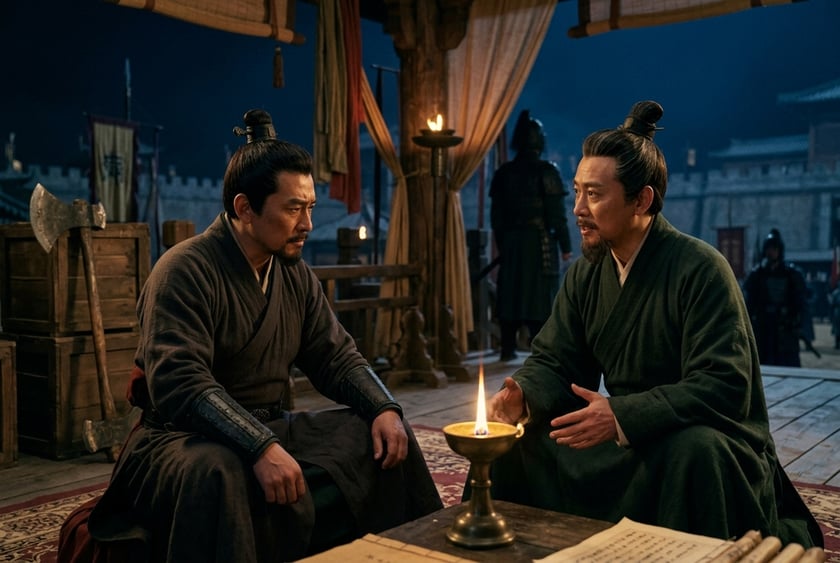
Cao Rui is the center. His handling of the "palace construction controversy" shows a clearly graduated pattern — "more lenient at the start, increasingly harsh later": when Dong Xun submitted his first memorial he was reduced to commoner status; when Zhang Mao submitted a second memorial he was executed the same day [preceding event c:16963]; thereafter Yang Fu, Gao Tanglong, and other veteran Confucian ministers continued to submit memorials citing "inauspicious phenomena" and "ritual norms," but Cao Rui stopped publicly reproaching them while also stopping his responses. The essence of this strategy was "using a descending cost curve of punishment to precisely sort the remonstrating group into 'still pardonable' and 'must now be silenced.'" Yang Fu, Tutor of the Heir Apparent, was the representative remonstrator of this period. After the Jingchu dismantling of the bronze figures, he submitted a memorial of sharp exhortation, citing "Han Wudi sought immortality but could not avoid growing old" and forcefully arguing that "from towering terraces and soaring parapets one cannot commune with immortals." Gao Tanglong, as an Erudite of the Grand Academy in charge of canonical rites, participated in remonstrance year after year in the mode of "reporting inauspicious phenomena to the throne" — this is the continued and archetypal expression of the Six Dynasties Confucian tradition of "using celestial phenomena and floods and droughts to argue about governance." Ma Jun was the chief engineer of the projects. During the dismantling of the Beiliang Terrace he encountered strange phenomena — "the bronze figures shed tears," "a mad wind blew sand and stones, the terrace tipped and columns fell, crushing more than a thousand people to death" — and even beneath the romance's dramatizing brush, these records convey the intense public unease toward this engineering program.
Core Issues
The first issue was the tension between "ritual norms and imperial power." Wei was founded on "inheriting the Han system," and the Confucian minister community held the ritual narrative and continuously supplied interpretations of imperial legitimacy. Cao Rui, through palace construction and the pursuit of immortality, shifted the source of imperial legitimacy from "the classics and ritual propriety" to "auspicious omens, immortals, and the mandate of heaven" — a fundamental transfer of discursive authority. The Confucian ministers' remonstrance was a resistance to this transfer. The second issue was the trade-off between "short-term imperial victory and long-term institutional attrition." By processing Dong Xun and executing Zhang Mao, Cao Rui suppressed the wave of remonstrance in the short term, but simultaneously severed the channel of political communication between the imperial power and the Confucian minister community — this is a distant cause of the complete absence of anyone to argue for the imperial house on the eve of the Gaopinglingzhibian. The third issue was the dual significance of the "physical constructions" as both material works and political symbols. Dismantling the bronze figures, casting the Wengzhong statues, and lining them up outside Sima Gate — physically this was a cross-city transport project; politically it was the most direct declaration of "self-divinization by appropriating Han Wu's artifacts." Cao Rui attempted to position himself, by "inheriting Emperor Wu's divine spirit," as the most capable ruler since the Han's Emperor Wu — but this violated the political taboo established at Caowei's founding of "Han is the previous dynasty, not to be held up for comparison."
Political Consequences
First: the Confucian minister community under Emperor Ming of Caowei, through repeated jousting with imperial power, gradually formed a political culture of "staying silent to protect themselves." Sima Yi exploited precisely this silence to obtain the court's general acquiescence when he launched the Gaopinglingzhibian in the first year of Jiaping (249). Second: the "immortality-seeking projects" exhausted Cao Rui's political capital. After the bronze-figure affair his health declined progressively; in the first month of the third year of Jingchu (239) he lay critically ill and entrusted his successor to regents. From the "more than a thousand crushed to death" in the engineering works to the emperor's own early death, public opinion naturally converged on "seeking immortality failed and shortened his own years" as the final verdict. Third: the remonstrance memorials of Yang Fu and Gao Tanglong became model texts for later Confucian ministers "arguing governance through ritual." Their influence far exceeded the reign of Emperor Ming himself — the memorials arguing against palace construction and against the pursuit of immortality in the Jin and Song dynasties onward almost all repeat Yang Fu's argumentative structure. Fourth: this event and the parent event Mingdidaxinggongshi together transformed Wei from "the strategic breathing space after Zhuge Liang's death" into "a period of internal institutional attrition" — alongside the parallel Liaodong Gongsun Yuan rebellion (the second year of Jingchu) — constituting the final exhaustion of the political capital of Cao Rui's reign.
Counterfactual Analysis
Had Cao Rui stopped the projects after Dong Xun's first memorial and responded to the Confucian ministers' remonstrance with a self-reproaching edict, the court's political atmosphere would have been significantly different — the channel of communication between imperial power and the Confucian minister community would have been preserved, and the condition of "court silence" that Sima Yi later needed to launch his coup would have been greatly weakened. A second counterfactual: had Cao Rui deferred the immortality-seeking projects until after completing clearer regency preparations — given the landscape of Jingchu with Gongsun Yuan already pacified and Zhuge Liang already dead, Wei had ample time to arrange things without haste. But Cao Rui chose to invest the brief strategic window entirely in projects like "the dew-basin to seek immortality" that could yield no return, rapidly burning through the imperial power's political credit. History has him choosing the fastest path of exhaustion, transforming "the palace construction controversy" from an internal court debate about ritual propriety into a landmark event of imperial institutional decline — and this is the fundamental reason why ministers like Yang Fu, who "lost to imperial power" on the surface, in substance "won the right to historical judgment."