Origins
The Zhonghuizhiluan had three overlapping causes. The first was the explosion of Zhong Hui's personal ambition: in the campaign to conquer Shuhan he had received Jiang Wei's surrender and absorbed the Shuhan surrender forces, and at one point commanded more troops than Deng Ai — he possessed the material conditions to make himself independent ruler of Shu [c:16933]. The second was Sima Zhao's wariness toward the simultaneous inflation of both Zhong Hui and Deng Ai: after moving against Deng Ai he immediately titled Zhong Hui Minister over the Masses, dispatched Wei Guan to supervise both armies, and personally camped at Changan — this sequence of moves led Zhong Hui to judge that "I am already under suspicion, and my avenue of retreat has been cut off" [c:16934]. The third was Jiang Wei's encouragement: drawing on the fresh energy of Shuhan's recent fall, he painted for Zhong Hui a vision of "if we succeed we take all under heaven; if we fail, retreating to western Shu is no worse than being Liu Bei" — a two-pronged fallback that pushed Zhong Hui's hesitation past the tipping point [c:16934]. Structurally, this was a revolt simultaneously triggered by multiple pressures, not an isolated act of individual adventurism.
Participating Forces
The main force of the rebellion was Zhong Hui's core personal troops and the Shuhan surrender forces commanded by Jiang Wei; the opposition consisted of the Wei generals who had been coerced into signing their assent and harbored deep doubts — Hu Lie and his son Hu Yuan were the key representatives [c:16935]. Wei Guan, as Sima Zhao's supervising officer, was nominally in a middle position but was in practice the one who finally ended the revolt; Qiu Jian, a confidant of Zhong Hui who nonetheless sympathized with Hu Lie, was the critical node through which intelligence leaked [c:16935]. In terms of the balance of forces, while Zhong Hui nominally held command, he lacked firm control over the morale of the troops — the very fact that he had to coerce the generals into signing betrayed that the army's heart had never truly gone over to him, and this was the structural weakness that doomed the revolt.
Critical Turning Points
The revolt's decisive turn came at two moments. The first was when Qiu Jian obtained a secret letter from Hu Lie, relayed the message to Hu Yuan, and on that basis launched a counterattack on the eighteenth day of the first month [c:16935]. The reason this intelligence channel could exist at all was that Zhong Hui had failed to vet his inner circle for political reliability at the most critical moment — he had assigned a person with prior ties to Hu Lie to handle the trivial task of "delivering water and food," in effect opening an intelligence leak with his own hands. The second turning point was Jiang Wei's sudden heart seizure and collapse just as he was preparing to move and eliminate the generals, leaving the critical orders unissued [c:16936]. From a purely military standpoint, had Jiang Wei been in good health and executed the plan to kill the generals on schedule, the revolt might have stabilized the situation for a short time; but structurally, even a brief stabilization would have left a massive question mark over whether the people and troops of Shu could sustain long-term support for a Zhong Hui regime that had "slaughtered all the Wei generals."
Suppression and Outcome
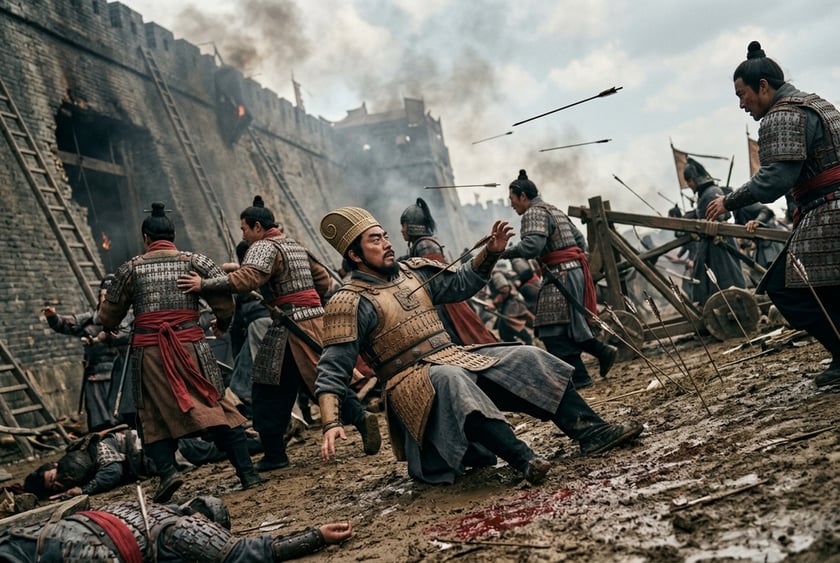
At noon on the eighteenth of the first month, Hu Yuan and Wei Guan jointly launched their counterattack; shouts erupted outside the palace, and soldiers converged from all directions without limit [c:16936]. Zhong Hui ordered his soldiers to mount the palace roof and pelt the attackers with roof tiles; dozens died in the fierce fighting, fires broke out on all four sides outside the palace, and outside troops hacked open the palace gates. Zhong Hui drew his sword and personally killed several men before finally being brought down by a volley of arrows. Jiang Wei drew his sword and charged back and forth across the hall, but his heart seizure worsened; raising his face to the sky he cried, "That my plan did not succeed is the will of Heaven!" and killed himself, aged fifty-nine [c:16936]. Several hundred people died inside the palace, and Jiang Wei's family members were also entirely exterminated. Wei Guan then turned to deal with Deng Ai — he dispatched Tian Xu to pursue and kill Deng Ai and his son at Mianzhu, just after they had been released, on the grounds that "if I leave him alive I will have no place to be buried" [c:16936]. This suppression accomplished three things within twelve hours: eliminating Zhong Hui, wiping out Jiang Wei, and settling accounts with Deng Ai — all potential political dangers from the Shu campaign cleared away at once.
Historical Resonance
The historical resonance of the Zhonghuizhiluan was extremely far-reaching. First, it utterly ended the last possibility of Shuhan's restoration: Jiang Wei's death meant the final military pillar of the Shuhan regime had broken, and the Shu territory passed directly into Jin administration from that point forward. Second, it allowed Sima Zhao through the "Wei Guan cleanup" model to successfully rid himself of the potential threat of "generals whose achievements overshadow the sovereign" — both of the top commanders from the Shu campaign, Deng Ai and Zhong Hui, were eliminated together, further consolidating the Simashi's centralized power. Third, it left the founding politics of the Jin dynasty an important lesson: allowing a commander in a distant expedition to acquire excessively independent military authority is dangerous — this lesson was reflected repeatedly in the Western Jin founder's treatment of meritorious subjects. Fourth, Jiang Wei's dying words — "That my plan did not succeed is the will of Heaven!" — became a classic symbol in later narratives of loyalty and righteousness; his strategy of attempting to avenge Shuhan indirectly by "instigating Zhong Hui's rebellion" earned his image in both the novel and official historiography a high evaluation of "utterly faithful to his duty." From a broader perspective, this uprising was the true final movement of the San Guo era — the last great strategist of the three kingdoms and the most ambitious of the Caowei veteran ministers fell together, and the San Guo story from that point entered the age of reunification.