Strategic Background
From late in the eighteenth year of Jian'an into the nineteenth, Liu Bei's Yizhou campaign entered a period of stalemate. After Pang Tong was killed at the Luocheng front, Liu Bei's main force hit a bottleneck and urgently needed reinforcements from the Jingzhou direction to push upriver and complete the encirclement. The three-pronged advance of Zhuge Liang, Zhang Fei, and Zhao Yun was a standard "divide and pacify the commanderies" approach orchestrated by Zhuge Liang — before the main force drove straight at Chengdu, the eastern half of Yizhou's commanderies had first to be brought in one by one, cutting off Liu Zhang's avenues of retreat and resupply. Zhang Fei's column was responsible for the Bajun direction, with Jiangzhou as the objective. [c:16911] Jiangzhou lay at the confluence of the Jialing and Yangtze rivers — the eastern gateway into Yizhou — and whoever controlled Jiangzhou controlled the key water-and-land junction of access from the upper Yangtze into the Chengdu plain.
Disposition of Forces
In terms of numbers, Zhang Fei's contingent was an elite mobile corps pushing upriver: not large, but well-trained and at peak morale; Yan Yan's garrison was the local defense force of Bajun, five or six thousand men who had not fought a major engagement in years. In terms of commander quality, Yan Yan was a renowned Shu general — old but with undiminished energy, skilled with a powerful crossbow and a great blade, and above all deeply hostile toward Liu Bei's entry into Shu from the start; his lament of "sitting alone in a rugged mountain and bringing a tiger in as one's own bodyguard" had long made clear he would not submit easily. [c:16913] The romance builds on this foundation by giving Yan Yan an additional tactical concept — deep ditches and high ramparts, exploiting Zhang Fei's impatient temperament to let the attacker expose his own vulnerability. [c:16913] In contrast: Zhang Fei prioritized speed; Yan Yan prioritized attrition — the clash of rhythms could not have been sharper.
Critical Decision Points
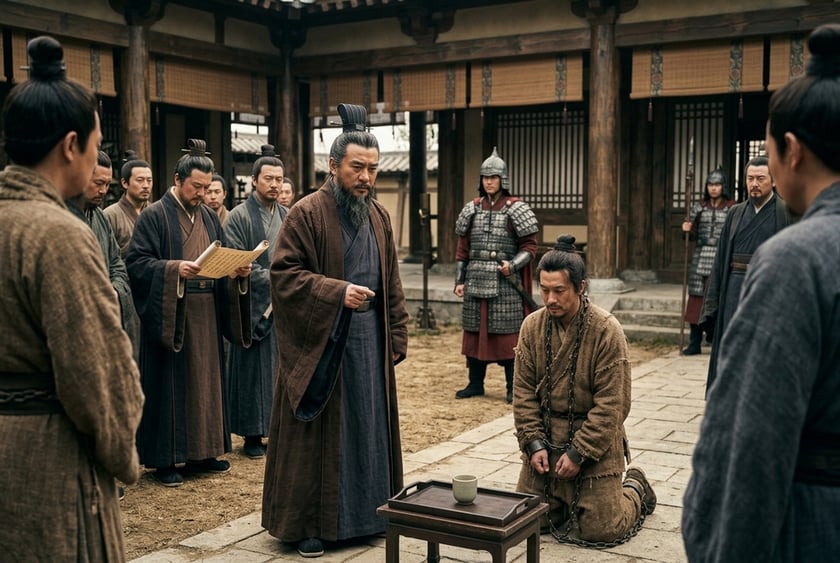
The romance constructs this battle as a multi-decision-point narrative. The first decision is Zhang Fei's tactical switch, after repeated failed assaults and being struck on his helmet by an arrow from Yan Yan on the walls, to a strategy of "fake woodcutting, real reconnaissance" — converting his aggressive exterior into a tool for luring the enemy. [c:16914] The second is setting up a double ambush of "fake Zhang Fei as the vanguard, real Zhang Fei as the rear force," [c:16915] with the signal being a retreat gong rather than a battle drum — a precise reversal of conventional tactics, flipping upside down Yan Yan's expectation of "drum signals the attack." The third is the choice of how to handle the prisoner after capturing him alive: Zhang Fei spares him and treats him with courtesy. [c:16911] From a tactical standpoint, the first two decisions reveal Zhang Fei as a commander rather than a brute; the third is the critical leap that converts military victory into political capital. These three layers of decision together elevate "the Battle of Jiangzhou" from a simple siege operation to the political template for the Shuhan Yizhou campaign.
Outcome and Resonance
The battle's result was the capture of Bajun and the taking and repatriation of Yan Yan as a guest. The official histories cover all of this in a single sentence, but the resulting chain reaction is plainly visible: Zhang Fei "fought his way through," linked up with Liu Bei at Chengdu, and with his column in place the Yizhou campaign rapidly moved to the final decisive phase. [c:16911] The romance dramatizes this chain further into the surrender-by-dispatch-of-letter of forty-five passes. [c:16917] From the standpoint of institutional legacy, the path by which Shuhan subsequently absorbed Shu-born generals such as Wu Yi, Li Yan, and Wu Lan under a framework of "treating surrendered generals with respect" can be traced back to Zhang Fei's handling at Jiangzhou. In terms of command reputation, the Battle of Jiangzhou is the independent engagement in Zhang Fei's operational record that modern historical commentary regards most favorably, because it simultaneously delivered tactical, political, and personal-transformation value across three levels.
Counterfactual Analysis
Had Zhang Fei chosen to attack Jiangzhou by conventional means — relying on numbers and valor to storm the walls directly — given Yan Yan's determination to hold and Bajun's terrain, the capture might have taken months; Zhang Fei's main force would have been pinned at the Jiangzhou line, unable to link up with Zhuge Liang and Zhao Yun on schedule, and the rhythm of the entire Yizhou campaign would have been disrupted — giving the Liu Zhang side time to counterattack in the Luocheng direction. Had Zhang Fei chosen to execute Yan Yan after capturing him alive — the natural reaction given his fierce temperament — the gentry of Shu would have received the negative demonstration that "surrender equals death," and the task of pacifying Yizhou would have been extremely difficult. The true value of the Jiangzhou battle lies not in the gain or loss of a single city, but in demonstrating that Zhang Fei could substitute wit for force at the tactical level and substitute courtesy for killing at the political level. These two-fold transformations together elevate this campaign to the highest-return operation of the Yizhou campaign in cost-benefit terms. It is worth adding that the divergence between the official histories and the romance on this battle is extreme: the historical Zhang Fei has only the restrained version of "admiring his integrity and releasing him"; the romance extends it into a complete narrative of stratagem, ambush, and surrender engineering — an expansion that is itself an act of creative rewriting in service of the Shuhan "governance through virtue" story.