Strategic Background
The Hefei campaign of the twentieth year of Jian'an was the pivotal moment in the prolonged tug-of-war between Cao Cao and Sun Quan along the Huainan front after Chibi. Cao Cao's main force was at the time driving west toward Hanzhong, leaving Zhang Lu yet to be subdued and Xudou lightly garrisoned; the Huainan screen consisted of nothing more than seven thousand defenders under three generals — Zhang Liao, Li Dian, and Le Jin. Sun Quan, his wound from the fall of Wancheng still fresh, keenly perceived a rare strategic vacuum on the northern line and led a personal expedition of one hundred thousand troops northward, intending to break through Huainan at a stroke and compress Caowei's strategic depth in the south. Viewed in full strategic context, had Sun Quan taken Hefei, he would have been able to push his bridgehead north of the Yangtze forward by a hundred li and directly threaten the heartland of the central plains, forcing Cao Cao into a binary choice between Hanzhong and Huainan. This form of strategic extortion — striking east while feinting west — was Sun Quan's consistent playbook against Cao Cao; but he underestimated Cao Cao's capacity for advance planning even while on campaign: one lacquered box and one sealed order were enough to lock in the defending trio's entire tactical approach.
Disposition of Forces
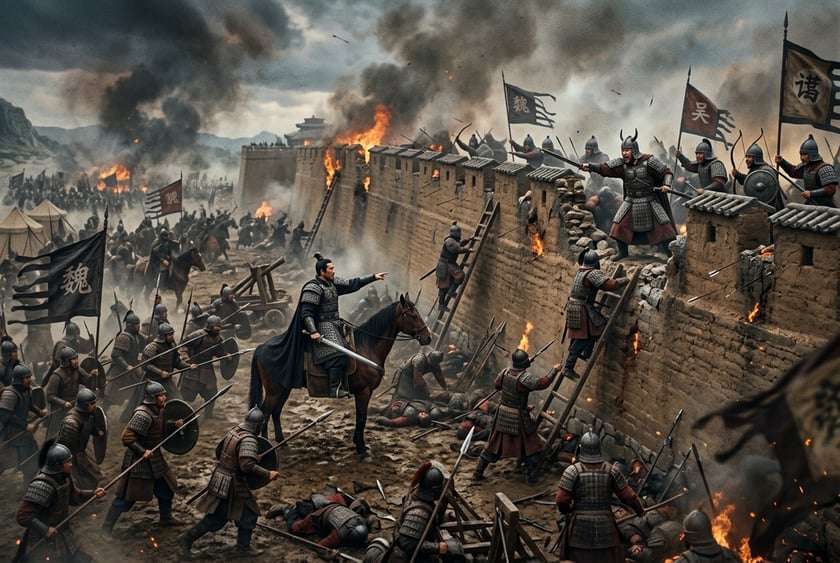
On the Caowei side, the configuration was the classic "few against many, combining defense with attack." Zhang Liao served as the spearhead, Li Dian as support, and Le Jin as the garrison defender — a division of labor both precise and clean. Cao Cao's sealed order pinned decision authority firmly in the hands of the offensive faction: strike first at the outset, blunt the enemy's edge, then shift to a defensive posture. This arrangement was extraordinarily shrewd — it preempted the three generals' instinctive drift toward passive defense given the disparity in numbers, and guarded against their well-known personal incompatibility producing discoordination in the field. The Eastern Wu side deployed in the mass-formation, steamroller style typical of a large corps: one hundred thousand troops advancing along multiple axes, relying on numerical superiority to press against the walls of Hefei and expecting to compel the garrison to surrender through siege and attrition, without anticipating that Wei forces would turn from defense to offense. In raw numbers Wu held an absolute advantage of more than seven to one; but topographically, the Xiaoyaojin area was laced with waterways and the crossing points were narrow, well suited to rapid strikes by small elite forces and ill-suited to the deployment of a large corps.
Critical Decision Points
The entire battle had three decision nodes. The first was Zhang Liao's "pro-offensive" stance upon reading the sealed order — rather than choosing the passive defense that was the instinctive response of most generals facing such odds, he seized the window before the Wu army had completed its encirclement and its formation was not yet steady, and overnight assembled eight hundred volunteers for a dawn surprise attack. The second was Zhang Liao's extremely bold decision to charge personally into Wu's central command formation and drive toward Sun Quan's headquarters — a classic "decapitation strike" logic: not expecting to rout one hundred thousand troops, but making the Wu leadership see firsthand the ferocity of Wei's edge, thereby breaking their morale. This approach demanded extraordinary personal valor from the commander, and Zhang Liao's prior battlefield record was sufficient to underwrite the wager. The third was the rearguard action at Xiaoyaojin during Sun Quan's retreat, when Zhang Liao pressed the pursuit and Sun Quan was saved only by the fierce last-stand of Gan Ning, Ling Tong, and others. Wu's tactical-level failure to produce a counterpart capable of checking Zhang Liao's momentum exposed a command weakness inherent in Sun Quan's "personal-command" system: many generals, few commanders.
Outcome and Resonance
The battle's outcome was Sun Quan's one-hundred-thousand-man army checked and repulsed by seven thousand defenders, its morale shattered, forced to withdraw north. Chen Wu was killed in action; Song Qian's and Xu Sheng's contingents briefly routed; Sun Quan himself narrowly escaped capture. In the short term, Caowei's Huainan defensive line was consolidated, and Cao Cao on his return from Hanzhong faced no need for reactive redeployment across two fronts. Over the long term, the battle created a sustained psychological pressure on Jiangdong — the phrase "Zhang Liao is coming, stop your crying" became a symbol of terror among the Wu people, and Sun Quan's subsequent northern campaigns all broke against the walls of Hefei; even in his old age he never broke through this line. The battle also established Zhang Liao's status as the foremost of the Five Elite Generals and made the collaborative model of Li Dian and Le Jin in the aftermath a template for Caowei commanders working in concert — Cao Cao himself repeatedly cited "Zhang Liao's Battle of Hefei" as an internal cautionary exemplar.
Counterfactual Analysis
Had Sun Quan adopted a more cautious, step-by-step approach — first consolidating his camp before completing the encirclement of Hefei — Zhang Liao's surprise attack would have been far less effective; in a siege, the seven-to-one troop advantage should have been overwhelming. Conversely, had Zhang Liao not acted on the sealed order to go out and fight but instead chosen to hold the gates shut, the Wu army would in all likelihood have compelled Hefei to surrender within a month or two through cutting off food and water; Cao Cao returning from Hanzhong would have faced a Huainan already lost, and the entire strategic configuration of the late Jian'an period would have been rewritten. The true deciding factor in this battle was not the force ratio but the difference in each side's commander's judgment on the question of "initiative" — Cao Cao's sealed order institutionally nailed the word "initiative" into Zhang Liao's hands, while Sun Quan's reckless advance handed the initiative straight to the other side. Seen from this angle, the Battle of Xiaoyaojin is better described not as a victory of Zhang Liao's valor but as a strategic victory of Cao Cao's long-range remote command.