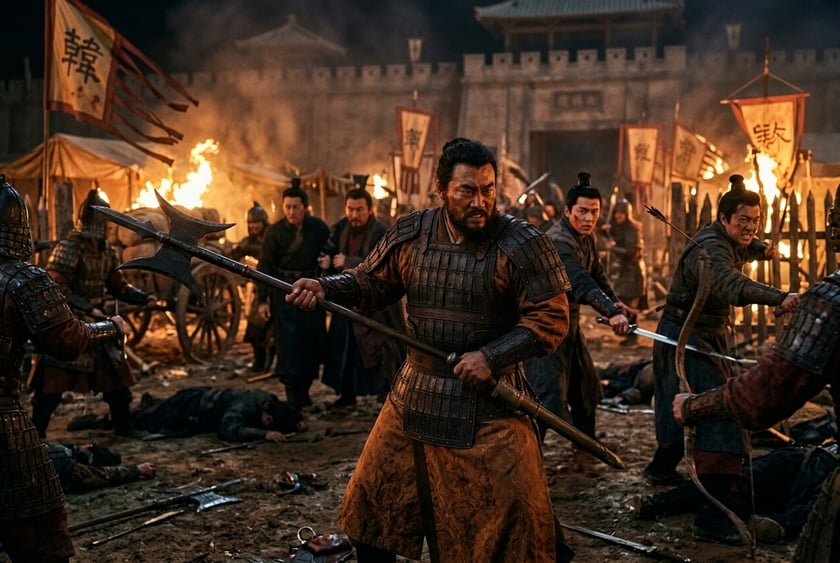
Background
In the fourth year of Jian'an (199), the political configuration of the realm was on the eve of a direct confrontation between Cao Cao and Yuan Shao. Yuan Shao had by then already pacified Gongsun Zan, held the four Hebei provinces alone, and was massing troops for a drive south; Cao Cao, though he controlled the central plains and Emperor Xian, was far weaker in troop numbers and faced potential threats from Liu Biao and Zhang Xiu on his southern flank. Zhang Xiu had engaged Cao Cao in two years of attritional fighting since the Wancheng night raid, with Cao Cao repeatedly campaigning against Wan while Zhang Xiu, guided by his chief strategist Jia Xu, repeatedly retreated and stood firm. In the winter of 199, before preparing to march on Xuzhou, Cao Cao accepted Kong Rong's advice to "first settle the southern front" — the deep winter was unsuitable for military action; better to pacify Zhang Xiu and Liu Biao by political means first, then deal with Xuzhou and turn attention to Yuan Shao. [c:16904] This window of opportunity was equally meaningful for Zhang Xiu: Yuan Shao was at the same moment dispatching envoys to draw him in, and Zhang Xiu had to choose between the two strongest powers.
Principal Figures
Zhang Xiu at this time held Wancheng with forces numbering in the thousands — a textbook "squeezed warlord" with neither sufficient strength to protect himself independently nor a natural advantage in selecting a patron. Jia Xu, as his chief strategist, had served Zhang Xiu's camp for several years and read the larger strategic picture with exceptional clarity. Liu Ye was sent by Cao Cao to Xiangcheng to negotiate the pacification; he went first to see Jia Xu — a critical procedural choice, since Jia Xu was the real decision-making center for Zhang Xiu. [c:16904] The fact that Cao Cao dispatched an adviser rather than a military commander as his envoy was itself an expression of sincere political intent: this was not intimidation, but negotiation. As for Yuan Shao's envoy, Jia Xu tore up his letter on the spot and sent him packing — a gesture that definitively locked in the direction of Zhang Xiu's submission to Cao Cao.
Central Issue
The political science question at the heart of this episode is: how do you make an adversary who personally killed your eldest son and beloved general willingly come over to your side? Jia Xu's reasoning is a textbook counter-intuitive analysis. He laid out for Zhang Xiu the logic of "three advantages in joining Cao Cao, three hazards in joining Yuan Shao": Cao Cao's weakness made him value every new general; Cao Cao's service to the Son of Heaven gave submission to him legitimacy; Cao Cao's ambition to unify the realm meant he was bound to forgive old grudges. Yuan Shao was the reverse on all three counts — his strength made him condescending to new defectors; his failure to serve the Son of Heaven meant submission lacked orthodox justification; and his narrow-mindedness meant he would eventually settle scores. Most critical was Jia Xu's read on Cao Cao's psychology: "If Lord Cao still harbored his old grudge, would he have sent me to broker friendship with you?" [c:16905] The envoy himself was the material evidence of sincerity. On Cao Cao's side the execution was equally precise — when Zhang Xiu came to make his submission, Cao Cao personally raised him to his feet and said "for small past offenses, hold no more grief," dismissing "the shame of Wancheng" with a single sentence. [c:16905] This gesture was a powerful signal to every fence-sitting force watching: follow Cao Cao, and the past stays in the past.
Political Consequences
Zhang Xiu's submission to Cao Cao produced four immediate layers of consequence. First, the most pressing military threat on Cao Cao's southern flank was lifted, allowing him to concentrate fully against Yuan Shao — a time window of critical importance for the victory at the Battle of Guandu. Second, Jia Xu entered Cao Cao's command staff and became the core adviser who would serve both Cao Cao and his son Cao Pi for years to come; his strategic wisdom at the Battle of Guandu, his cautious opposition before the Battle of Chibi, and his covert support for Cao Pi in the succession struggle were each of incalculable value. Third, Zhang Xiu himself fought with distinction at Guandu, was enfeoffed as Marquis Xuanwei, and had his food stipend increased by two thousand households — his transformation from "the man who killed Cao Cao's son" to "a meritorious subject of Caowei" was itself a living advertisement for Cao Cao's political brand. Fourth, Liu Biao, the leading figure of Jingzhou's power, lost the northern buffer of Zhang Xiu and could henceforth only defend against Cao Cao's direction, unable to pose any meaningful offensive threat.
Counterfactual Analysis
Had Zhang Xiu chosen to align with Yuan Shao — with his forces slender but his position pressing directly against Cao Cao's southern wing — a northward push from Wancheng in concert with Yuan Shao's main drive could have placed Cao Cao in a two-front war. The outcome at the Battle of Guandu might have been completely reversed, with Cao Cao possibly defeated by Yuan Shao in 200, and the San Guo balance of power might never have taken shape. Had Cao Cao shown even the slightest trace of old resentment when Zhang Xiu came to submit — greeting him coldly, or deploying Wancheng as a bargaining chip — Zhang Xiu, even if outwardly compliant, would have harbored doubts, and Jia Xu would never have committed himself wholeheartedly; Caowei's camp would have been deprived of one of its preeminent strategists. Cao Cao's acuity lay in his clear-eyed understanding that the political return of showing generosity to the man who killed his son — neutralizing the southern threat, recruiting Jia Xu, setting an example of magnanimity — far exceeded the personal satisfaction of airing old grievances. This calm calculation of costs and benefits is the fundamental distinction between Cao Cao and the ordinary warlord. Later historians have repeatedly cited Zhangxiujiangcao as a representative case of Cao Cao's philosophy of personnel management — not because the pacification was large in scale, but because it demonstrated a hard truth of wartime politics: hand the past to the ledger, and hand the future to reality.