Background
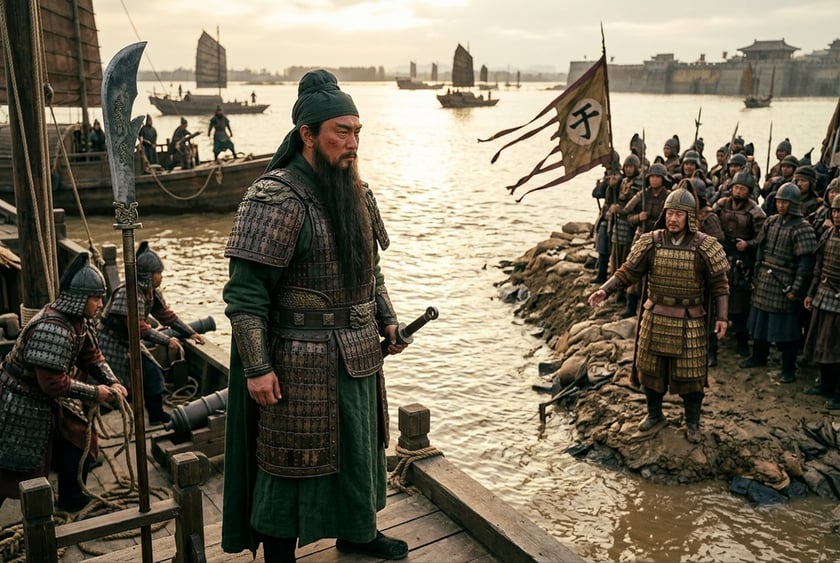
Yujinjiangguanyu appears on the surface to be a military defeat, but in essence it is the endpoint of a sixteen-year personal tragedy. In 219, Guan Yu's Guanyubeifa reached Fancheng; the Shuiyanqijun operation was a rare "natural-disaster-class victory" in Chinese military history — the Hanshui autumn flood coincided with the low-lying terrain of the Pingyuan outside Fancheng, and Yu Jin's main force was swiftly fragmented and isolated. Caught in the extreme situation of "surrender and live, or refuse and die," Yu Jin chose to surrender, while his subordinate Pang De chose death. This contrast became the standard reference case for all subsequent discussions of "loyalty and righteousness" versus "pragmatic accommodation." But the real political tension of the story lies not on the battlefield but in the aftermath: captured by Guan Yu and held in Jingzhou, Yu Jin then fell into the hands of Sun Quan when Guan Yu was defeated, and Sun Quan — by political calculation — returned him to Wei. What Cao Pi received was neither a "martyr who died for the cause" nor a "complete traitor," but an awkward intermediate state: an old general who was still alive, still potentially useful, but whose personal credibility had been entirely destroyed.
Key Figures
The central parties are three: Yu Jin, Guan Yu, and Cao Pi. Yu Jin held the highest status among the non-clansman generals of his generation in Caowei — within Cao Cao's military system he was the "embodied form of the law," having established his reputation by executing his surrendered friend Chang Xi, and having maintained strict discipline during the Zhang Xiu crisis to avert a collapse. He was granted the authority banner with arbitrary power. The reason his surrender shook all of Caowei was that it shattered the personal archetype of "Yu Jin = law admits no sentiment = will die before surrendering." Guan Yu's role in this affair was that of "personal judge" — treating Yu Jin well and executing Pang De were in themselves sharply contrasting political evaluations of the two men's character, and through those evaluations he indirectly humiliated Cao Cao's ability to read people. Cao Pi, for his part, was the "political auditor": his handling of Yu Jin represents a new dynasty's choice of posture toward veterans of the old order — do not execute him, but strip him of his honor, thereby sending a signal to all the "Cao Cao old guard" still in the government that the new dynasty demands new loyalty, not loyalty that has already been once compromised.
Core Issues
The true issue of this event is "whether one can resume office after losing one's moral integrity." In the political ethics of the transition from Han to Wei, moral integrity was the core political capital of the educated gentleman — but this was not absolute. Many eminent ministers, such as Xun Yu and Jia Xu, operated right at the boundary of "serving a new lord" without thereby being condemned. Yu Jin's special case was that his prior store of personal-character capital had been built on an extreme image of "law admits no personal sentiment," making the irony of his surrender far more devastating than it would have been for an ordinary general — a particularly brutal instance of self-contradiction. Cao Pi's handling of the situation thus incorporated a triple calculation: first, assigning Yu Jin to oversee Gao Ling (Cao Cao's mausoleum works) was giving him "a chance to live on the job"; second, preemptively painting the scene of Shuiyanqijun on the mausoleum walls was publicly exhibiting the ruins of his personal character — a "self-destroying assignment" from which he could not escape; third, the entire arrangement made the court officials understand that Cao Pi would neither uniformly purge Cao Cao's former generals (which would destabilize the ruling foundation) nor uniformly retain them without judgment (which would blur the new dynasty's identity), but would assess each individual case and assign status according to the quality of their moral integrity. This was very mature political management.
Political Consequences
The most direct consequence was that Yu Jin died not long afterward of shame and resentment — but that is only the surface layer. The second consequence was that fear of "surrendering" among Caowei generals was significantly intensified: in later campaigns at Xiangfan, Hefei, and Jieting, Caowei generals showed a notably greater willingness to die in place rather than surrender compared to generals of Eastern Wu or Shuhan, and the anti-model of Yu Jin was playing a role behind this. The third consequence was that the Guan Yu mythology was paradoxically reinforced: by having "Guan Yu's Shuiyanqijun" painted on the mausoleum walls, Cao Pi's original intent was to humiliate Yu Jin, but he inadvertently planted Guan Yu's image inside Caowei's imperial mausoleum art — this is one of the early cultural resources that contributed to Guan Yu's later deification as "Guan Sheng Dijun," the God of War. The fourth consequence was ideological: the contrast between Pang De's death and Yu Jin's surrender made "Pang De's death for the cause" a standard case in subsequent Chinese traditional education in loyalty and righteousness, while Yu Jin entered the comparative system of "loyalty biography" and "traitor biography" as the negative example "not to be emulated."
Historical Significance
Taking a longer view, the event of Yujinjiangguanyu marks a "self-refutation" within Cao Cao's military system — the military discipline built on the "backbone of law," constructed over thirty years, was broken in person by this most law-officer-minded of all his generals. This gives modern historians reason to question: can rule-by-law genuinely forge stable loyalty? Or do all external institutions ultimately need to rest upon internal moral choices? Yu Jin's story provides a negative answer — institutions can make men maintain discipline in wartime, but they cannot guarantee that men will hold their integrity when facing death. This caused successive generations of military and political thinkers through the Jin dynasties, the Northern and Southern Dynasties, and into the Tang and Song periods to return repeatedly to this case in thinking about the effective boundaries of "shaping a general's character." In modern management and leadership research, analogous questions have been reformulated: where is the boundary between institutional leadership and values-based leadership? Yu Jin's answer is tragic — but for that very reason, educational. A man who constructs his character out of law and rules will, the moment those laws and rules prove insufficient to sustain his choices, instantly lose his entire identity. This is perhaps the part of Yujinjiangguanyu most worth chewing over for the modern reader.