Final Circumstances
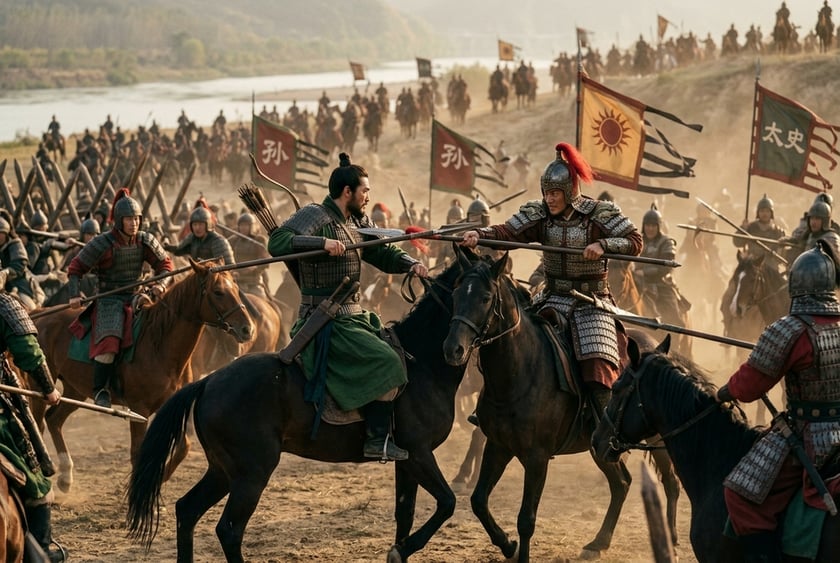
In the autumn of the twenty-fourth year of Jian'an (219), Guan Yu advanced north from Jiangling to besiege Fancheng. Cao Cao dispatched General of the Left Yu Jin to supervise seven armies marching south to reinforce the position, with Pang De serving as deputy commander. Continuous torrential rain around Fancheng caused the Han River to rise catastrophically, inundating Yu Jin's forces, which had been camped on low-lying ground — the entire army broke apart. Yu Jin's troops surrendered one after another. Pang De withdrew the remnant to defend an embankment, fired arrows until he had none left, then fought on with a short weapon until he was captured alive by Guan Yu's forces. Brought before Guan Yu, Pang De was severely wounded yet unbowed, refusing to salute. Guan Yu attempted to persuade him by pointing out that his elder brother Pang Rou was serving in Liu Bei's Hanzhong army. Pang De retorted that "the King of Wei commands a million armored troops whose might shakes all under heaven; what can Liu Bei do?" — and actively sought a swift death. Guan Yu, simultaneously moved by his fierce loyalty and wary that releasing him would cause problems, ordered him beheaded in front of Fancheng's battle line.
Final Words and Testament
What is most admired about Pang De in his final moments was not any particular speech but the totality of his conduct after capture: refusing to surrender, defying his captors, seeking death. The contrast with Yu Jin's conduct in the same battle — proactively removing his armor and surrendering en masse — is stark. Before the campaign, Pang De had brought a coffin along on the march to signal his intention to die in battle and had bidden farewell to his family. This advance ritual of "establishing a moral stand" made his defiance after capture logically coherent: the death-script he had set for himself was completed in full through a battlefield defeat. In the context of the Han-Wei transition, when "loyalty and righteousness" was becoming the public standard for evaluating military commanders, this ritualization of death carried a powerful political message — announcing to Cao Cao and to all under heaven that Pang De, a recently assimilated Xiliang general, was no less loyal to Caowei than any commander of the old guard.
Aftermath
When Cao Cao learned of Pang De's death, he wept, explicitly contrasting it with Yu Jin's surrender: "I have known Yu Jin for more than thirty years — how could I have imagined that at the moment of crisis he would prove inferior to Pang De?" Pang De's two sons, Pang Hui and Pang Shu, were enfeoffed as marquises, and the family continued to enjoy generous treatment under the later Caowei regime. Pang Hui, moreover, when Zhong Hui and Deng Ai extinguished Shu in the fourth year of Jingyuan (263), entered Chengdu and "exterminated the entire Guan clan" — an act that many later historians view as the family's settling of accounts for Pang De's death. This private vendetta line, spanning more than forty years, means that Pang De's death was not merely a personal episode but was embedded in a generational blood-feud narrative between the leading military families of the Wei and Shu powers.
Historical Assessment
Historical judgment of Pang De displays a striking pattern of "posthumous reputation far exceeding that in life." During his lifetime he was no more than a subordinate general under Ma Chao, and even after going over to Cao Cao his rank and position were unremarkable. Yet his unbending stance before Fancheng placed him in the first rank of the San Guo's loyal and heroic dead. Chen Shou in the San Guozhi groups him with Dian Wei, Xu Chu, and Yan Wen, emphasizing that he was "the bravest man in Ma Teng's army." Both later military scholarship and Confucian loyalty narratives have held him up as a touchstone — especially in contrast to Yu Jin, who "surrendered to the enemy after the seven armies were routed." On Guan Yu's side, killing Pang De was the signature achievement of the Northern Expedition at its peak, standing alongside the capture of Yu Jin and the shaking of the Hua Xia region. Yet four months later Lv Meng seized Jiangling, and Guan Yu himself was captured and killed by Eastern Wu during his retreat — in a sense Pang De's death and Guan Yu's death are separated by the briefest of windows and answer each other, forming the most dramatically charged death narrative in the San Guozhi. Structurally, all the key figures of Guanyubeifa — Guan Yu, Yu Jin, Pang De — ultimately had their fates rewritten by that autumn's rains.