Background
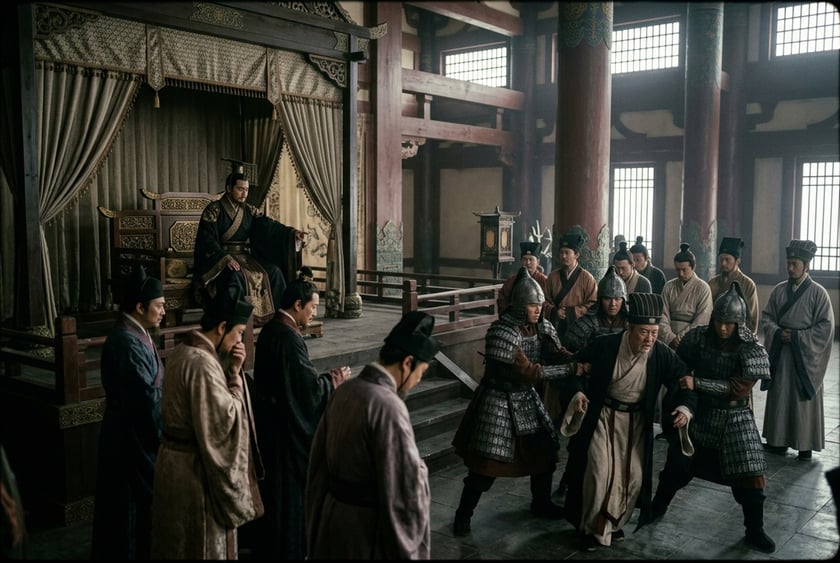
The Cuiyanan — Cui Yan's case — spanned roughly a decade of political life as its axis. In the early Jian'an years Cui Yan transferred from Yuan Shao's service to Cao Cao, who entrusted him with offices such as East Cao Aide and Secretary of State. Around the eighteenth year of Jian'an (213), when Cao Cao secretly sought views on succession, Cui Yan publicly stated his position supporting Cao Pi in a "露板 — open declaration" (a document meant to be a private memorandum but made public), which violated the taboo of an official with kinship ties intruding emotions into a public matter (Cao Zhi was married to Cui Yan's brother's daughter), yet on the grounds of the Confucian ethics of "appoint the eldest son" and the concrete assessment that "the Five-Office General is humane, filial, wise, and bright," he firmly advocated for Cao Pi and won Cao Cao's exclamation of admiration that he was "honest and upright." This open declaration in effect took a public stand, transforming Cui Yan from an ordinary counselor into a figurehead of the Cao Pi faction in the succession contest, and thereby earning the deep-seated resentment of Ding Yi and others in the Cao Zhi camp. The death-by-forced-suicide case that came three years later (216) arose precisely on this planted seed.
Key Figures
Cui Yan is the protagonist of the event, his political personality being "unyielding and stern, never flinching from confrontation" — a quality that was an asset at the succession milestone and became a fatal liability at the royal-elevation milestone. Cao Cao presents two completely different faces across the two periods: during the succession phase he regarded Cui Yan as a model of honest integrity, sighing in admiration; during the punishment phase his attitude was "fury that admitted no argument," proceeding from penal servitude to death by order with a cruelty that is hard to overstate. Ding Yi is the key figure in the hidden plotline — he was the core strategist of the Cao Zhi faction, harboring old grievances because Cui Yan's open declaration had supported Cao Pi, and exploiting the phrase "change will surely come" in Cui Yan's reply to Yang Xiu to file a denunciation, cashing in years of resentment in one stroke on the eve of the royal elevation. Yang Xiu is a secondary figure drawn into events — he had submitted a memorial praising Cao Cao; Cui Yan wrote to him intending to counsel against excessive flattery, and this letter became the trigger that detonated the case.
Central Issues
The Cuiyanan has two layers of central issue. The surface layer is the question of the boundary for establishing "speech crimes" — what Cui Yan wrote in a private letter was no more than an ironic comment on the prevailing atmosphere of the time, but it was extracted from context and reframed as a curse against the King of Wei. The deeper layer is the "crisis of role identity for pure-stream Confucian ministers in the process of a powerful regent's power upgrade." Cui Yan's open declaration on succession demonstrated his willingness to intervene in imperial succession through the Confucian ethics of "appoint the eldest" — he advocated for Cao Pi, but in essence was affirming that the principle of "succession by legitimate eldest" should not be subverted by affection. By the royal-elevation phase, Cui Yan most likely still wished to hold to his own ethical bottom line, but under a political climate of "Cao Cao demands unconditional support for the elevation from everyone," that bottom line would inevitably become an attack target. Ding Yi's choice of Cui Yan as the target for framing was not accidental — Cui Yan was "the standard-bearer of the pure-stream faction who dared to speak," and taking him down was equivalent to taking down the spokesman for pure-stream rhetoric.
Political Consequences
The political consequences of Cui Yan's death manifested simultaneously on several levels within the Caowei regime. First, the Cao Pi faction in the succession contest lost its most important "ally of moral legitimacy" — Cui Yan's open declaration supporting the succession had been the cleanest, most unassailable vote in the Cao Pi faction's favor, and after his killing Cao Pi temporarily lost a protective shield; the activity space of the Cao Zhi faction's Ding Yi, Yang Xiu, and others actually expanded — this situation was not reversed until the twenty-second and twenty-third years of Jian'an, when Yang Xiu and others made errors. Second, the pure-stream rhetoric of the Caowei advisory corps entered a period of rapid contraction — Xun Yu, Mao Jie, Cui Yan were in succession suppressed or executed; the remaining Confucian scholars mostly shifted to "practical and low-profile" postures, forming a stable coupling with the gradually Caowei-consolidated political structure. Third, the Cuiyanan, as an acknowledged miscarriage of justice, left a long-term indigestible political memory within Caowei — Chen Shou explicitly noted in the San Guozhi that "to this day he is most mourned and regarded as wronged," indicating that even decades later the scholarly community had never rendered a verdict on this case consistent with the official one.
Counterfactual Analysis
The counterfactual can be examined on two levels. First, if Cui Yan had not made the open declaration on the succession but instead stated his position privately, would he have avoided the death sentence three years later? Almost certainly he would have delayed it — but not avoided it. Cui Yan's role positioning — "willing to use public deliberation to intervene in imperial succession" — was itself in conflict with Cao Cao's logic of power upgrade, and sooner or later would have triggered a similar crisis. Second, if Ding Yi had not filed the denunciation against Cui Yan, would someone else have done so? The answer would almost certainly still be yes — the ironic allusion in Cui Yan's reply, in a political climate where "any ambiguity is read as opposition," was almost inevitably going to be exploited by someone; Ding Yi was simply the quickest to act. Taken together, the Cuiyanan was not an accidental execution of a single dissident by a single powerful minister, but a structural clearance of pure-stream rhetoric from inside the Caowei power-upgrade mechanism. Cui Yan's tragedy lay in the fact that there was simply no room for coexistence between his Confucian ethics and the new political order Cao Cao was constructing; as the representative of Eastern Han pure-stream scholar-officials in the process of Caowei-ization, he was inevitably going to be "sacrificed" — and alongside the contemporaneous Xunyuzhisi and Mao Jie's removal, his death together forms the complete sequence of "the pure-stream Confucian scholar faction being cleared out in the course of the Han-Wei dynastic transition."