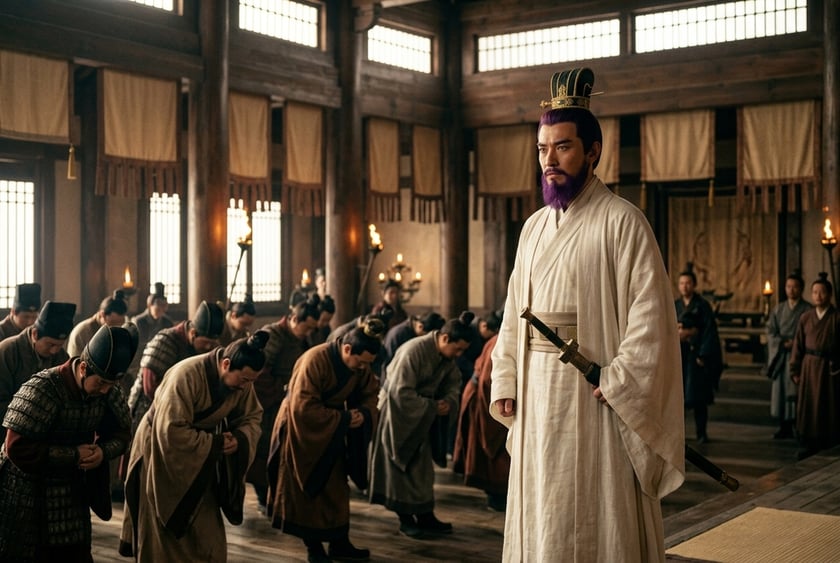
Strategic Background
The Battle of Yanzhou in the second year of Xingping was the most dangerous internal rebellion of Cao Cao's formative years — while Cao Cao was away campaigning in Xuzhou, the Zhang Miao and Zhang Chao brothers joined Chen Gong in welcoming Lv Bu to occupy Yanzhou, and nearly every commandery and county fell before them. The base Cao Cao had spent years building was lost almost overnight. After hurrying back with his forces, Cao Cao engaged Lv Bu in repeated battles at Puyang, at one point surrounded by fire and nearly killed, escaping only because Dian Wei fought his way out at the cost of his own life [c:16852]. The grinding attrition from Puyang to Dingtao was the most grueling stretch of Cao Cao's early career: if Yanzhou were lost, he would be completely stripped of his "power base and source of legitimacy," and any thought of later welcoming Emperor Xian of Han, wielding the Son of Heaven to command the lords, would have come to nothing. Dingtao, as the southeastern gateway to Yanzhou situated at the communications nexus along the Ji River, was the last forward position that Lv Bu could hold in his retreat.
Deployments
Cao's main battle force was by now the seasoned core that had been forged through months of fighting at Puyang: Dian Wei, Xu Chu, Xiahou Dun, Xiahou Yuan, Li Dian, and Le Jin were all there; strategic coordination in Xudou was handled by advisors including Guo Jia [c:16852][c:16854]. The Lv side's core was Lv Bu himself together with Chen Gong and Gao Shun. Chen Gong played a crucial role — he was formerly a subordinate of Cao Cao and had a deep understanding of Cao Cao's style of warfare; in this chapter of the novel he was responsible for providing counter-analyses of Cao Cao's feigned death and ambush stratagems, but Lv Bu's arrogance led him to disregard Chen Gong's advice repeatedly [c:16854]. Zhang Miao, Zhang Chao, and other local powerful clan figures were nominally the "host party" of the anti-Cao alliance, but lacked the military strength for frontal resistance to Cao's troops, occupying a position of "political instigators rather than military main force."
Key Decision Points
The battle had three key decision points. The first was Cao Cao's "turning the tables" after his Puyang defeat — immediately after falling into an ambush, he announced the counter-plan: "spread word that I was injured in the fire and died in the fifth watch; Lv Bu will certainly lead troops to attack, then we ambush in the Ma Ling hills and strike while they are halfway across" [c:16852]. The subtlety of this stratagem lay in disguising "one's own desperate state" as "one's own death," relaxing the vigilance of the victor — the standard method of using an informational disadvantage in reverse. The second was the "double ambush at the forest and the levee" in the second phase — after judging that Lv Bu's suspicions of an ambush in the forest would cause him to fall back, Cao Cao raised the stakes: planting flags in the forest to create the impression of a lurking ambush force, while placing the real ambush force at the hidden location of the "long levee with no water" [c:16853]. The key to this stratagem was "using Lv Bu's own suspicion as the bait for the adversary's attention" — the phantom troops in the forest kept Lv Bu's mind occupied with setting fire to the trees, while the real ambush below the levee appeared only when the fighting was at its most intense; Cheng Lian's death from a single arrow by Le Jin was the landmark detail of this engagement [c:16854]. The third was the human-relationship tension between Lv Bu and Chen Gong — every time Chen Gong warned "Cao Cao is full of deceptive schemes and must not be taken lightly," Lv Bu responded "I'll use fire attacks" [c:16854]; this pattern of "advisor speaks but commander does not listen" repeated itself several times and finally exploded at Dingtao as a fatal mistake.
Outcomes and Reverberations
The immediate consequence of breaking Lv Bu at Dingtao was that Yanzhou returned entirely to Cao Cao's hands: Zhang Chao burned himself to death, Zhang Miao fled to Yuan Shu, and the whole of Shandong was recovered [c:16854]. The reverberations of this victory extended far beyond the geographic recovery of Yanzhou. First, it established Cao Cao's command style of "daring to use extreme psychological warfare in a crisis" — feigned death, phantom troops, night raids, deep ambushes are elements that recur repeatedly in his later major campaigns at Guandu, Wancheng, Hanzhong, and elsewhere. Second, it reduced Lv Bu from "a warlord with a base in the Central Plains" to "a fugitive lord in flight for survival" — the trajectory by which Lv Bu then retreated to the coast, sought shelter from Yuan Shao and was refused, and finally settled in Xuzhou was opened up from this moment [c:16855]. Third, Chen Gong's image in the novel — "perceptive but unable to be effective" — is further consolidated in this chapter; his repeated correct judgments ignored by Lv Bu lay the groundwork for the tragic undertone of his calm acceptance of death at the Battle of Xiapi.
Counterfactual Analysis
The counterfactual can be posed on two levels. First, if Lv Bu had heeded Chen Gong's advice after Cao Cao's initial retreat and held firm at Puyang without sallying out, what would have happened? The most likely outcome would have been a longer attrition between the two sides — but Cao Cao urgently needed a quick victory given food shortages, and if he could not lure Lv Bu's main force into the open, he would probably have been forced to negotiate a partial ceasefire with Lv Bu and return to regroup; the contest for Yanzhou would have been delayed by six months to a year, Liu Bei's Xuzhou, Yuan Shao's Hebei, and others would all have gained more time to consolidate, and Cao Cao's timetable for unifying the Central Plains would have been set back by some years. Second, if Lv Bu had won at Dingtao rather than lost, would Cao Cao have been driven completely out of Yanzhou? Looking at the scale of forces in the novel's account, even a defeat at Dingtao would have left Cao Cao with Xudou as a fallback; but a Cao Cao without Yanzhou would be significantly weakened in the rhetorical authority of "commanding under the Son of Heaven" — unable to frame his next moves under the legitimacy of "suppressing the disloyal on behalf of heaven," he might have been forced to form short-term alliances with Liu Bei, Yuan Shu, and others, with deep consequences for the configuration on the eve of Guandu. On balance, the significance of the Battle of Dingtao lay not merely in "winning a regional engagement" but in allowing Cao Cao, at the most dangerous window of his career, to complete the self-proving of "turning defeat into victory" — this victory gave his early advisory corps (Xun Yu, Guo Jia, and others) confidence in him, which in turn formed the stable central decision network that would prevail three years later at the Battle of Guandu.