Strategic Background
Dingjunshan sits on the southern rim of the Hanzhong basin and serves as the southwestern shield connecting Nanzheng to Micang and Yangpingguan; more importantly, it was the principal grain-storage area for Caowei forces in Hanzhong. From the twenty-third year of Jian'an onward, Liu Bei committed the full strength of Sichuan in a northern assault on Hanzhong, locking in a near two-year standoff against the forces of Xiahou Yuan and Zhang He based at Nanzheng. For Shuhan, Hanzhong carried the dual significance of "gateway and springboard": seizing it allowed Shuhan to look down into Guanzhong to the north and to control Shangyong to the east; losing it would allow Caowei to descend down the Han River and drive straight for Chengdu. Cao Cao had placed Xiahou Yuan as the western-front bulwark precisely because he valued his style of command — "profound in strategy and adept at reading the disposition of forces". Huang Zhong's volunteering to assault Dingjunshan came at the critical moment when the contest for Hanzhong was shifting from the standoff phase to the decisive phase.
Deployments
The Shu deployment was "one commander, one advisor, one commanding height" — Huang Zhong as the main commander, Fa Zheng as the military advisor, with the objective of the high mountain on the western side of Dingjunshan, described as "surrounded on all four sides by treacherous paths" and able to "look down on the disposition of Dingjunshan from above". When initially selecting commanders, Zhuge Liang even asked pointedly whether "an old general can match Xiahou Yuan," and arranged for Fa Zheng to go along, creating an offensive "paired structure." On the Wei side, Xiahou Yuan was the main commander and Zhang He his deputy, with Du Xi holding the west hill with several hundred troops on watch, and forces distributed at mountain passes to defend them. The problem was that Xiahou Yuan's command style inclined toward personally leading the vanguard and seeking battle quickly — a structural contradiction with Zhang He's subsequent steadier thinking, as he repeatedly urged "you must not go out to fight; it is best to hold firm".
Key Decision Points
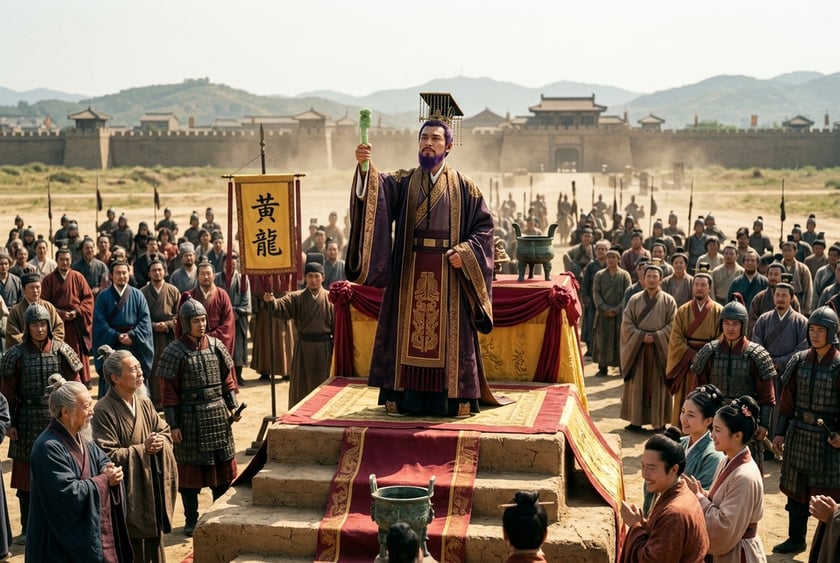
The battle had three key decision points. The first was Fa Zheng's proposal of "first seizing the opposite hill to look down on the dispositions of Dingjunshan" — this elevated the campaign from a flat face-to-face contest into a three-dimensional terrain battle, giving the Shu army the physical advantage of "control from height." The second was the command design by which Fa Zheng signaled Huang Zhong's timing to charge from the hilltop using white and red flags — white flags meant hold position, allowing the Wei soldiers to shout taunts and insults without response, and waiting until the afternoon when the Wei troops were "tired and off their guard, many of them dismounted and resting"; then the red flag was raised and Huang Zhong charged down from mid-slope. This was a classic "rest against exhaustion" tactic, with the key being Fa Zheng's precise control of battlefield tempo. The third was Xiahou Yuan's own error of judgment — after Du Xi returned with defeated troops to report, Xiahou Yuan concluded "they have seized our opposite hill and are watching our dispositions — how can we not go out to fight?" Zhang He's strong remonstrance was ignored. This decision reversed the Wei forces' command advantage into command passivity within a matter of hours.
Outcomes and Reverberations
Huang Zhong charged down from mid-slope; Xiahou Yuan was caught completely unprepared and was cut down, head and shoulders together, in two pieces. The Wei forces collapsed in rout; Zhang He led the defeated troops toward Dingjunshan only to learn "Dingjunshan had already been taken by Liu Feng and Meng Da," and had no choice but to retreat to encamp by the Han River. When news of Xiahou Yuan's death reached Cao Cao, he wept aloud — Xiahou Yuan was not only the western-front bulwark but a member of the Cao kinship, bound by ties of brotherhood — and he personally led a large army to Hanzhong to seek revenge. But by that point Liu Bei already held the key positions, and though Cao Cao arrived he could not reverse the western-front passivity; within months the Wei forces had no choice but to withdraw from Hanzhong. In the novel this battle is the landmark episode in which Huang Zhong completes his transformation "from veteran general to top-tier warrior," and also Fa Zheng's most recognizable masterpiece as a military advisor. From the strategic standpoint it directly triggered Liu Bei's political elevation to "King of Hanzhong," a decisive step in his path to kingship.
Counterfactual Analysis
The counterfactual can explore two questions. First, if Xiahou Yuan had adopted Zhang He's advice to "hold firm and not go out to fight," how would the Dingjunshan situation have unfolded? The most likely development would have been a longer standoff between the two sides, but since the Shu army had already seized the commanding height on the opposite hill, the long-term outlook was poor for Wei — Caowei's grain stockpile there could not remain secret indefinitely, and Zhang He's approach could only delay, not reverse, the defeat. If Cao Cao could have arrived with a main-force relief in time during the standoff, the western front might have barely held, but the time window he would have needed to move his main force from the Central Plains to Hanzhong exceeded both sides' tolerance for supply attrition. Second, if the Shu side had not sent Fa Zheng along and Huang Zhong had led the assault alone, could the Battle of Dingjunshan still have been won? Huang Zhong's bravery was similar to that of Huang Gai and Zhang Fei — the archetype of a front-line fighting general — but he lacked the capacity for mid-battle control of tempo. The entire chain of decisions — seizing the opposite hill, using flag signals, waiting until midday before charging down — all required strategist leadership; the novel's casting of Fa Zheng as "the flag-bearer on the mid-slope" is in essence an acknowledgment that this victory, at the tactical level, was strategist-driven. Taken together, the value of the Battle of Dingjunshan lies not in the killing of a prominent commander in itself, but in the way it demonstrated how "terrain, tempo, and division of command" could together be used to break the line of a famous general — a successful template that Zhuge Liang would attempt repeatedly in his later northern expeditions but never quite reproduce.