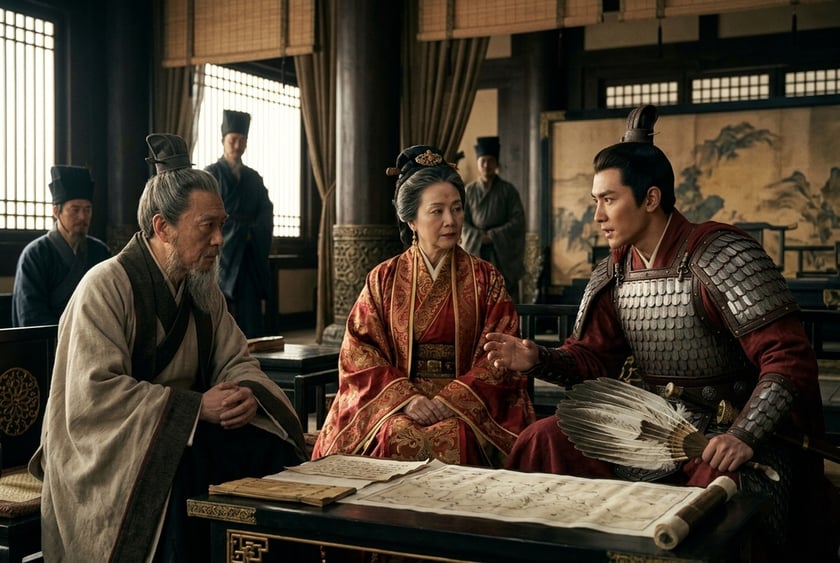
Background
The event unfolds against the dual pressures of Guan Yu's northern campaign and the eve of Liu Bei's royal proclamation. In the summer of the twenty-fourth year of Jian'an, Guan Yu had flooded the seven armies and besieged Xiangfan for three months; meanwhile, the three commanderies of Shangyong, Fangling, and Xicheng had just been captured in a joint assault — Meng Da advancing north from Zigui and Liu Feng descending east from Hanzhong — and nominally belonged to the King of Hanzhong, but were in practice jointly controlled by Liu Feng, Meng Da, and the local powerful brothers Shen Dan and Shen Yi. When Guan Yu at Xiangfan appealed to Shangyong for reinforcements, Liu Feng and Meng Da refused on the grounds that "the newly acquired mountain commanderies cannot yet be safely moved" — a decision that later became a direct external factor in Guan Yu's defeat at Maicheng. In the year following the incident Guan Yu was killed and Jingzhou was entirely lost; the King of Hanzhong had already entered a phase of assigning blame and rebuilding the frontier, and Shuhan faced a double crisis in the direction of Shangyong: internal accountability and external infiltration by Caowei [c:16774].
Key Figures
Four forces are entangled in this event. The first is Meng Da himself — originally a close friend and fellow townsman of Fa Zheng from Yizhou, he had entered Shu together with Fa Zheng and Peng Yang, and long occupied the position of a "guest general." After Fa Zheng's death and Peng Yang's execution, Meng Da lost his strongest political patron and felt certain the King of Hanzhong would settle old scores with him [c:16774]. The second is Liu Feng — the King of Hanzhong's adopted son, whose ambiguous status had made him a political embarrassment after the birth of Liu Chan; his assertive and fierce personality had frequently suppressed Meng Da during their collaboration, indirectly catalyzing Meng Da's decision to defect to Wei. The third is the Shen Dan and Shen Yi brothers — local powerful clan members of Shangyong who had always harbored inclinations toward Wei; they provided Meng Da with an escape route and arranged to switch sides at the same moment [c:16774]. The fourth is the Wei side's receiving party — Cao Pi, Xu Huang, and Xiahou Shang — who happened to be in the window of "absorbing the dividends left by Guan Yu's fall," and were happy to welcome Meng Da with high titles and political endorsement [c:16775].
Central Issues
There are three central issues to this event. The first is the question of the legitimacy of "defensive defection" in late Han politics: Meng Da's going over to Wei was not an act of proactive treachery but a flight for survival after he calculated he would be held accountable — this pattern of "defensive defection" appeared frequently among the upper ranks in the late Han and San Guo, but each time it reshaped the strategic landscape. The second is the contested strategic value of Shangyong — Shangyong sat at the pivot of three directions: Hanzhong, Xiangfan, and the Wan–Luo corridor; it was the only possible "wedge foothold" Shuhan could have maintained on its northern flank, and losing it meant Shuhan would henceforth have no choice but to launch northern campaigns directly through Hanzhong, with no lateral corridor — a path restriction directly linked to the constraints Zhuge Liang would face in his later six expeditions to Qishan. The third is the first open confrontation in the politics of dynastic succession — Liu Feng as an adopted son, after the birth of Liu Chan, had already become a "transitional succession candidate," and his very survival was a potential source of future fragmentation in the regime; Meng Da's defection to Wei gave Zhuge Liang a clear window in which to counsel Liu Bei [c:16775].
Political Consequences
From a military standpoint, after defecting Meng Da immediately led the vanguard back against Shangyong, joining forces with Xu Huang and Xiahou Shang; Shen Yi switched sides and opened the gates, and Liu Feng fled alone back to Chengdu, leaving Shuhan's control over the three commanderies of Shangyong completely shattered. Caowei thereafter obtained a stable wedge extending into the upper reaches of the Han River in the direction of Xincheng Commandery (under Meng Da's command) [c:16775]. From a political standpoint, Liu Bei ordered Liu Feng to die by his own hand, nominally to punish him for "driving Meng Da to rebellion and losing Shangyong," but in substance accepting Zhuge Liang's judgment that he was "too fierce and willful to be controlled and would become a future calamity" — thus eliminating in one stroke a potential crack in the dynastic succession of the ruling family. This was a crucial personnel move as the Shuhan regime transitioned from "Liu Bei's founding coalition" to "the regency system of Liu Chan and Zhuge Liang." From a reputational standpoint, the novel casts Liu Feng as a figure of "fierce loyalty who tore up the letter and executed the messenger and died a noble death," set against the image of Meng Da as "unprincipled and faithless," reinforcing the narrative warmth of "the Liu bloodline still has mettle."
Counterfactual Analysis
The counterfactual has two interesting branches. First, if Meng Da had not defected to Wei but held Shangyong, what would have happened? Based on the historical record of Zhuge Liang's second northern campaign, when Meng Da secretly plotted to return to Shu and was crushed by Sima Yi in an eight-day forced march, one can infer that even had Meng Da remained in Shuhan, the long-term stability of Shangyong was far from certain — his collaboration with the Shen brothers was fragile, and the three commanderies of Shangyong without strong central support would sooner or later have been absorbed by Caowei. Second, if Liu Bei had not executed Liu Feng, how would the regency landscape after Liu Chan's succession have looked? Liu Feng, as a seasoned general and the King of Hanzhong's adopted son, would very likely have become a figurehead for militarist factions like Li Yan and Wei Yan, competing with Zhuge Liang's civil-governance approach, making it unlikely that Shuhan in its middle and later periods could have maintained the stable structure of "Chancellor's autocracy, Emperor within the palace." The potential cost of that division would almost certainly have exceeded the value Liu Feng could have contributed as a capable frontier commander. Taken together, the outcome of the incident — even as a double failure for Shuhan, losing territory and putting a son to death — was the relatively "least costly" option available under the conditions of the time.