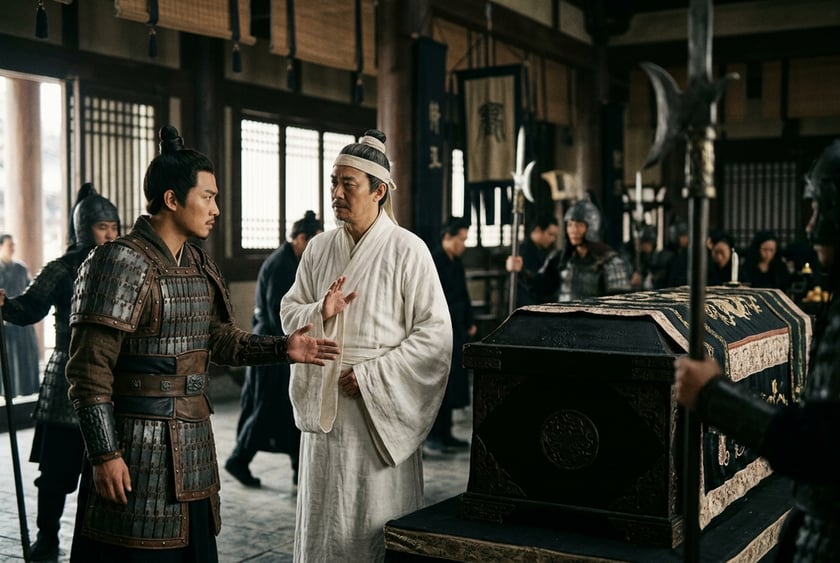
Background
Sun Quan designated Zhuge Ke as chief regent before his death, intending to use a "son of a renowned general combined with fresh battlefield prestige" to stabilize the succession and hold in check the tensions among the imperial clansman Sun Jun, Sun Hong, the civil official Teng Yin, and the military commander Lv Ju. Yet although Zhuge Ke initially established his authority by destroying the Wei army in the great victory at Dongxing, he immediately overreached. In the spring of Jianxing's second year he mobilized two hundred thousand troops for a northern campaign to besiege Hefeixincheng, only to meet with Wei's tenacious defense and a devastating epidemic inside his own ranks; "more than half the soldiers and officers died," and in the eighth month of autumn he was forced to withdraw back to Wu. This catastrophe stripped away almost all of Zhuge Ke's political capital in Jiangdong. At the same time, on returning to court he did not exercise self-restraint; instead he further concentrated power, reshuffled the palace garrison — seizing the palace guard from Sun Jun — and increasingly marginalized the senior ministers, driving those who had merely been discontented into a position where they felt compelled to act.
Principal Figures
Sun Jun was the great-great-grandson of Sun Jing, younger brother of Sun Jian, and son of Sun Gong — a junior generation of the imperial clan, appointed by Sun Quan during his lifetime to command the palace guards, and thus in possession of the most critical resource for a coup: armed force inside the palace precincts. Grand Master of Ceremonies Teng Yin bore an old grievance against Zhuge Ke; in the novel's narrative he advises Sun Jun, charging that "Zhuge Ke exercises power arrogantly and cruelly, has slaughtered senior officials, and harbors disloyal intentions," constructing the rhetorical legitimacy for the coup. The boy-emperor Sun Liang, enthroned at ten and barely twelve at the time, was nominally the instigator of the coup — he provided the banquet that lured Zhuge Ke to his death — but in reality served as the instrument of imperial clansmen and close ministers. The novel even has him say proactively, "I too am terrified of this man", giving the coup the outward appearance of an action personally authorized by the emperor. Zhuge Ke, the victim, had formerly enjoyed great prestige in Jiangdong for his Dongxing victory, but now stood isolated and reviled because of his New City defeat, his seizure of the palace guard, and his high-handed autocracy.
Core Issues
This coup crystallizes three issues in political history. The first is "how military failure converts into political death": Zhuge Ke was not directly dismissed for the New City campaign, but the defeat robbed him of the popular standing and momentum indispensable for fending off political enemies. It was precisely because "popular resentment was widespread and the multitude had turned against him" that Sun Jun was able to build a pretext to frame him. The second is "the decisive importance of controlling the palace garrison": the physical basis of the entire coup was Sun Jun's command of the palace guard, enabling him to "deploy hidden troops" inside the throne hall itself — exposing the fact that Eastern Wu's garrison system had no external-court check on it whatsoever. The third is "the position of the imperial clan within the regency system": Sun Quan placed Sun Jun in the regency council to counterbalance the civil officials, but ultimately let the imperial clan use palace garrison force to swallow the civil-official camp's power in a single move, throwing open the door to five years of imperial-clan dominance.
Political Consequences
The coup's immediate products were three. First, Sun Jun was on the very same day appointed Chancellor and enfeoffed as Marquis of Fuchun, with all power consolidated in the imperial clan. Second, the line descended from Zhuge Jin through Zhuge Ke — including Zhuge Ke's eldest son Zhuge Chuo, second son Zhuge Song, and youngest son Zhuge Jian — was subsequently killed or driven into exile, extirpating within two generations the political family line that Zhuge Jin had established in Jiangdong. Third, although Teng Yin had briefly risen to prominence by participating in the coup, he was soon purged by Sun Lin after Sun Jun's death; commanders like Lv Ju on the Huainan front were caught up in the same disaster; the entire anti-Zhuge-Ke coalition consumed itself within three years. The longer-term consequence was that the pattern of "using palace troops to kill a chief minister" was used repeatedly: Sun Lin later deposed Sun Liang and installed Sun Xiu; Sun Xiu then used the same method to lure Sun Lin to his death; Wu's court politics entered a vicious cycle of chain killings.
Counterfactual Analysis
Had Zhuge Ke immediately after returning in defeat from New City submitted a memorial of self-censure and surrendered part of his power to placate public resentment, Sun Jun — even with his advantage inside the palace garrison — would have found it very difficult to assemble in short order the triple legitimacy of "popular resentment + court officials + imperial will" needed to justify a killing. At worst the outcome would have been loss of the regency position and return to a provincial generalship. Had Sun Quan before his death not placed the palace guard in Sun Jun's hands but entrusted it to some senior non-clan general — a veteran in the mold of Ding Feng — then even had Zhuge Ke been politically isolated, Sun Jun would have lacked the tool to launch a coup, and the power transition might more plausibly have followed an internal bureaucratic succession of "Zhuge Ke removed, Teng Yin taking over as executive." Either way Eastern Wu could have avoided the five-year abyss of imperial clan dominance that followed, and the kingdom's military and diplomatic rhythm would have been markedly different.