Background
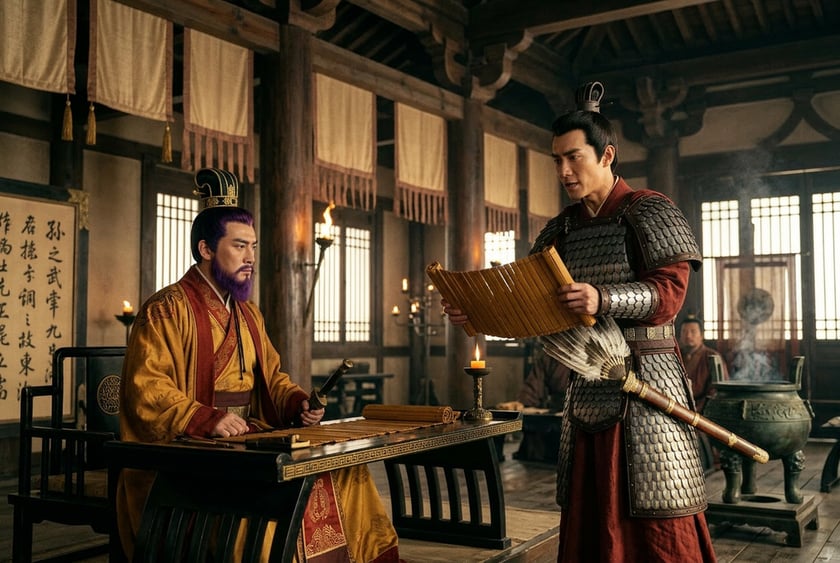
After Sun Quan's death, Wu's politics entered a recurring cycle of "strongman regency — young ruler seizes power — strongman strikes back." Zhuge Ke was killed by Sun Jun, Sun Jun then died in office, and authority passed to his cousin Sun Chen. The young emperor Sun Liang had been only ten when he ascended the throne; by the third year of Taiping he was barely sixteen — just the age of longing for personal rule while lacking any political base. Within the Romance's narrative structure this episode is one link in Sunwu's "self-destructive power struggle" sequence, following the dominance of Sun Jun and Sun Chen and leading into the restoration of Sun Xiu.
Key Figures
In the novel Sun Liang is portrayed as a young ruler with ambition but insufficient political seasoning: he can identify Sun Chen's danger and recognises that he must strike first, but the "inner circle" he chooses — maternal uncle Quan Ji and father-in-law Quan Shang — simply cannot withstand the pressure of a direct coup attempt. After receiving the imperial edict Quan Ji went home to ask his father for support, but Quan Shang revealed the information to his wife — who was Sun Chen's elder sister — and by that very evening the news had been passed to Sun Chen. The most dramatic detail in this passage is that Sun Liang had already sensed the risk of "your mother is Chen's sister" during the secret deliberations, yet still failed to build an information firewall between Quan Shang's household and Quan Ji. Sun Chen, for his part, is presented throughout as "a practised coup operator" — his intelligence sources were reliable, his response was lightning-fast, and his target list was clear.
Core Issues
The central issue of this episode is "information security in a young ruler's bid to reclaim power." Sun Liang's only political capital was the legitimacy of the emperor's title; to convert that capital into real power he needed a short, tight chain of command — palace guard, emperor, trusted inner circle. But the chain he actually chose stretched across three generations of in-laws and exposed the imperial edict to a family whose interests were bound up with Sun Chen's. This is an almost inevitable tragedy in the politics of young rulership: there are too few people one can use, and the ones picked are not necessarily reliable. Huan Yi's denunciation on the eve of his execution is an authorial flourish, but it captures the true attitude of the scholar-official stratum toward Sun Chen's conduct — the number willing to oppose him openly in court had already dwindled to almost nothing.
Political Consequences
Sun Chen completed the entire sequence — surrounding the palace, purging the consort clan, deposing the emperor, and installing a new one — in a single night; the efficiency of the operation throws the fragility of Sun Liang's coup plan into sharp relief. In the short term Sun Chen's power reached its apex, with the elevation or removal of emperors decided by a single word from him. In the medium term, the entire Quan consort clan was uprooted, and the Wu imperial house began to take a deeper hand in succession questions. In the long term, precisely because Sun Chen's success in this episode was so easy and so brazen, it accumulated the moral justification for the subsequent counter-strike by Sun Xiu, Ding Feng, and Zhang Bu. In other words, this failure was not simply "a young ruler losing to a strongman" — it was laying the emotional and moral groundwork for the victory of the next "young ruler plus veteran general" combination.
Counterfactual Analysis
Suppose Sun Liang had confined his inner circle to mid-level palace guard officers, bypassing the Quan consort clan as an intermediary layer entirely — what then? Given the density of Sun Chen's intelligence network as depicted in the Romance, there would still have been a substantial chance of failure, but at least the entire plan would not have collapsed overnight. More fundamentally, had Sun Liang chosen to bide his time — learning, cultivating allies, and gradually splitting Sun Chen's faction — and waited several more years before striking, he might never have needed to replay the script of "secret edict exposed — strongman counter-strikes — emperor deposed." Seen from a broader perspective, the true significance of this episode is that it renders personal imperial rule in Sunwu virtually impossible as a practical task: each failure pushed power further into the hands of the imperial clan and the palace guard, cumulatively producing the political instability that characterised late Sunwu.