Strategic Background
In 236, Sunwu was in the grip of an expansionist anxiety characteristic of its "second decade after proclaiming the empire." Sun Quan had launched multiple northern expeditions against Hefei, all ending in failure, with not an inch of land gained north of the river — an extremely high political cost for a regime that had already proclaimed itself an empire. Lu Xun and Zhuge Jin's westward offensive against Xiangyang on this occasion was in essence a strategic lateral detour after the repeated failures at Hefei: by applying pressure in the Jingzhou direction, they hoped to force Wei to split its forces, and at minimum to declare to audiences at home and abroad that Sunwu was not "complacent while facing south." The Wei side's Xiangyang was held by the commander-in-chief overseeing Jiangxia, Xincheng, and other territories — a hub connecting the Huainan and Hanzhong theaters. At this time Caowei's Emperor Ming was on the throne; there was residual pressure from the aftermath of Zhuge Liang's campaigns in the west, Gongsun Yuan's provocations in the north, and though the southern front could not afford to be lost, its troop allocations were extremely limited.
Deployments
The Wu side adopted a "divided-command, combined land-and-water advance" model. Lu Xun, in his capacity as Jingzhou Shepherd and Grand Marshal, commanded all forces overall, advancing from Jiangxia along the Han River; Zhuge Jin, as General-in-Chief, directed the naval forces, with the fleet advancing northward up the Mian River in a pincer formation. Lu Xun was renowned for "preserving his edge and moving with deliberate weight"; his early-phase deployment focused on concealing his intentions, to the point that even confidential military dispatches were carried by trusted personal messengers. The Wei side's commander was Hu Zhi (or his predecessor — sources differ slightly); the walls of Xiangyang were thick and solid, and additionally the water level of the Mian River was gradually falling — this was the practical reason behind Zhuge Jin's recommendation to withdraw, since the naval force's room for maneuver shrank rapidly as the dry season approached.
Critical Decision Points
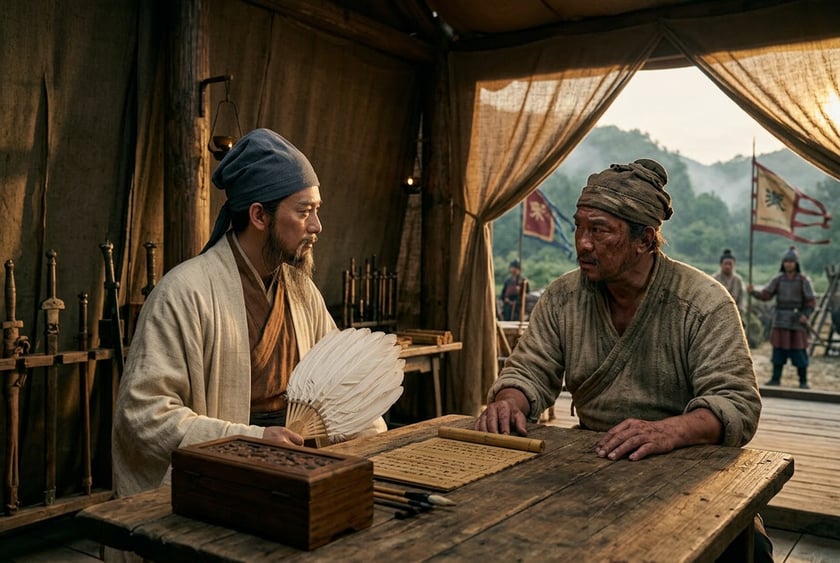
This campaign saw no large-scale clash of arms; the outcome hinged entirely on a single psychological gambit. The critical juncture was the capture by Wei cavalry patrols of Han Bian, whom Lu Xun had dispatched to transmit military intelligence through the Mian region — meaning the Wu army's troop disposition, supply situation, and withdrawal intentions may all have become known to the enemy. After receiving word of the breach, Zhuge Jin immediately wrote urging a prompt withdrawal; Lu Xun, however, seized on a crucial judgment: even if the enemy had obtained the intelligence, they might not dare take the initiative to attack, because they too feared the unpredictability of Lu Xun's use of troops. He therefore chose to do the opposite — in camp he had gourds planted, played chess, and practiced archery, creating an atmosphere of unhurried ease with no thought of withdrawing. The effect of this "reverse psychological warfare" was twofold: internally it steadied morale and prevented Zhuge Jin's naval forces from hastily weighing anchor under pressure; externally it transmitted to the enemy the signal that "Lu Xun has other plans," forcing Wei forces to opt for a conservative response. He then conferred secretly with Zhuge Jin, and together they settled on a rotating withdrawal plan: "Lu Xun's main force feigns an attack on Xiangyang while Jin's forces withdraw first."
Outcome and Echoes
The Wu army withdrew with all forces intact and not a single casualty — a rare case in the repeatedly frustrated history of Sunwu's northern expeditions. At the tactical level, Lu Xun applied the strategic principle of "subduing the enemy without fighting" to a withdrawal, transforming what could have been a catastrophic rout after an intelligence breach into an almost completely unscathed extrication. At the strategic level, this battle further consolidated Lu Xun's central position within Sunwu's military-political system; he was shortly afterward appointed as chancellor, jointly steering Sunwu's mid-to-late period policy toward Wei together with Zhuge Jin. For Wei, although this battle produced no actual gains, it exposed Wei's sluggish response after an intelligence capture and its conservative tendencies; in the subsequent period dominated by Cao Shuang and Sima Yi, both reinforced their military preparedness in the Jingxiang direction.
Counterfactual
If Lu Xun had adopted Zhuge Jin's advice and withdrawn immediately, Wei cavalry — once they confirmed Wu's intent to retreat — would very likely have given chase, and the Wu fleet's mobility in the period straddling the Mian River's dry season would have been badly damaged, potentially losing major generals and tens of thousands of troops. Conversely, if Lu Xun had pressed forward and launched a full assault on Xiangyang, he would have fallen into Sunwu's version of the "Hefei dilemma" — repulsed in the siege, battered by summer disease, caught between advance and retreat, possibly even repeating the fatigue of Wu forces operating far from home after Lv Meng seized Jingzhou. Lu Xun's choice of "feigning attack then withdrawing" was the optimal solution between the two extremes, and this decision has become an example cited by later strategists studying "the art of withdrawal." At a more macro level, after this battle Sunwu's strategic initiative against Wei factually shifted into a defensive posture; offensives against the Xiangyang–Fancheng line never again reached this scale until the fall of Wu.