Strategic Background
By the late Han, Liaodong had already coalesced into an independent regime under the Gongsun clan: from Gongsun Du's initial seizure of Liaodong (around 190 CE), down to Gongsun Yuan who was the third generation — nearly fifty years in total. Caowei had long pursued a "loose-rein" policy toward Liaodong, enfeoffing the Gongsun clan as Governors of Liaodong, Generals of Chariots and Cavalry, and with titles such as Prince of Lelang, while never exercising direct jurisdiction. The problem was Gongsun Yuan's volatile temperament: one moment pledging submission to Wu in exchange for military supplies, the next executing Wu's envoys and presenting their heads to Wei. Then in the first year of Jingchu (237) he simply proclaimed himself King of Yan, created his own era name, cultivated ties with the Xianbei, and plotted raids on Caowei border commanderies. This "independent kingdom on the northeastern flank" posed a threat to Caowei not as an immediate military blow but as a "demonstration effect" — if Liaodong could achieve independence, Liangzhou and Bingzhou might follow suit. Even gravely ill, Cao Rui insisted on sending troops precisely to end this possibility of fragmentation on an institutional level.
Disposition of Forces
The Wei commander was Sima Yi, then serving as Grand Commandant, fresh from ending the standoff against Shu along the Yong-Liang defensive line. Cao Rui authorized him sixty thousand infantry and cavalry and permitted him to draw on Youzhou and Qingzhou resources. Sima Yi's deployment rested on three key points: the expedition force was to complete the "round trip of ten thousand li, settle Liaodong in one year"; the seasonal flooding of the Liao River was to serve as a tactical node; and siege-warfare engineering equipment was to be prepared from the outset. On Gongsun Yuan's side, his main force constructed a long defensive perimeter at Liaosui (west bank of the Liao River) to block Wei forces on the western side of the Liao, while simultaneously cultivating ties with the Maek and Buyeo peoples in hopes of pinning down Wei's rear. However, Gongsun Yuan's total local forces numbered only a few tens of thousands, and Gongsun Yuan himself depended far more on diplomatic leverage than on military organization.
Critical Decision Points
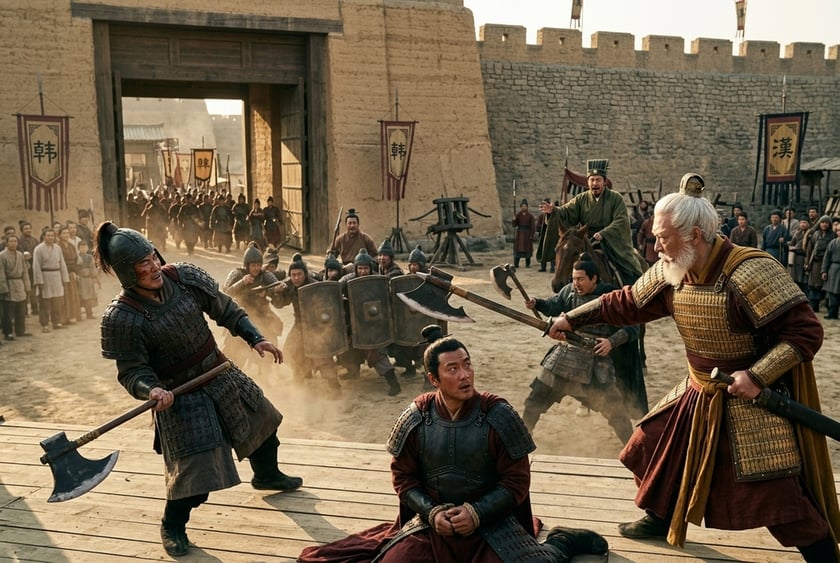
The campaign had three decisive turning points. First: fully aware that Gongsun Yuan had constructed a long perimeter and deep moat at Liaosui on the western bank, Sima Yi nonetheless ordered his main force to feint southward while crossing the Liao by a northern route under cover, driving directly into the flank and rear of Liaosui. This "show force in the south, strike in the north" operational method was a model Caowei would reuse repeatedly against Shu and Wu, but 238 was the first time it succeeded on this scale. Second: after winning the open battle at Liaosui, Sima Yi did not pursue the retreating troops but instead went directly to besiege Xiangping — an abandonment of short-term gains in exchange for the strategic pressure of "main force encircling Xiangping," ensuring Gongsun Yuan could not reconstitute. Third: during the siege the Liao River flooded violently and Wei warships were able to anchor directly below the city walls — a heaven-sent advantage. But Sima Yi's remarkable quality was that he did not exploit the floodwater to mount a direct assault; instead he "used the floodwater to build earthen mounds, while continuous crossbow bolts and thunderbolt catapults advanced day and night," turning the rainstorm into an extended mechanism for tightening the siege.
Outcome and Reverberations
After holding out for more than a month with no food and reports of cannibalism inside the walls, the general Yang Zuo and others opened the gates to surrender. Gongsun Yuan and his son fled southward with several hundred cavalry, were overtaken by Wei troops, and were beheaded at the spot where a meteor had fallen — the "falling meteor" detail carries an astrological cast, but it indicates that the pursuit route had been prepared in advance. After the city fell Sima Yi took two extreme measures: he had more than seven thousand males over the age of fifteen in the city built into a "display of skulls," and he publicly announced the abolition of the old Yan state offices and the establishment of four commanderies — Liaodong, Xuantu, Lelang, and Daifang — under direct Wei jurisdiction. Thereafter Liaodong was incorporated into the Wei-Jin northeastern administrative territory, and did not again break free of Central Plains control until the Xianbei rose to power in the Southern and Northern Dynasties period. From the perspective of political history, this campaign established Sima Yi's supreme prestige in Wei's military-political world and accumulated military capital that could not be dislodged — capital he would draw on in the Gaopinglingzhibian eleven years later.
Counterfactual Analysis
Had Gongsun Yuan chosen before the Liaosui open battle to withdraw his main force and adopt a scorched-earth defense along the Xiangping-Wencheng line, Sima Yi — operating with sixty thousand troops on a long-distance supply line — might not have been able to meet his target of "ten-thousand-li round trip in one year." He might even have been compelled to withdraw due to Liaodong's bitter cold, leaving open the possibility of continued Gongsun separatism. Conversely, had Cao Rui not decided on a northern expedition in the first year of Jingchu, Gongsun Yuan would have had time to integrate the Xianbei, Buyeo, and Goguryeo into a genuine diplomatic circle with Wu, and northeastern unification would have been delayed until the middle or later period of the Jin dynasty or beyond. From the perspective of institutional history, the critical significance of this campaign was: it established "using one year of decisive campaigning with the central army to resolve a borderland separatist regime" as a repeatable model of state action. The Simashi's ability to exercise virtually independent military dispatch authority within the Wei state — the foundation for that — was laid right here, beneath the walls of Xiangping.