Strategic Background
Hefei in the twentieth year of Jian'an was the foremost fortress of Caowei's Huai River defensive line, guarding the corridor from the Ying River through the Huai River and Runan toward Xudou. If Sunwu could take Hefei, it could push its offensive line to the southern bank of the Huai River, threatening Yuzhou and Xuzhou; should Cao Cao lose Hefei, the entire Jianghuai defense would cease to exist. Sun Quan chose this particular year to strike because Cao Cao had just led the main army on a distant campaign to Hanzhong against Zhang Lu, leaving the Huai River south region with only Zhang Liao, Le Jin, and Li Dian — approximately seven thousand men [c:17895]. From Sunwu's perspective, this was a rare strategic window opened by "luring the tiger from the mountain."
Force Dispositions
On the Sunwu side, the Romance of the Three Kingdoms figures ten thousand troops; the official histories speak of a hundred thousand infantry and cavalry. The vanguard included dozens of battle-seasoned generals — Gan Ning, Ling Tong, Lv Meng, Chen Wu, Xu Sheng, Pan Zhang — the strongest order of battle Sunwu could field. On the Caowei side, Zhang Liao, Le Jin, and Li Dian had long been on poor terms with one another; before departing on campaign, Cao Cao left a sealed letter stipulating that "should Sun Quan arrive, Zhang and Li shall go forth to fight while Le Jin defends the city" [c:17895]. This sealed letter cleverly exploited the three men's individual characters: Zhang Liao's aggressive boldness, Li Dian's grasp of the larger picture, and Le Jin's steady defence were cleanly divided into complementary roles, converting the liability of three mutually hostile generals into a set of complementary strengths. This design of "advance authorization matched to personality" was a characteristic expression of Cao Cao's mastery of military management.
Critical Decision Points
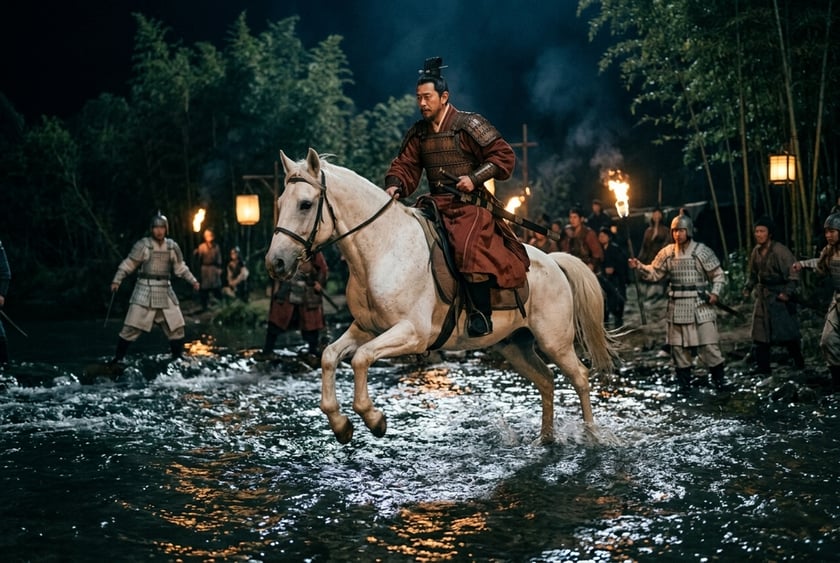
In the first phase, Zhang Liao led a handpicked force of eight hundred death-volunteers in a surprise night assault on the Wu main camp, personally charging to within reach of Sun Quan's command parasol; the Wu general Song Qian was killed and the Wu army lost its fighting spirit. The significance of this strike lay not in the number of enemy killed but in the psychological shock — it instantly rewrote the operational narrative from "Wei army passively defending" to "Wei army daring to attack" [c:17895]. In the second phase, the Wu army besieged Hefei for more than ten days without taking it; morale and supply both declined, and Sun Quan ordered a withdrawal. At this point, the order of the retreat became critical. Sun Quan chose to let the main force cross Xiaoyaojin first, retaining with himself only a thousand or so personal guards to cover the rear — a classic misplacement of a supreme commander's role: exposing the highest commander during a withdrawal is far more dangerous than charging forward in battle [c:17897]. In the third phase, Zhang Liao precisely identified this gap and led Xu Huang in a converging assault, surrounding Sun Quan in the eye of the storm; it was only through the desperate individual fighting of Gan Ning, Ling Tong, Gu Li, and others that Sun Quan was escorted to the toll bridge, whereupon Sun Quan spurred his horse and leaped the broken bridge, escaping with his life alone.
Outcome and Aftermath
The Battle of Xiaoyaojin was Sunwu's largest offensive operation in the direction of Huainan and also its most devastating defeat. Despite a ten-to-one advantage in numbers, Sun Quan failed to take the city and nearly lost his life; several core generals were killed. At the campaign level, Caowei held Huainan at minimal cost, and Zhang Liao thereafter came to be regarded as the most offensively capable of the "Five Elite Generals of Caowei"; the name Xiaoyaojin became a shadow that haunted Sunwu for a generation — later lore held that Zhang Liao's name alone could stop a crying child in the south [c:17897]. At the strategic level, Sunwu did not again mount a large-scale northern offensive against Huainan for nearly a decade, shifting its strategic focus toward Jingzhou and thereby sowing the seeds for the seizure of Guan Yu's defensive line and the rupture with Liu Bei's forces.
Counterfactual Analysis
Had Cao Cao not left the sealed letter assigning roles to the three generals, Zhang and Li would likely have clashed with Le Jin and remained on the defensive; Sun Quan's vanguard would have been sufficient to storm Hefei within ten days, and Sunwu's forces would have reached the southern bank of the Huai River directly, dramatically increasing Caowei's pressure on the southern front and possibly forcing a withdrawal from Hanzhong — which would have rewritten the outcome of the Hanzhong campaign, and the entire 215-219 three-way maneuvering would have been thrown into disarray. Conversely, had Sun Quan placed himself in the middle of the column rather than at the rear during the withdrawal, even a perfect strike by Zhang Liao could only have cut the rearguard, and Sunwu's overall losses would have been far smaller, sparing the psychological trauma that lingered in Jiangdong for two decades. The true historical value of Xiaoyaojin lies in this: it demonstrated to later generations that seven thousand defenders, equipped with a well-designed contingency plan and the right commander combination, can send a hundred thousand strong army home empty-handed — and that the art of command can reverse the effect of numerical disadvantage more decisively than numbers themselves.