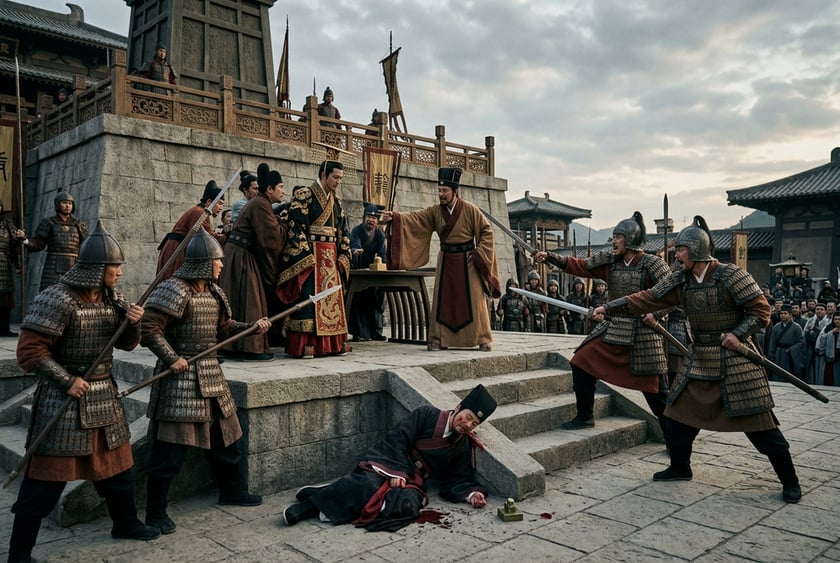
Strategic Background
Huoshaoxinye in the Romance of the Three Kingdoms takes place in the thirteenth year of Jian'an (208) — the middle installment of Zhuge Liang's "fire trilogy" and a critical prelude to the great battle at Chibi. The backdrop: after completing the unification of the north Cao Cao formally launched his southern campaign; Jingzhou's Governor Liu Biao had died and his son Liu Cong surrendered, allowing Cao Cao to take over most of Jingzhou almost without fighting — but Liu Bei's contingent remained at Xinye, the last obstacle Cao Cao had to clear before unifying the south [c:17308]. Liu Bei's situation was dire. Xinye was "no more than a speck of territory," its forces thin (roughly ten thousand or so), and he also had to protect the common people who had followed him for many years from being massacred by Cao Cao's army. Once Zhuge Liang had assumed military command, his assessment was this: defending Xinye would end in defeat; it was necessary to actively abandon it, and then use fire to delay Cao Cao's advance guard, buying time for the southward withdrawal.
Deployments on Both Sides
On Cao Cao's side, the vanguard was Cao Ren and Cao Hong leading one hundred thousand troops, with Xu Chu commanding three thousand iron-armored troops to clear the road ahead. Cao Ren was one of Cao Cao's most relied-upon regional commanders before Chibi — strong-willed and decisive; Cao Hong was a kinsman commander, Cao Cao's uncle's younger brother. These two, combined with Xu Chu's elite guard forces, formed the strongest combination for the Wei southern campaign's vanguard [c:17308]. On Liu Bei's side, Zhuge Liang's deployment was masterful. He designed a three-phase connected stratagem of "empty city — fire attack — flood": Phase one, empty Xinye. Zhuge Liang ordered: "regardless of old or young, male or female, all who wish to come may follow us today to Fancheng to shelter temporarily," withdrawing the entire population and garrison from the city, but having previously "hidden sulfur, saltpeter, and other fire-starting materials in the roofs of the townspeople's houses" [c:17306]. This was a dead city, meticulously prepared. Phase two, the fire attack on Xinye. Zhao Yun led three thousand troops in four columns, personally commanding one column stationed outside the east gate; the other three columns were placed in ambush outside the west, south, and north gates. When Cao Cao's forces entered the city and settled for the night and a great wind rose, the three ambush columns shot fire arrows into the city to ignite the sulfur and saltpeter in the house rooftops; Zhao Yun's column outside the east gate intercepted Wu troops fleeing the city [c:17306]. Phase three, the flood at the Bai River. Guan Yu led a thousand troops upstream on the Bai River, using sacks filled with sand to dam the water; when shouts and horse-cries were heard from downstream he urgently released the sacks to unleash the water, drowning the Caowei troops pressing through; Zhang Fei led a thousand troops in ambush at the Bolu Ford to follow up [c:17306].
Key Decision Points
Several key decisions in this battle embody the essence of "asymmetric warfare." The first was the decision to abandon Xinye itself. This violated the traditional military ethic of the late Han — "duty to defend one's territory" — with no small political cost in actively surrendering a city. Zhuge Liang dared do this because he had clearly calculated: defend the city and you lose; abandon the city and you survive, and the empty city could moreover become the stage for a fire attack. The second was the psychological design of "luring the enemy into the city." Cao Ren and Cao Hong pursued Liu Feng and Mi Fang's red-and-blue-banner troops all the way up the Jiawei Slope and concluded that their quarry was "desperate and outmaneuvered — driven to flee with all the people in tow," and so decided "our forces should rest in the city for the night and advance at dawn" [c:17309]. This was precisely what Zhuge Liang had calculated they would do — exhausted troops from a long chase would instinctively recuperate in an empty city. "At this point the troops were worn from running and all were hungry; all went off to find lodging and make a meal" — this single detail is beautifully rendered, as "making a meal" becomes the plausible explanation for the fire starting. The third was the timing coordination of Guan Yu's flood. After Liu Bei retreated to Fancheng, "suddenly the noise of troops and horses broke out" — it was Guan Yu releasing the water to drown great numbers of Cao Cao's troops [c:17310]. The fire attack and the flood had to be sequenced with perfect precision — the fire attack first to drive Cao Cao's forces out of the city, the flood afterward to cut down the fleeing soldiers. This kind of multi-arm, multi-phase coordination was extraordinarily rare in the cold-weapons era; the Romance renders it very smoothly, though its actual operational difficulty would have been extreme.
Outcome and Reverberations
The result was severe losses for Cao Ren and Cao Hong's vanguard of one hundred thousand inside and outside Xinye's walls. Xu Chu, for all his valor, "did not dare linger in the fighting and cut his way out to flee" [c:17310]. Liu Bei's main force, under cover of the fire attack and the flood, withdrew successfully to Fancheng and then transferred to Changban — this is the famous "carrying the people across the river." Liu Bei's forces were unable to hold Fancheng; eventually Cao Cao's crack five thousand iron cavalry caught up at Dangyang Changban, triggering the famous Battle of Changbanpo — Zhao Yun's seven-pass rescue of the young Liu Shan, Zhang Fei alone holding Changban Bridge, Liu Bei's wives and children captured. From this perspective, Huoshaoxinye was only a tactical victory that won a few days' time before Changbanpo. As a narrative device, the fire at Xinye served several purposes: first, it further deified Zhuge Liang's image, upgrading the single fire attack of Bowangpo into a multi-arm "fire-plus-flood" combination; second, it gave Cao Ren — one of Wei's frontline commanders — an experience of being thoroughly outmaneuvered, throwing into relief the depth of Shuhan's strategic planning; third, it created the dramatic contrast of "minor victory" followed by "major defeat" (Changbanpo), building emotional tension toward the reversal at Chibi.
Counterfactual Analysis
What if Liu Bei had not abandoned Xinye and had defended the city walls? Cao Ren and Cao Hong's vanguard of one hundred thousand would have applied siege machinery around Xinye; Liu Bei's ten thousand or so troops might have held for ten or fifteen days. But within that time, Cao Cao's main force would have arrived; Xinye would ultimately have fallen, with Liu Bei himself and the Jingzhou elite all captured or killed. This hypothetical outcome is much worse than actual history — Liu Bei's faction might have been entirely extinguished. If Cao Ren had not rashly entered the empty city to encamp, but had set up camp outside the walls instead, the fire attack would have lost its stage. The flood-and-ambush stratagems, however, would still have been partially effective — once Cao Cao's forces advanced deep toward Xinye and the Bai River, they would still have faced attack on withdrawal. Losses would have been far smaller, though, and Cao Ren might well have continued pursuing Liu Bei. The biggest counterfactual is the causal link between Huoshaoxinye and the Chibi fire attack. If the two earlier fire attacks at Bowang and Xinye had not succeeded, Cao Cao's wariness about "southern water-land terrain combined with fire tactics" might have been much higher — his reaction when Zhou Yu launched the fire attack at Chibi might have been faster and his losses smaller. From this perspective, Zhuge Liang's "fire trilogy" at the strategic level constitutes a coherent psychological operation: two medium-scale fire attacks induce Cao Cao and his northern commanders to develop the misconception that "fire is only a local tactical problem," then at Chibi deploy a decisive-battle-level fire attack to overturn the situation in one stroke. This psychological groundwork is one of the most masterful elements of the Romance's narrative, and is central to the technique by which Zhuge Liang is shaped into a strategic-level mastermind.