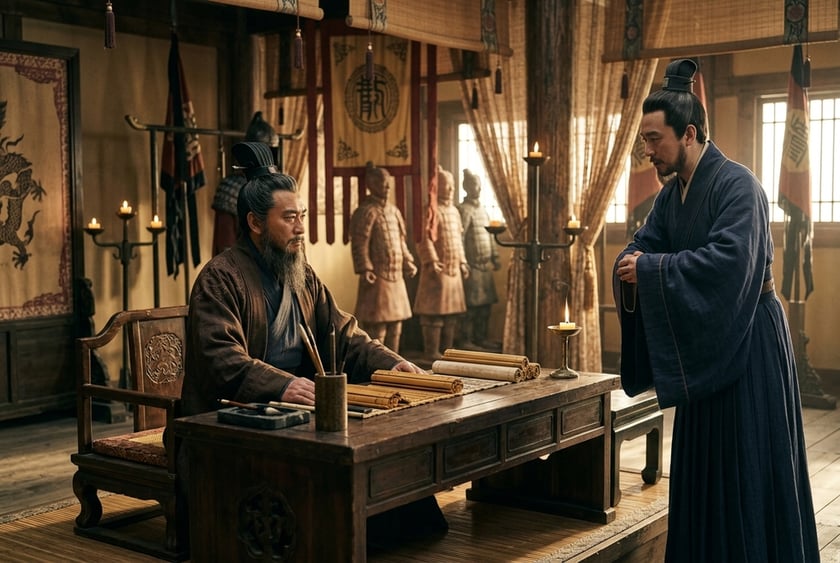
Strategic Background
The Battle of Ruxu in the first year of the Huangwu reign (222) took place during the most delicately balanced year in the San Guo relationship. The previous year (221) Liu Bei had proclaimed himself emperor and Sun Quan had submitted as a vassal to Wei; in the seventh month of that same year Liu Bei launched the Battle of Yiling against Wu, with Sun Quan fully committed to the western front; in the sixth intercalary month, Lu Xun decisively defeated Liu Bei at Xiaoting. This seemed to present Cao Pi with a perfect window: Wu's main force was absorbed on the western front, the eastern flank was thin, and Wei could now strike "to exploit the exhausted enemy". Cao Pi's deployment was a classic three-pronged attack on Wu: the western prong under Cao Zhen and Xiahou Shang besieged the Jiangling mid-river position; the central prong under Cao Xiu, Zhang Liao, and Zang Ba struck out through Dongkou to attack Lv Fan; the eastern prong with Cao Ren's several tens of thousands of infantry and cavalry drove straight at Ruxu. If any one prong succeeded, Wu's Yangtze defensive line would be broken. Yet Sun Quan's side was not unprepared — the victory at Yiling freed Wu's main force from the western front, and Zhu Huan, Zhu Ran, Lu Xun, Zhuge Jin, and others could be stationed at key points.
Deployments on Both Sides
Cao Ren's prong was the most heavily committed of the three (several tens of thousands of infantry and cavalry), targeting the capture of Ruxu — the most vital land-water junction at the mouth of Chaohu Lake along the Yangtze. Cao Ren's deployment had a cunning element: he spread word of an intention to attack Xianxi in the east, luring Zhu Huan into dividing his forces; once Zhu Huan had actually dispatched troops to Xianxi, Cao Ren's main body abruptly turned west and arrived within seventy li of Ruxu. This feint was highly effective in principle — Ruxu was already undermanned, and siphoning off some troops to Xianxi left barely five thousand defenders. Zhu Huan was in his mid-thirties, recently posted by Sun Quan to supervise Ruxu, and had only five thousand men. Cao Ren's main force was several times his number, and had arrived without warning, leaving him virtually no time to reassemble — the Xianxi contingent, even if urgently recalled, could not arrive in time.
Key Decision Points
Zhu Huan's first key decision was to "steady the troops' hearts." When his various commanders, suddenly confronted by Cao Ren's main force, were "each in a state of dread," Zhu Huan assembled them and offered an analysis: military theory says parity of forces is achieved "when the attacker outnumbers the defender by double" — but that refers to open-plain decisive battle with no natural defenses to rely upon. Now we have the high walls of Ruxu, the great river to the south, and mountain ranges to the north behind us — "resting, we await the exhausted enemy; as hosts we govern guests." This was a formation certain to win every battle. Even if Cao Pi himself came, there would be nothing to fear — much less Cao Ren. The subtlety of this speech was that it converted the panic of "enemy numerous, we few" into the conviction of "we hold the initiative" — the hardest thing for a frontline commander to accomplish. The second key decision was "luring the enemy." Rather than challenging Cao Ren directly, Zhu Huan ordered his men to "lower all banners and drums, outwardly showing emptiness and weakness," leading Cao Ren to conclude that Ruxu was barely defended. Cao Ren took the bait and split his forces: he sent his son Cao Tai to spearhead the assault on Ruxu's walls; dispatched Chang Diao, overseeing Zhuge Qian and Wang Shuang, to go by boat to raid the central island (where Wu troops' families lived); and kept ten thousand men at Tuogao himself as reserve. This division became Cao Ren's fatal error — his already-sizable numerical advantage was diluted into three separate contingents, none strong enough to complete its mission independently. The third key decision was "simultaneous counter-strikes." Zhu Huan also divided his own forces: one part to seize the boats; one part to separately strike Chang Diao's landing troops; he himself to personally hold off Cao Tai. This turned Cao Ren's dispersal against him — where Cao Ren had dispersed to attack on multiple points, Zhu Huan dispersed to defeat each point in turn. In personally holding off Cao Tai, Zhu Huan employed the tactic of "burning the camp and withdrawing": he first evacuated the main camp, allowing Cao Tai to find it empty, then turned and counter-attacked.
Outcome and Reverberations
The result of the entire engagement was stunning: five thousand Wu troops defeated Cao Ren's force of tens of thousands, killing Chang Diao, capturing Wang Shuang alive and sending him to Wuchang, and cutting down or drowning over a thousand Wei troops in the battle. Cao Ren himself retreated to Tuogao and returned defeated. Sun Quan was overjoyed, enfeoffing Zhu Huan as Marquis of Jiaxing and promoting him to General of Awe-Inspiring Might with concurrent command as Chancellor of Pengcheng. The broader repercussion was the complete failure of the entire three-pronged campaign against Wu: the western prong of Cao Zhen and Xiahou Shang's siege of Jiangling was also routed by Lu Xun's ambush and Zhuge Jin's external assault; the central prong under Cao Xiu was also checked by Lv Fan. On top of this, plague swept through the Wei army that summer — "six or seven in ten died" — and Cao Pi could only withdraw to Luoyang, after which Wu and Wei officially became open adversaries. This was the largest and most costly military operation of Cao Pi's life, directly affecting his later strategic posture toward Wu — he never again dared to launch a campaign of comparable scale. From the perspective of developing commanders, the Battle of Ruxu made Zhu Huan's name in a single engagement. Alongside the more senior Wu commanders Zhu Ran, Lv Fan, and Lu Xun, Zhu Huan proved himself capable of standing alone as a regional commander of the new generation, making an important contribution to the reservoir of military talent Wu would need in its later years.
Counterfactual Analysis
What if Zhu Huan had seen through Cao Ren's feint and had not sent troops to Xianxi? Then at the start of the battle Zhu Huan would have had seven or eight thousand men, and Cao Ren would more likely have opted for a prolonged siege rather than risking a divided surprise attack. The outcome might well have been a protracted attritional defense: Wu could ultimately have held on, but with greater losses, and an annihilating counter-attack would not have materialized. If Cao Ren had not split his forces but concentrated his tens of thousands in a massed assault on Ruxu, then with five thousand defenders and the geographic advantage of Ruxu, holding for some time would not have been a problem, but a counter-attack opportunity could not have been created. The most likely outcome would have been a stalemate while waiting for Sun Quan to send reinforcements from other directions — and dispatching reinforcements would take time, during which Ruxu might have been in grave danger. Another counterfactual: if the three Wei prongs had simultaneously achieved even partial breakthroughs, could Sun Quan have held? Given Wu's state of relative independence after the submission of 221, the complete failure of all three prongs prevented Wei from threatening Wu in the short term and allowed Sun Quan to stabilize his regime; but if any one prong had shown clear momentum, Wu might have been forced once again to nominally submit to Wei, delaying the process of becoming a fully independent state. The victory at Ruxu in 222 — along with the victories at Jiangling and Dongkou — was in fact one source of the political capital Sun Quan drew upon when he proclaimed himself emperor in 229: it demonstrated that Eastern Wu could independently resist a full-scale Wei assault.