Strategic Background
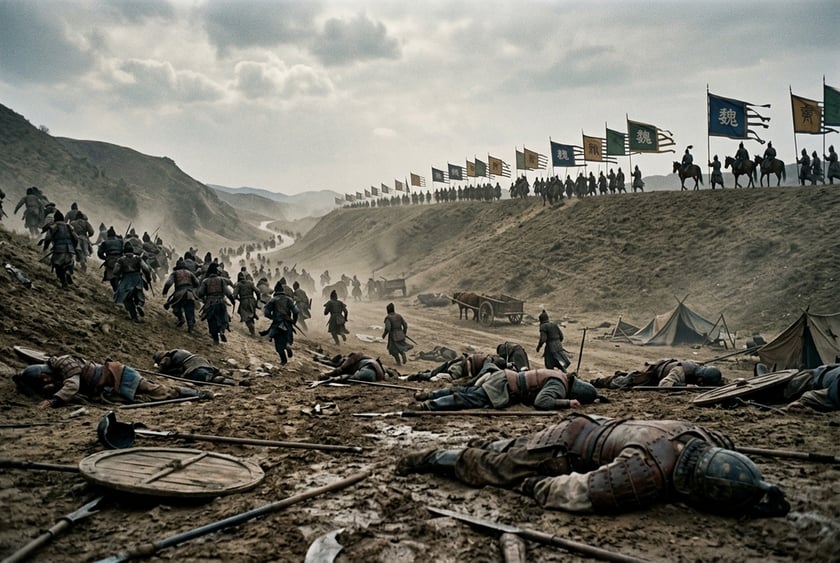
The second year of the Qinglong reign (234) was the pivotal year of Zhuge Liang's fifth northern campaign. The Shuhan chancellor personally led a great army out through the Xie Valley and encamped at Wuzhangyuan, there to face off against Sima Yi south of the Wei River; at the same time, in accordance with the "east-west simultaneous offensive" strategy that Zhuge Liang and Sun Quan had developed over many years, the Wu ruler Sun Quan personally led the main force north to the mouth of Chaohu Lake, threatening Huainan, Xiangyang, and other points along three separate axes — the intention being to draw Wei's eastern-front forces away and relieve pressure on the western front. For Caowei, this was the most severe multi-front pressure since the reign of Emperor Wen. Emperor Ming Cao Rui needed to deploy responses simultaneously across the fronts of Sima Yi, Man Chong, Tian Yu, and others; and Hefeixincheng, which Man Chong was defending, was both the weakest and most critical link in the Huainan defensive system — situated north of Chaohu Lake and south of Shouchun, it was a point through which Sun Quan's navy, if it broke through, could drive straight into the heartland of the Huai River.
Deployments on Both Sides
Sun Quan on this occasion committed three tiers of force: a frontal assault contingent, a flank-harassment contingent, and a long-range pinning contingent. He personally led the main force to strike at Hefeixincheng; Lu Yi (Lu Xun) and Sun Shao each commanded roughly ten thousand men entering the Huai and the Mian to tie down Xiangyang and Shouchun, creating pressure at multiple points. Cao Rui's response was also decisive: rather than accepting Man Chong's suggestion to "abandon the new city and lure the enemy deep toward Shouchun," he insisted on the strategic value of the new city as a forward anchor, citing Emperor Guangwu's precedent of holding Luehyang to defeat Wei Xiao and emphasizing that "there are positions one must contest." The core of this judgment was: though Hefeixincheng lay well forward, abandoning it would push the entire Huainan defensive line back a hundred li, losing both morale and geographic advantage. Cao Rui simultaneously led a personal expedition eastward aboard the imperial dragon boat — a rare instance of an emperor commanding in the field personally — aimed at using this political gesture to suppress Wu morale and compel Sun Quan to lift the siege before the Wei emperor's main force arrived.
Key Decision Point
The turning point of this battle was Man Chong's fire-attack tactics: "a small force winning big." Faced with a large-scale Wu siege apparatus — scaling ladders, battering rams, siege towers, and the like — Man Chong did not choose to pit his garrison against the attackers in a straightforward defense. Instead he selected dozens of stalwart soldiers from the defenders, wrapped pine branches in hemp oil to fashion torches, and using an upwind position set fire to the siege equipment Wu had positioned beneath the city walls. The tactical elegance lay in three points: first, the target selection focused on Wu's scarcest and hardest-to-replenish siege equipment rather than enemy soldiers; second, the timing seized on the upwind conditions to allow the fire to spread across the entire area where the equipment was massed; third, in the ensuing chaos the defenders precisely shot and killed Sun Tai — Sun Quan's nephew's son — inflicting a psychological shock on Wu's command layer. From a decision-theory perspective, the default alternative for Man Chong would have been the conventional thinking of holding tight and waiting for relief. Under conventional city-defense, with Wu's numerical advantage they could attack in waves, either exhausting the garrison or ensuring Man Chong could not hold until Cao Rui's main force arrived. The fire attack instantly transformed defense into offense and disrupted Wu's siege rhythm.
Outcome and Reverberations
The immediate results were striking: Wu's siege equipment was destroyed in large quantities; Sun Tai was killed in action; the siege rhythm was broken; and morale suffered. Combined with the political pressure of Cao Rui's imperial convoy being "still several hundred li away," Sun Quan chose to withdraw his army, and the two columns of Lu Yi and Sun Shao also pulled back. Cao Rui then advanced to Shouchun, rewarded the garrison at Hefei, and bestowed honors on the meritorious commanders, cementing the prestige of Caowei's Huainan defensive line. For Wu, this northern campaign was the most serious defeat Sun Quan suffered in a personally led campaign in his later years. Combined with Zhuge Liang's death at Wuzhangyuan that same year, the coordinated "east-west simultaneous offensive" strategy of Wu and Shuhan collapsed completely. For close to twenty years afterward, Sun Quan never again personally organized a northern campaign on such a scale; the Huainan direction shifted into a posture dominated by low-intensity harassment.
Counterfactual Analysis
If Man Chong had, as originally proposed, abandoned the new city and retreated to Shouchun to lure Sun Quan into a decisive battle on the plain, what would have happened? History cannot be relived, but several judgments are possible. First, Sun Quan's Wu main force consisted of naval troops; moving deep inland away from the waterways would have left their supply situation extremely fragile. Second, Caowei's cavalry advantage in the Shouchun area could have been fully exploited. Third, however, the political cost of this option would have been surrendering Hefeixincheng — tantamount to a public display of weakness that would have shaken the allegiance to Caowei of the local powerful clans of Huainan. Cao Rui's choice to "hold firm and not yield" was the more prudent political judgment, and it also demonstrated that the tactical flexibility of the frontline commander (Man Chong) and the strategic steadiness of the central decision-maker (Cao Rui) were not in contradiction — it was precisely their combination that turned what might have been a loss into a signature fire-attack victory.