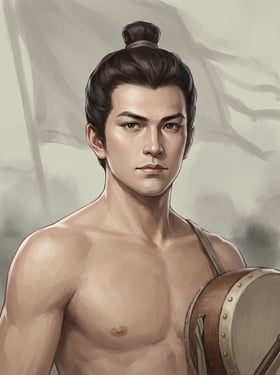
Historical Record
Regarding the biographical record of Mi Heng (courtesy name Zhengping), the surviving historical sources contain no detailed independent biography or clear account of his life. This means that in official histories such as the Records of the Three Kingdoms, Mi Heng is not a central figure; his deeds may be scattered through the biographies of others, or simply were not recorded in detail by the historians. We therefore cannot construct a complete account of Mi Heng's life from historical materials.
In the Novel
In Romance of the Three Kingdoms, Mi Heng is a highly distinctive and controversial figure whose image is entirely a literary creation with no basis in history. He is remembered for his arrogant, unrestrained character and his haughty pride in his own talent. In the novel, Mi Heng's first appearance showcases his astonishing eloquence and his biting mockery of Cao Cao and his civil and military officials, displaying his contempt for everyone around him. He boasted that he was "versed in astronomy and geography, conversant with the three teachings and nine schools; above, he could make his lord a Yao or Shun, and below, match his virtue with Confucius and Yan Hui," and dismissed Cao Cao's advisors and generals as worthless—saying Xun Yu was "fit only to attend funerals and inquire after the sick," Xu Chu "fit only to herd cattle and tend horses," even ridiculing Xiahou Dun as a "general with an intact body" and Cao Ren as a "money-grubbing governor" c:2893. Such extreme words enraged Cao Cao, but Cao Cao did not kill him outright; instead he appointed him a drummer, intending to humiliate him. Yet when Mi Heng beat the drum, he did so "naked," and publicly denounced Cao Cao: "Not knowing the worthy from the foolish—this is muddy eyes; not reading the Odes and Documents—this is a muddy mouth; not accepting loyal counsel—these are muddy ears; not knowing past from present—this is a muddy body; not tolerating the lords—this is a muddy belly; ever harboring usurpation—this is a muddy heart!" c:12887, cursing Cao Cao utterly. Kong Rong, fearing Cao Cao would kill him, mediated, and Cao Cao finally sent him off to Liu Biao in Jing Province. At the farewell banquet, Mi Heng again displayed his arrogant nature, likening Xun Yu and the other advisors of Cao's camp to "corpses in coffins," likening himself to a "headless mad ghost," and calling the men of Cao's camp "parasitic worms" c:12889, enraging them once more. Mi Heng's end matched his arrogant character: he ultimately offended Liu Biao with his words and was killed by him, cursing to the very end—fully embodying his trait of "arrogant and proud of his talent, contemptuous of all; cursing without cease unto death."
Key Relationships
* Cao Cao (enemy_of): The relationship between Mi Heng and Cao Cao is one of the most central and tense conflicts in Romance of the Three Kingdoms. Mi Heng's scorn and mockery of Cao Cao reached an extreme—whether in his disparagement of Cao Cao's civil and military officials c:2893 or his public denunciation of Cao Cao's "six muddinesses" c:12887, both reflect his intense resentment and disdain for Cao Cao and his regime. Cao Cao's attitude toward Mi Heng shifted from initial restraint—"to kill him, the realm would surely say I cannot tolerate men" c:2893—to later humiliated rage, finally sending him off to Liu Biao, in effect killing him with a borrowed knife; their relationship was full of opposition and contradiction. (Novel only)
* Kong Rong (ally): Kong Rong was Mi Heng's only supporter in Cao's camp. He admired Mi Heng's talent and repeatedly pleaded for him before Cao Cao, sparing Mi Heng from being put to death directly. Kong Rong's protection of Mi Heng also indirectly reflected some scholars' dissatisfaction with Cao Cao's autocratic power at the time. (Novel only)
* Liu Biao (enemy_of): After Cao Cao sent Mi Heng off to Liu Biao, his arrogant and unrestrained nature did not subside. He likewise offended Liu Biao with his sharp words, ultimately leading Liu Biao to have him executed. This shows that Mi Heng's arrogance was not directed at any particular person but was simply his nature, and it foreshadowed his tragic end. (Novel only)
Signature Scenes
* Beating the Drum and Cursing Cao: This is Mi Heng's best-known scene. At Cao Cao's court banquet, Mi Heng was appointed a drummer. Dressed in old clothes, he then stripped them off and beat the drum naked, publicly denouncing Cao Cao's "six muddinesses," accusing him of "not knowing the worthy from the foolish" and "ever harboring usurpation" c:12887. This scene vividly displays Mi Heng's arrogant character and his fearlessness before power, and it became a classic literary passage in Romance of the Three Kingdoms. (Novel only)
* Mourning at the East Gate Farewell: When Cao Cao sent Mi Heng off to Jing Province, he ordered the civil and military officials to see him off at the East Gate. Arriving there, Mi Heng did not bow to the assembly but instead burst into loud wailing. When Xun Yu asked why, he replied, "Walking among corpses in coffins, how could I not weep?" and likened the men of Cao's camp to "dead corpses," himself to a "headless mad ghost," even disparaging them all as "parasitic worms" c:12889. This scene again highlighted Mi Heng's extreme contempt for Cao Cao and his men, and his arrogant nature that he would not change unto death. (Novel only)
* "The god in the temple… resentful of his lack of efficacy…": Although the complete line "The god in the temple… resentful of his lack of efficacy…" does not directly appear in the provided materials, Mi Heng's mockery and scorn of Cao Cao, along with his boast that "above, I could make my lord a Yao or Shun, and below, match my virtue with Confucius and Yan Hui" c:2893, all imply that he regarded Cao Cao and his men as mediocre and incapable of great achievement, like a god in a temple lacking efficacy. This biting satire of those in power is an important component of Mi Heng's characterization. (Novel only)
Portrait file
Character profile
- Appearance
- He stood stark naked, his whole body wholly exposed [c:3].
- Character
- Wildly arrogant and presuming on his talent, with no one in his eyes, cursing without cease even unto death [c:1].
- Manner of speech
- His speech was cutting parallelism, disparaging others in matched couplets, and he boasted of himself: "Of astronomy and geography, there is nothing I do not fathom; of the Three Teachings and Nine Schools, there is nothing I do not know" [c:7].
- Life
- Styled Zhengping, a man of Pingyuan. At twenty-four he was recommended by Kong Rong, who called him "ten times my equal in talent" [c:2].
- Anecdotes
- A recluse-gentleman of Pingyuan, he was once humiliated by Cao Cao and made a drum-clerk, later dispatched as an envoy to Jing Province, and finally killed by Huang Zu [c:4]; an old friend of Kong Rong, he once insulted Cao Cao, and Xi Lü used this to frame Kong Rong [c:5]; Yang Xiu once likened Mi Heng to Zhang Song, urging Cao Cao to be tolerant of him [c:6].
Relationships
5 relationships
Friends1
Enemies3
Quotes
9 recorded lines · 2 featured
「公言差矣。此等人物,吾盡識之:荀彧可使弔喪問疾,荀攸可使看墳守墓,程昱可使關門閉戶,郭嘉可使白詞念賦,張遼可使擊鼓鳴金,許褚可使牧牛放馬,樂進可使取狀讀詔,李典可使傳書送檄,呂虔可使磨刀鑄劍,滿寵可使飲酒食糟,于禁可使負版築牆,徐晃可使屠豬殺狗。夏侯惇稱為『完體將軍』,曹子孝呼為『要錢太守』。其餘皆是衣架飯囊,酒桶肉袋耳!」
This passage appraises Cao Cao's generals with sharp sarcasm, displaying Mi Heng's wildly arrogant and unrestrained character.
「汝不識賢愚,是眼濁也;不讀詩書,是口濁也;不納忠言,是耳濁也;不通古今,是身濁也;不容諸侯,是腹濁也;常懷篡逆,是心濁也!吾乃天下名士,用為鼓吏,是猶陽貨輕仲尼、臧倉毀孟子耳!欲成霸王之業,而如此輕人耶?」
Mi Heng bitterly denounces Cao Cao's 'six turbidities' with cutting words, a classic embodiment of his image as a wild scholar.
Chapters2 回 ▸
- 演ch.23ch.40
Relationship timeline1 条 ▸
演 ch.23
- Cao Cao§8
enemy_of
三诟其朝(鼓吏裸骂、东门哭丧、京邑之骂);操借刘表黄祖之手杀之
Inner monologues · AI-generated1 段 ▸
- I stood in the hall and saw Cao Cao summon me. After the formalities, he did not ask me to sit. The men at the gathering
Life events3 ▸
- 0198-01-01 · XuMi Heng Beats the Drum and Reviles Cao Cao· Victim
- 0198-01-01 · XiakouHuang Zu's Execution of Mi Heng· Victim
- 0208-01-01 · XuchangExecution of Kong Rong