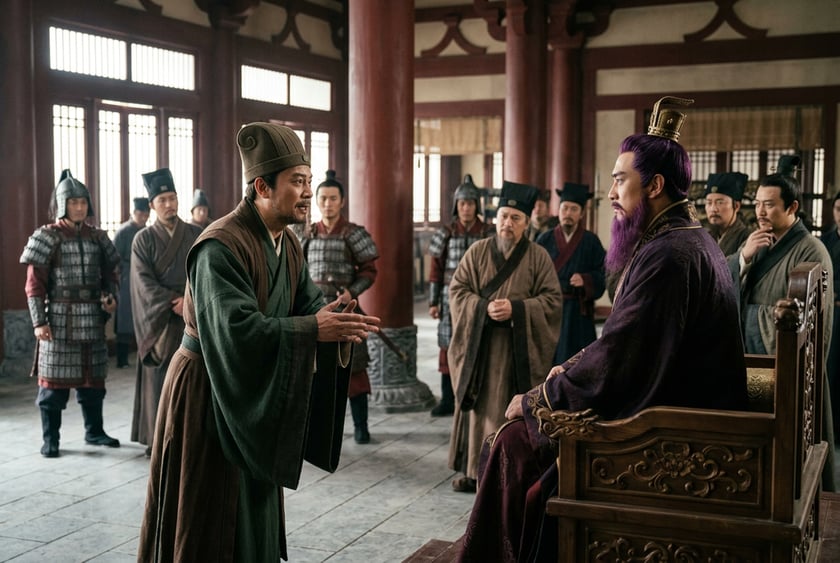
Background
Wu and Shu Renew Their Alliance should not be understood merely as an exchange of envoys. It must be considered within the strategic context after the Battle of Yiling, when Shu Han was eager to ease tensions on its eastern front while Sun Quan also faced pressure from Wei. The provided Romance of the Three Kingdoms, chapter 86, places Deng Zhi’s mission after Sun Quan learns of the situation between Cao Wei and Shu Han. Sun Quan judges that renewing hostilities with Shu could leave Wu facing enemies on two fronts; Shu, meanwhile, hopes that restoring the alliance will prevent Wei from exploiting the situation to attack. The alliance, then, was not an abstract bond of “brotherly states,” but a choice made after both sides recalculated the costs amid a security dilemma.
Shu’s reasoning is explained by Zhuge Liang to the Later Lord: making peace with Wu would reduce the risk of facing an enemy in the north, allowing Shu to deal with affairs in the south and later turn its attention to action against Wei. This plan reflects how a weaker regime prioritizes its tasks: first secure its borders, then concentrate its limited forces. It also reveals the alliance’s instrumental nature. Shu had not abandoned its primary strategic focus on Wei, nor did it regard cooperation with Wu as a substitute for lasting mutual trust. On Sun Quan’s side, the shift from Deng Zhi’s persuasion to sending Zhang Wen on a return visit shows that both parties needed to turn verbal intentions into a diplomatic relationship that could be reaffirmed through reciprocal exchanges.
Key Figures
Zhuge Liang was Shu’s strategic coordinator. He chose Deng Zhi to undertake the task of persuasion, anticipated that Sun Quan would send someone to return the courtesy, and arranged for the Shu court to receive the envoy with due ceremony. Deng Zhi was the negotiator who carried out the mission. He framed Sun Quan’s choice as one between “making peace with Shu” and “making peace with Wei,” then argued that if Wu submitted to Wei, it might be required to send its heir to Wei; refusal, however, could invite an attack by Wei, while Shu would seize the opportunity to invade. His appeal did not rely on sentiment alone: it laid out both the benefits of alliance and the risks of remaining outside it.
Sun Quan was both the center of decision-making in Wu and a cautious judge of diplomatic risks. He first tested Deng Zhi by staging an intimidating reception. After hearing his arguments, however, he acknowledged that making peace with Shu served Wu’s interests and asked how contact should be established. Zhang Zhao represents the doubts of the court in the narrative, urging Sun Quan to regard Deng Zhi’s mission as one of Zhuge Liang’s schemes. Sun Quan ultimately did not let this defensive logic dictate his decision; instead, he kept Deng Zhi and consulted him about whom to send as an envoy. Zhang Wen’s mission to Shu shows Wu responding to Shu’s envoy with a reciprocal visit, ensuring that the alliance did not depend solely on the promises of a single emissary.
The exchange between Zhang Wen and Qin Mi brought diplomatic protocol and the prestige of learned men into political communication. Qin Mi challenged Zhang Wen with questions about celestial phenomena and the formation of heaven and earth, leaving Zhang Wen briefly at a loss for words. Zhuge Liang immediately stepped in to smooth things over, emphasizing that the exchange was only playful banter and preventing the Wu envoy from being humiliated at the Shu court. Although Zhang Zhao, Zhuge Jin, Zhao Zi, and others appear on the list of participants, the passage provided does not sufficiently show their specific statements or decision-making roles in this exchange. Their presence on the list should therefore not be expanded into negotiating details unsupported by the source.
Core Issues
The first issue is whose security the alliance served. Deng Zhi’s argument turned the geographic features of Wu and Shu into a shared interest: Shu had the protection of its mountains and rivers, while Wu had the defense of the Yangtze; cooperating, they could shield one another. If Wu relied on Wei alone, it might face demands befitting a subordinate, or even further pressure from Wei. The point was not to prove that the two sides had no conflicts, but to show that, given the balance of power at the time, restraining one another’s enemies was more advantageous than standing alone. The alliance was thus both a mechanism for sharing risk and a signal meant to constrain Cao Wei strategically.
The second issue is how trust could be established. Sun Quan used a cauldron and armed warriors to create a scene of intimidation. This tested the Shu envoy’s courage and reflected Sun Quan’s concern that Shu might use diplomacy as cover to expand its influence. Deng Zhi refused to yield, pointing out the contradiction in Wu’s setting a deadly trap while also demanding that an envoy place his trust in it. Sun Quan eventually acknowledged that his decision was made, showing that the diplomatic breakthrough did not result from trust suddenly taking root. Rather, it came about through a combination of interest-based judgment, the envoy’s performance, and the ruler’s decision. Zhang Wen’s return visit and Zhuge Liang’s courteous reception of him helped restore dignity and affirm goodwill.
The third issue is the balance of status within the alliance. As Wu’s envoy, Zhang Wen was put on the spot by Qin Mi’s challenges. Zhuge Liang did not take the opportunity to humiliate him, instead bringing the episode to a close as “playful banter.” This had practical political significance: an alliance required not only discussion of military interests but also care to prevent the other side’s domestic opinion from interpreting the relationship as humiliating. Here, ceremony was not mere ornament. It was an institutional resource for reducing the costs of cooperation and preserving room for negotiation.
Political Consequences
As for the immediate effects presented in the narrative, Sun Quan agreed to make peace with Shu, Zhang Wen was ordered to travel to Shu, and Zhuge Liang arranged for Deng Zhi to accompany Zhang Wen on his return to Wu. Diplomatic relations thus shifted from one-sided probing to contact in both directions. Shu Han gained an expected buffer on its eastern front, allowing Zhuge Liang to turn his attention to affairs in the south and strategy against Wei. Wu, meanwhile, avoided committing too soon to one side amid pressure from both Wei and Shu. It must be emphasized that the cited material recounts the dramatized narrative of the Romance of the Three Kingdoms. The cauldron used to test the envoy, the exaggerated debate, and the characters’ speeches cannot be equated directly with verifiable historical records; the passage is better suited to analyzing how the novel portrays alliance politics.
Yet the alliance did not eliminate structural suspicion. Chapter 105 relates that after Zhuge Liang’s death, when the Later Lord heard that Wu troops had gathered at Baqiu, he immediately feared that Wu would “break the alliance and invade our borders,” and sent Zong Yu to report the death and probe Wu’s intentions. This episode is not an immediate consequence of the alliance’s renewal, but it reveals its fragility: a change in leadership, military activity along the border, and uncertainty about intelligence could all revive old suspicions. Wu–Shu relations were therefore more like limited coordination sustained by a common threat than a stable political community. These passages alone do not support a conclusion about whether the alliance remained secure over the long term.
Counterfactual Analysis
Had Sun Quan rejected Deng Zhi’s proposal, or insisted on relying exclusively on Wei, Shu Han would have faced a more serious threat on its eastern front, while Sun Quan might also have had to bear the subordinate demands and pressure from Wei that Deng Zhi described. Shu would at least have lost a relatively useful strategic buffer, making it harder to allocate resources between campaigns in the north and operations in the south. This, however, is only an inference based on the strategic arguments made by the characters in the novel. It does not mean that Wei would certainly have demanded that Wu send its heir to serve at its court, or that Wu and Shu would inevitably have gone to war at once; the material does not establish either outcome.
Conversely, if Zhuge Liang had taken advantage of Zhang Wen’s embarrassment to humiliate the Wu envoy further, Shu might have displayed its cultural prestige in the short term, but Sun Quan could then have found it harder to justify cooperation to the Wu court, increasing the likelihood that ministers would challenge the alliance. The novel’s arrangement, in which Zhuge Liang steps in to smooth things over, presents a low-cost form of diplomatic repair: Shu retains its ceremonial advantage while allowing the other side to save face. Ultimately, the key to Wu and Shu Renew Their Alliance was not the elimination of their differences, but the fact that, for the time being, both sides judged cooperation more worthwhile than hostility and used exchanges of envoys to sustain that judgment. If the strategic environment or border situation changed, that judgment could still be put to the test.