Background
The episode known as Lü Dai Executes Shi Hui is placed, according to the date specified in the title, around the fifth year of Huangwu (226). It was not simply a local clash, but a collision between central appointments and established local power as Sun Quan’s regime sought to bring Jiaozhi under more direct administrative control. Citing the distance to Jiaozhi, Sun Quan divided the region at Hepu: the area north of it became Guangzhou, while the area to the south remained Jiaozhou. He appointed Lü Dai and Dai Liang as inspectors of the two provinces, respectively, and sent Chen Shi to take over as Administrator of Jiaozhi. This division and change of appointments show the central government’s attempt to reorganize the administrative hierarchy in a remote region. But Shi Hui, son of Shi Xie, appointed himself Administrator and mobilized clan troops to resist Dai Liang, showing that the new orders did not automatically translate into local obedience.
The conflict also unfolded within local society. Huan Lin, an official once recommended by Shi Xie, urged Shi Hui to welcome Dai Liang, but Shi Hui had him beaten to death. Huan Lin’s brother Huan Zhi and Huan Zhi’s son Huan Fa then gathered clan troops and attacked Shi Hui. After besieging the city for several months, the two sides made peace and withdrew their troops. This episode shows that Shi Hui faced resistance not only to the new appointment from outside, but also from local clan and bureaucratic networks. Before Lü Dai advanced, armed standoffs and a temporary compromise had already emerged in the region. The central government’s subsequent intervention thus served at once to restore administrative order, punish defiance, and reshape power relations.
Key Figures
Sun Quan was the decision-maker behind the operation: he reorganized the provincial and commandery structure, dispatched officials, and issued the decree ordering Shi Hui’s execution. Lü Dai was the executor, carrying out the decree by traveling day and night from Guangzhou and proceeding alongside Dai Liang via Hepu. Dai Liang represented the newly appointed Inspector of Jiaozhou, but remained at Hepu because Shi Hui refused to welcome him. This shows that Sun Quan did not rely solely on the ordinary transfer of office, but backed the administrative appointment with military force. The practical execution of the plan and the handling of its risks, however, fell mainly to Lü Dai.
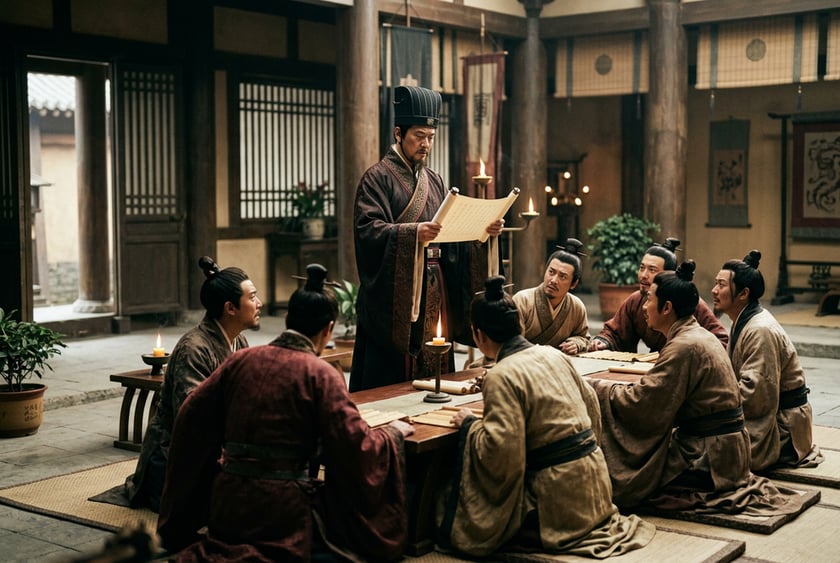
Shi Hui was the one put to death, while Shi Kuang served as the intermediary Lü Dai used to convey his message and urge surrender. Shi Kuang had an old connection with Lü Dai, who appointed him as an aide in the Office of the Tutor and Friend. He first sent a letter to Jiaozhi explaining the advantages and dangers, then dispatched him to meet Shi Hui in person, promising that even if Shi Hui lost his post as Administrator, he could avoid any further misfortune. Shi Hui and his brothers subsequently came out with their upper bodies bared to surrender, indicating that they accepted this arrangement, conveyed through personal ties and secured by the assurance of limited punishment. Yet the next day, Lü Dai read out the imperial decree, ordered his men to bind Shi Hui and his brothers, and ultimately had them executed. The relationships among the key figures thus involved not only official positions and military orders, but also trust, assurances, and personal ties that were put to use.
Core Issues
The first issue is how central authority reached a remote region. Sun Quan’s reorganization of provincial boundaries and appointment of inspectors and administrators constituted an institutional claim to authority; Shi Hui’s self-appointment and mobilization of troops were an open rejection of that claim. Lü Dai’s actions gave the appointments coercive force, but also exposed the limits of institutional reach: when a local power-holder could prevent officials from taking office, central rule might have to resolve the question of sovereignty through military means before ordinary administration could begin. The text gives no details about the subsequent administration of Jiaozhi, so the execution alone cannot establish that integration had become secure.
The second issue is the credibility of political promises. Through Shi Kuang, Lü Dai conveyed that Shi Hui could lose his post as Administrator without suffering any further misfortune. After Shi Hui and his brothers came out with their upper bodies bared to surrender, however, Lü Dai produced the imperial decree and had them executed. As the narrative presents it, the expectation created by the offer of reassurance stands in sharp contrast to the final punishment. Sun Sheng’s comment elevates the issue into a conflict between good faith and political expediency: he argues that Lü Dai used the “tutor and friend” relationship to communicate with them and induce them to entrust themselves to him, then destroyed them in pursuit of political gain. Sun Sheng’s judgment is a later moral assessment, not independent proof of the motives behind the action. But it reveals why, in traditional historical commentary, the affair became not only a case of suppressing a rebellion but also a test of a ruler’s credibility.
The third issue is who was punished and where responsibility lay. Shi Hui and his brothers were executed, while Shi Yi, Shi Wei, Shi Kuang, and others were later reduced to commoner status. Shi Xie’s hostage son, Xin, was also reduced to commoner status. Several years later, Shi Yi and Shi Wei were executed for crimes, while Xin died of illness. The historical record thus depicts punishment meted out in degrees, rather than the one-time elimination of the Shi clan. It does not explain the full policy behind these later punishments or their connection to the Shi Hui case, so they cannot simply be characterized as either a general pardon or a purge. The more cautious conclusion is that Sun Quan’s regime distinguished among members of the family even as it executed those who had directly resisted it.
Political Consequences
The immediate consequence was the execution of Shi Hui and his brothers, whose heads were sent to Wuchang. Shi Hui’s refusal to allow the newly appointed officials to take office was thus ended by force. Sun Quan’s regime also sent a clear message: local powers could participate in the administrative network, but could not choose their own Administrators or use clan troops to defy central orders. At the same time, the damage to the credibility of official assurances was also significant. If local leaders who submitted came to believe that they might still be executed, the central government might find it harder to win trust in future efforts to secure surrenders, transfers of office, or pacification in border regions. This is a risk inferred from how the episode unfolded, not an outcome explicitly recorded in the historical sources.
The subsequent treatment of the family presents a more complex political picture. Other members of the Shi clan were not all immediately executed; some were reduced to commoner status. Sun Sheng, however, used the episode to criticize Sun Quan for lacking far-reaching strategic vision and linked the fortunes of the Lü clan to the breach of trust. The former refers to specific punishments recorded in the historical account; the latter is a moralized interpretation by a historian of the long-term political consequences, and the two should not be conflated. If the title’s claim that the “outcome is unclear” refers to the long-term effectiveness of governance in Jiaozhi or whether local society was stabilized as a result, the cited passage is indeed insufficient to judge. If it refers to what happened to Shi Hui himself, the cited Records of the Three Kingdoms clearly state that he was executed.
Counterfactual Analysis
If Lü Dai had honored his promise that Shi Hui would face no further misfortune after losing his post as Administrator, and Shi Hui had been spared after surrendering power, this might have reduced hostility toward the Shi clan and local clans in the short term. It might also have made future efforts by officials to win over local powers more credible. But this would not necessarily have ensured that Jiaozhi could be brought under stable rule: Shi Hui had already appointed himself Administrator and mobilized troops to resist Dai Liang, so if he had retained substantial local influence, whether the central appointment could truly have been implemented would still have been in question. Conversely, exchanging the lives of those who surrendered for their compliance might have avoided an immediate siege and battle, but could have postponed the dispute over power rather than resolved it.
Another possibility would have been for Sun Quan to establish a clearer procedure: Dai Liang and Chen Shi would first take office and require Shi Hui formally to relinquish power, while publicly setting out the penalties for defiance. Lü Dai’s military force would then serve as a last resort, rather than first creating an expectation of leniency through personal connections. In theory, such an arrangement might have reduced the impression that a promise had been broken. But the historical record provides no further information about local forces in Jiaozhi, attitudes within the Shi clan, or the level of risk Sun Quan was willing to accept, so it cannot be said that this approach would certainly have succeeded. The counterfactual dilemma left by this case is how a frontier regime could uphold both its authority to command and its credibility: emphasizing punishment alone might win obedience but erode trust, while emphasizing leniency might fail to end local challenges to central appointments.