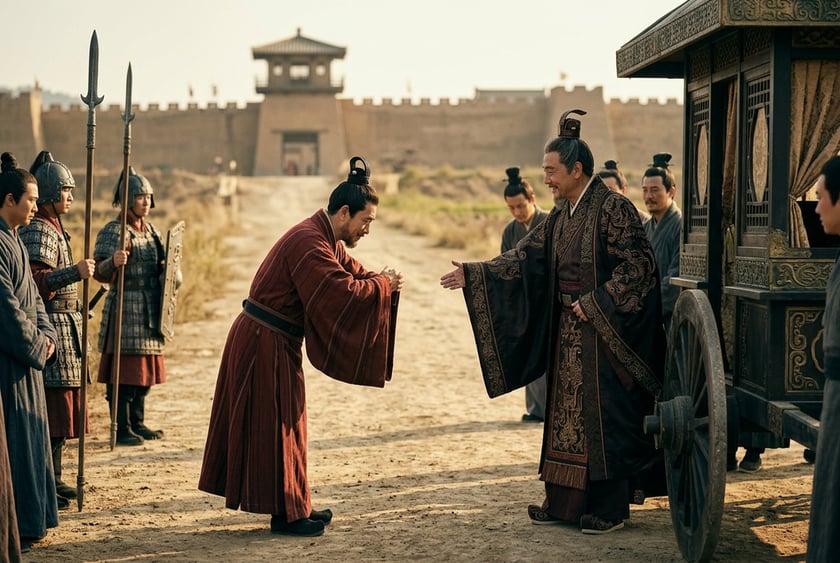
Background
The several tribute missions from Yamatai-koku arrived during a singularly unusual window in Caowei's diplomatic history. In Jingchu year 2 (238 CE), Sima Yi led an army of forty thousand to pacify Gongsun Yuan and re-establish the commanderies of Liaodong and Daifang, bringing Caowei's control over the Liaodong Peninsula and the western coast of the Korean Peninsula to its high-water mark for the San Guo period. The tribute corridor along the route Daifang — Tsushima — Iki — northern Kyushu was only reopened in that same year. The near-certainty is that Himiko chose to send Nashime north in the sixth month of Jingchu year 2 because she had seized the precise window when Wei armies had just crushed the Gongsun clan and the sea lanes were open; this was a piece of diplomatically precise timing.
Principal Figures
Himiko was the "spirit-way" (kidou) shamaness-queen of Yamatai-koku. The Weizhi Account of the Wa records that she never married, lived in seclusion, and had a younger brother handle external affairs on her behalf—a landmark figure in Japan's early dual polity of ritual and governance. Nashime and Tsushiguri were her principal and deputy envoys; they were received in audience by Emperor Cao Rui of Wei in person and invested with titles of Suishan Commandant (Solicitous of Goodwill) and Suishan Colonel respectively. On the Caowei side, the decision-maker in the earlier phase was Cao Rui himself, who issued the decree of investiture in the twelfth month (by corrected calendar) of Jingchu year 2; in the later phase governance passed into the regency of the court ministers of the Zhengshi era, with Daifang commandery administrators Gong Zun and Zhang Zheng carrying out the specific tasks of investiture and return visits. On the Wa side, the younger brother, Iyo (Himiko's kinswoman), and the rival male king Himikuko of the enemy state of Gouna together formed the internal tensions that underlay this round of diplomacy.
The Central Issue
The genuine issue behind this tribute mission was how Yamatai-koku used external authority to resolve an internal legitimacy problem. The Account of the Wa states explicitly that Himiko "practiced spirit-way and could bewitching the multitudes," but that she had "already grown old and had no husband"—a shamaness-queen who could not perpetuate herself through bloodline needed a form of legitimacy higher than heredity. The gold seal with purple cord conferring "Queen of Wa Friendly to Wei" (Shingi Waou) filled that gap precisely: it elevated Himiko from a queen "jointly installed by the various kingdoms" to the sole legitimate ruler of the islands, endorsed by the Son of Heaven of the central plains. For Wei, the issue took the opposite shape: caught in long-term attrition on two fronts—west against Shuhan, south against Sunwu—bringing the Korea–Wa flank into the investiture order allowed Wei to enlarge the narrative of "Wei as the legitimate center of all under heaven" at negligible cost. This explains why the scale of the return gifts was so extravagant (one hundred bronze mirrors, brocade with crimson-ground interlaced dragon pattern, five-chi blades, gold, white pearls)—far exceeding what the Wa envoys had presented.
Political Consequences
The most immediate consequence of the investiture was that Yamatai-koku gained a symbolic advantage in its civil war against Gouna: in Zhengshi year 8, Gong Zun was defeated by Himikuko's faction, and Zhang Zheng was subsequently dispatched to Wa to support Himiko with "an edict and yellow banners"—the first time in any Chinese dynastic history that a central plains government used investiture backing to intervene directly in an overseas polity's civil war. After Himiko's death, a brief failed tenure by a male king was followed by the people reinstating Iyo, a thirteen-year-old kinswoman, who immediately sent envoys to escort Zhang Zheng home and renewed tribute—proof that the investiture order had become the legitimacy scaffolding for the Yamatai polity. Looking further ahead: after San Guozhi the Sino-Japanese tribute relationship went dormant for a century and a half, not reviving until the era of the Five Kings of Wa in the fifth century; yet the fifth-century Wa kings still cited the "successive generations of splendid tribute" as a basis for their claims in their memorials. These ten-odd years of tribute in the Jingchu–Zhengshi period were thereby enshrined as the founding origin of official Sino-Japanese relations.
Counterfactual Analysis
Had Sima Yi not resolved the Gongsun Yuan problem in Jingchu year 2 and the Daifang commandery remained under Gongsun proxy control, Wa envoys would likely have been stopped at Lelang, as in the Later Han under Emperor An, and been unable to reach Luoyang; the Wei-Wa relationship would have been intercepted as a private connection of a Liaodong warlord, and Yamatai-koku would have obtained no "Queen of Wa Friendly to Wei" credential. Conversely, had Himiko delayed her northward mission by two years and missed the window when Cao Rui was still personally ruling, she would have found envoys arriving in the white heat of the factional struggle between Sima Yi and Cao Shuang in the middle Zhengshi era—the grade of return gifts and the rank of investiture might not have been maintained at their historical levels. More ironically still: had Himiko's succession by a male king succeeded smoothly, Yamatai-koku might never have needed to petition Wei for support again, Zhang Zheng would not have been dispatched, and the "earliest recorded instance of a Sino-Japanese investiture actually being implemented" that the Account of the Wa bequeathed to posterity would not exist. The reason these several round-trip sea voyages over eleven years carry such weight is precisely that they crystallized a chain of contingencies—each easily missed—into an institutionalized beginning.