Background
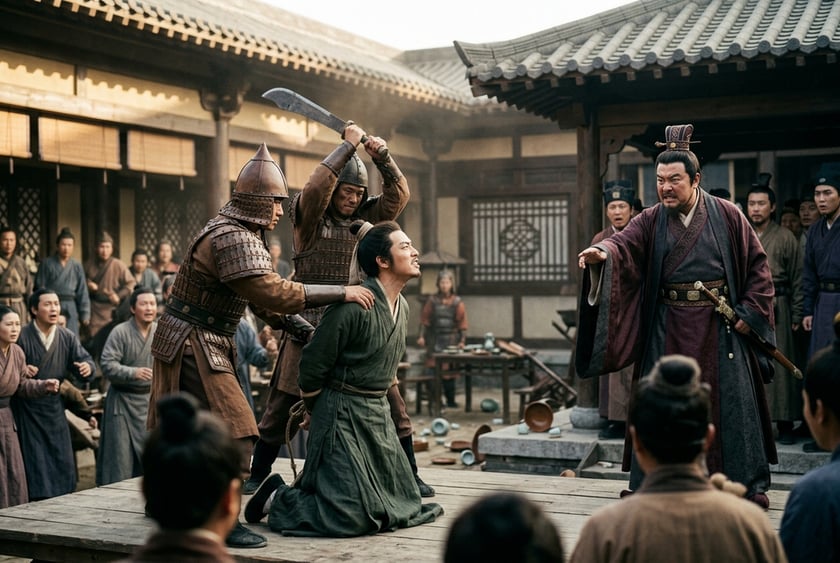
This is a superb political interlude in the novel, built around the theme of "killing through a borrowed hand." Mi Heng was a celebrated figure of the Jian'an years, equally famous for his talent and his arrogance; he had beaten his drum in Xudou and publicly insulted Cao Cao to his face — a rare instance, in the climate of pure criticism that marked the age, of someone openly attacking those in power through words. Cao Cao, for reasons of political image, could not move against Mi Heng himself: killing a man of letters was straightforward enough, but the cost of killing a famous scholar was the loss of the literati's goodwill. So he used the pretext of "sending him as an envoy" to dispatch Mi Heng to Jingzhou, hoping Liu Biao would bear the infamy of killing a worthy man. By the time this political chain entered Jingzhou it already carried the mark of "the previous link refusing to take responsibility."
Principal Figures
All three tiers of political calculation are on display. Cao Cao is the hidden instigator: his choice to move Mi Heng safely out of Xudou under the guise of a diplomatic mission was among the most commonly used "elegant disposals" in the political arts of the day. Liu Biao is the intermediary handler; the novel presents his reasoning with exceptional clarity — he tells his subordinates: "Mi Heng has repeatedly insulted Cao Cao, yet Cao Cao did not kill him, fearing it would cost him popular support; so he sends him to me as an envoy, wishing to borrow my hand to kill him", cutting straight through Cao Cao's calculation and refusing to shoulder the blame on his behalf. Huang Zu is the terminal link in the chain; his role is not that of a planner but of a "quick-tempered executor" selected for the purpose — Liu Biao dared send Mi Heng to him precisely because Huang Zu was hot-headed, knowing the outcome would almost certainly be Mi Heng's death.
The Core Issues
The surface issue is "what to do with a wild eccentric," but the substance is "how to apportion among three parties the political cost of a reputation for killing the talented." Neither Cao Cao nor Liu Biao was willing to bear the label of "harming the worthy," so each passed the moral debt onward; what landed on Huang Zu's doorstep was not political calculation but impulsive temper, which was precisely where this chain was safest to end — Huang Zu's killing in anger read as a personal incident rather than a political decision, leaving both Cao Cao and Liu Biao's political images intact. Liu Biao's own verdict on the episode was "to let Cao Cao know that I possess discernment" — acknowledging openly that this had been a public-relations exercise in political image management.
Political Consequences
From the perspective of the history of literati criticism, Mi Heng's death sharply reduced the willingness of scholars to speak out openly against those in power. Any literatus who attacked the ruling party with words now faced the prospect of being put to death through exactly this kind of multi-tiered borrowed hand, with the instigator emerging without a political blemish. From the perspective of Huang Zu's personal fate, the killing of Mi Heng branded him with the label of "brutal and without judgment"; Sun Quan, who launched multiple western campaigns against Jiangxia, consistently regarded Huang Zu as a defeatable opponent and eventually had him killed at Jiangxia in the thirteenth year of Jian'an. From the perspective of Jingzhou's political landscape, Liu Biao used the affair to signal goodwill toward Cao Cao ("to let Cao Cao know that I possess discernment"), buying a delay in northern pressure on Jingzhou, but also sacrificing what little reputation for "reverence toward the worthy" he still retained.
Counterfactual Analysis
The most interesting counterfactual centers on Mi Heng himself: had he restrained his edge after being sent to Jingzhou — or even, as on the occasion when he was previously expelled from Xudou, settled for merely "reciting praises" rather than mocking his hosts to their faces — Liu Biao would probably have kept him in Xiangyang in some nominal sinecure indefinitely. He might have survived several more years, as Kong Rong did, before dying in some other upheaval. But Mi Heng was Mi Heng precisely because he had no awareness of, or regard for, the "borrowed hand" trap; at each stop he proactively provoked the person receiving him. This posture of "walking into the trap knowingly" gave his death the character of a deliberate political statement — he was not a passive sacrificial victim but a man who, with his own life, simultaneously exposed the calculations of Cao Cao, Liu Biao, and Huang Zu to the light of day. Viewed from this angle, even though it was Huang Zu who raised the blade in the novel's text, what truly "killed" Mi Heng was the late Han political environment in its entirety — the scholar-gentry's extreme pursuit of reputation and the limits of self-expression within it.