Origins
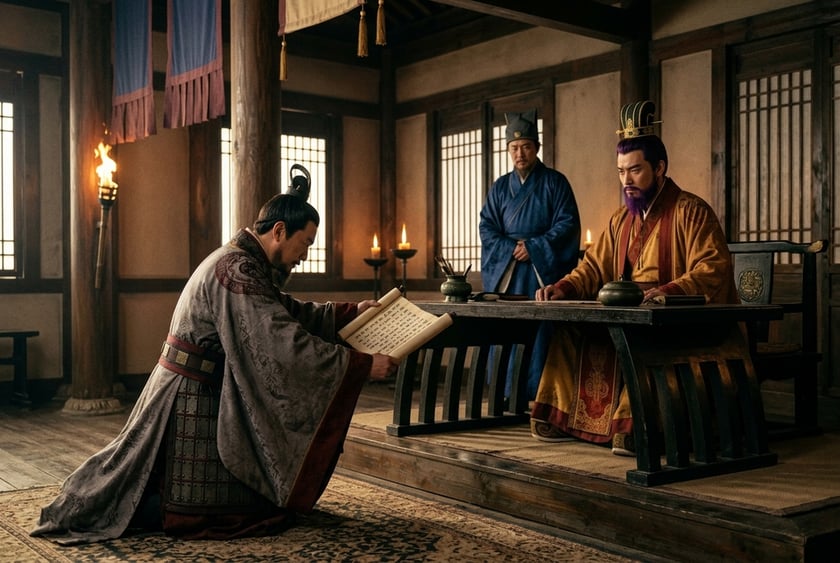
Viewed through the lens of modern military history, Gao Gan's Bingzhou rebellion was not an isolated mutiny by a frontier garrison but a final bid by the remnants of the Yuan Shao bloc to seize what remained of their living space in the aftermath of the Battle of Guandu. Guandu decided the victor, but it did not mean an instant transfer of the entire Hebei region: after Yuan Shao's death his sons Yuan Tan and Yuan Shang fell into fratricidal conflict, and Cao Cao exploited this rift to gradually absorb Jizhou; yet the political network of the Yuan clan outside Hebei was not dismantled in one stroke. Gao Gan held Bingzhou as Yuan Shao's nephew — a strategic disposition that Yuan Shao had set in place during his lifetime to control the resource belt on the western side of the Taihang Mountains and the two strategic corridors leading toward Guanzhong and the steppe beyond. Between Jian'an 10 and 11, when Cao Cao personally led the northern expedition against the Wuhuan and was far from Yecheng, the defensive pressure along the Bingzhou front fell to a cyclical low; Gao Gan judged that this was the last opportunity to rise under the Yuan banner — his aim was not to reclaim Hebei but to use Bingzhou's mountain terrain to delay Cao Cao's unification timetable and secure outside assistance from beyond the frontier [c:18026].
Forces Involved
The dominant force in the rebellion was Gao Gan's Bingzhou remnants; the backbone of the troops came from the Taihang garrison that Yuan Shao had stationed there during his lifetime, supplemented by a small number of Qiang and Hu auxiliaries. The suppression on Cao Cao's side was not commanded by Cao Cao himself — he had not returned from the Wuhuan expedition — but was entrusted to the pairing of Le Jin and Li Dian: Le Jin favored offensive assault, Li Dian favored steady containment, a standard tandem that Cao Cao deployed for local pacification campaigns; the very assignment signals how Cao Cao categorized this rebellion — "significant but not critical, no need for personal command" [c:18026]. Noteworthy is the direction in which Gao Gan sought outside help after retreating to defeat: first to the northern Zuo Xianwang (the Left Worthy King), then to Liu Biao of Jingzhou. This trajectory reveals the two standard directions for a "weakling seeking aid" in the late Han — the steppe Hu tribes or a southern domain holder — but both routes were already closed by Jian'an 11. The Zuo Xianwang had already reached a tacit understanding with Cao Cao and was unwilling to antagonize him over Gao Gan; Liu Biao was old, his domestic administration unstable, and he had no capacity to harbor an explicitly anti-Cao Bingzhou warlord. Gao Gan was ultimately killed at Shanglü by the local commandant Wang Yan — not in battle but through political opportunism: Wang Yan used a fugitive's head to buy himself the rank of a full marquis [c:18026].
The Key Turning Point
The pivotal turn at the tactical level was the lure at Huguan. Gao Gan was holding the pass in a defensible position and could on the strength of the Taihang terrain have prolonged the campaign considerably; but acting on the advice of subordinate officers he launched a night raid against Cao Cao's main camp, only to be encircled by Le Jin and Li Dian's pre-positioned ambush, then discovered on his return that Huguan had already been seized — a textbook case of "voluntarily surrendering the natural advantage of terrain," turning a mountain defense campaign into a flat-ground engagement [c:18026]. Once Huguan fell, the entire defensive system of Bingzhou lost its linchpin: no matter how many soldiers Gao Gan had left, he could not hold the whole of Bingzhou without the protection of a key pass. From a military-history perspective, the root of this error was Gao Gan's miscalculation of the force balance: he overestimated the fatigue of Cao Cao's army from its prolonged campaign and underestimated the mobility of the Le Jin–Li Dian combined force, and so voluntarily discarded his sole strategic advantage.
Suppression and Outcome
The result of the suppression was not death in battle but political isolation leading to death. After losing the pass, Gao Gan tried to recover his position through diplomatic channels, but both directions he moved in fell within the radius of Cao Cao's political influence: the Zuo Xianwang had a tacit understanding with Cao Cao, and Liu Biao had neither the will nor the capacity to accept him. When Gao Gan was forced to traverse the intermediate zone of Shanglü in Shangdang, the local commandant Wang Yan recognized his situation as a "stray dog without a master" and moved to deliver his head [c:18026]. This manner of disposal is very characteristic of the late Han: the last senior commander of the Yuan clan's remnant forces did not die on a battlefield but at the hands of a local minor official's political opportunism — a graphic metaphor for the complete exhaustion of the Yuan clan's political capital.
Historical Resonance
In terms of strategic consequences, Gao Gan's death marks the full closing of Cao Cao's Hebei-front operations. With Bingzhou pacified, Cao Cao could turn his attention south and west; the timeline of the northern expedition against the Wuhuan in Jian'an 12, followed by the campaign at Chibi in Jian'an 13, was made possible precisely because there was no longer any residual threat at Bingzhou's back [c:18026]. In terms of institutional consequences, Wang Yan's marquis rank earned by killing Gao Gan opened a new channel in the late Han for "local officials receiving noble rank for situational initiative" — an influence that carried through to the standards by which Cao Pi and Cao Rui assessed local inspectors and commandants. In terms of narrative and cultural legacy, the novel gives Gao Gan very little page space, treating him as a walk-on figure in the tail end of the Guandu narrative — yet the role he plays as "the last Yuan partisan" is precisely the marker event by which the Yuan Shao bloc makes its complete exit from the main stage of San Guo. After this, the roster of principal actors contains no one bearing the name Yuan.