Background
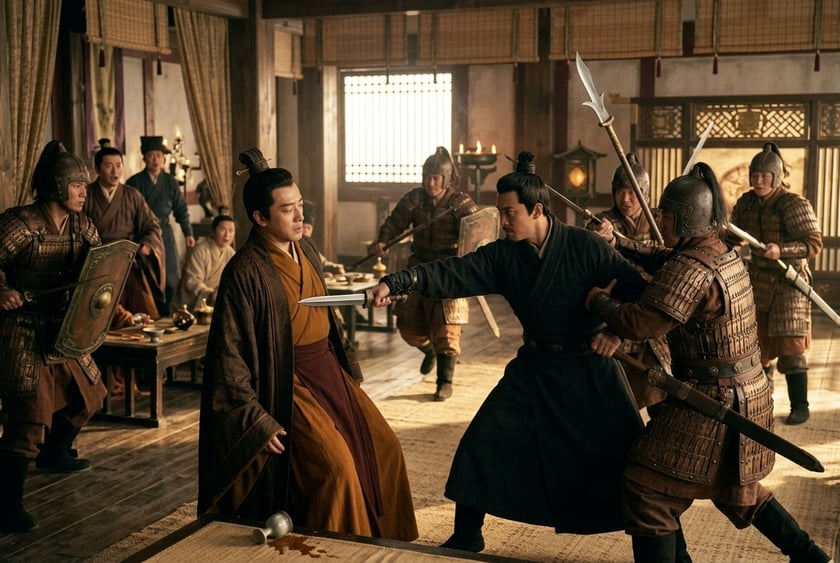
Guanzhong in the second year of Xingping was the deepest quagmire in all of late Han politics. After the killing of Dong Zhuo, the Liangzhou generals Li Jue, Guo Si, Fan Chou, and Zhang Ji seized control of the emperor and dug into Changan; court affairs sank into the humiliation of being decided beneath warlords' tent-canopies. By 195, tensions between Li Jue and Guo Si had erupted into open armed conflict — Li Jue seized the emperor, Guo Si held the high ministers hostage, and the entire city of Changan was left in ruin by their alternating pillaging. The eastern warlords nominally served Han but in practice each held his own ground: Yuan Shao held Hebei, Cao Cao had just acquired Yanzhou, Liu Biao protected Jingzhou, Gongsun Zan, Liu Bei, and Sun Ce each had their own territories. The question was not "who still remained loyal to Han" but "who could extract the emperor from Changan and preside over the court." That year, Cao Cao had just defeated Lv Bu and was beginning to establish direct contact with the court, dispatching his agent Wang Bi to deliver his life-preserving tribute to the emperor — the earliest probe of the "hold the emperor to command the warlords" strategy.
Key Figures
The central figures of the event were Zhong Yao, Li Jue, and Guo Si, with Cao Cao and Xun Yu strategically echoing them from offstage. Zhong Yao came from the Zhong clan of Changsha in Yingchuan — a grandson of the Zhong Hao and Zhong Yu line — who from an early age had had a physiognomist predict of him "this child will suffer an ordeal by water" and "this child has the features of the noble," and was funded by his clan uncle Zhong Yu to specialize in classical learning; he passed the filial and incorrupt examination and served successively as Secretariat Drafter, Prefect of Yangling, Corrector of Imperial Counselors, and Palace Attendant. By 195 he was one of the very few mid-level civil officials at court who combined administrative skill with political discernment. Li Jue and Guo Si's political judgment was extremely limited: they could hold the court by force, but once confronted with a political signal like "Cao Cao dispatches an envoy" they fell into confusion — they feared the eastern warlords might set up a new emperor yet were unwilling to relinquish the resource of the court's legitimacy. This contradiction was precisely the opening into which Zhong Yao could insert himself.
Core Issue
On the surface the question was "whether to release Wang Bi (Cao Cao's envoy) and let him return"; at a deeper level it was "how the Guanzhong warlords understood the rising power in the east." Li Jue and Guo Si's instinctive reaction was to detain Wang Bi and sever the court's relationship with Cao Cao; Zhong Yao's argument rewrote this frame — he stressed that "at this moment, when heroes are rising on all sides, each proclaiming commands and acting as sole authority, only Cao of Yanzhou is genuinely devoted to the royal house". The political effect of this line lay in distinguishing for Li Jue and Guo Si between "warlords loyal to Han" and "self-aggrandizing warlords," implying that the former were worth cultivating as allies. Viewed as an information operation, Zhong Yao provided Li Jue and Guo Si with a simple, usable political map — marking Cao Cao as "a loyal minister worth cooperating with" rather than "a potential threat" — and thereby induced Li and Guo to release Wang Bi and maintain the communication channel with Xudou. Xun Yu, around this same period, repeatedly praised Zhong Yao lavishly to Cao Cao; upon learning of his persuasion of Li and Guo, Cao Cao's esteem for him "grew still more sincerely" — a process that laid the trust foundation on which Cao Cao would later entrust all Guanzhong affairs to Zhong Yao's sole discretion.
Political Consequences
The most immediate consequence was that the path for the emperor to move east from Changan was opened. "Later, Jue forced the emperor; Yao and Secretariat Drafter Han Bin together devised the scheme. The emperor was able to depart from Changan — in this, Yao had a hand". Behind these sixteen terse characters lay a series of complex inner-court operations: establishing contact with Yang Feng, Dong Cheng, and other warlords willing to escort the emperor, coordinating the route of the eastward journey, and evading Li Jue's pursuit. These actions directly provided the foundation for Cao Cao's interception of the emperor at Luoyang in the first year of Jian'an and his relocation to Xu — had Zhong Yao and the others not completed this first step in Changan, Cao Cao would have had no opportunity to receive the emperor at Luoyang. Zhong Yao was immediately appointed Censor-in-Chief, promoted to Attendant Gentleman and Deputy Imperial Secretary, and enfeoffed as Marquis of Dongwu Pavilion, vaulting him from mid-level civil official to the core of the court. Over the longer term, this operation established Zhong Yao's unique identity as a political bridge between "Guanzhong and the center" — he both understood the language of the Guanzhong warlords (having been in Changan for nearly ten years) and belonged to the eastern Yingchuan gentry network (sharing native-place and peer ties with Xun Yu, Xun You, Chen Qun, Du You, and others). This dual identity made him irreplaceable in Cao Cao's comprehensive management of Guanzhong in the years that followed — Zhong Yao's decade-plus of supervising Guanzhong during the Jian'an era, pacifying Ma Teng and Han Sui, breaking Guo Yuan, and pacifying the Xiongnu Chanyu (Shanyu), all grew out of the political capital established in this episode.
Counterfactual Analysis
Had Zhong Yao failed to persuade Li Jue and Guo Si to release Wang Bi, what would have happened? Most likely Cao Cao's direct connection with the court would have been delayed by one to two years, and Cao Cao would have had to wait for Li and Guo's internal conflict to run its course, or for the emperor to find another route east, before he could intervene; on Yuan Shao's side, the possibility of dispatching men first to escort the emperor — which the "receive the emperor" strategy of Xun Yu and Guo Jia was racing to execute ahead of Yuan Shao — would have grown. Had Yuan Shao secured the emperor, the script of late Han politics would have been entirely rewritten: Cao Cao might have remained confined to Yanzhou indefinitely, unable to build the legitimacy advantage of "holding the emperor." The political backdrop of the Battle of Guandu would also have changed accordingly. Seen in this light, Zhong Yao's seemingly unremarkable act of persuasion in Changan in 195 was one of the hidden prerequisites that made the "hold the emperor to command the warlords" strategy implementable. This is also a classic case in late Han political history of "an intermediary figure determining the grand outcome" — Zhong Yao was not a warlord and held no military tally, but in the tangled political grid of Guanzhong he found the fulcrum that could change the direction of the information flow, and thereby laid the foundation for a whole phase of the great events to come.